
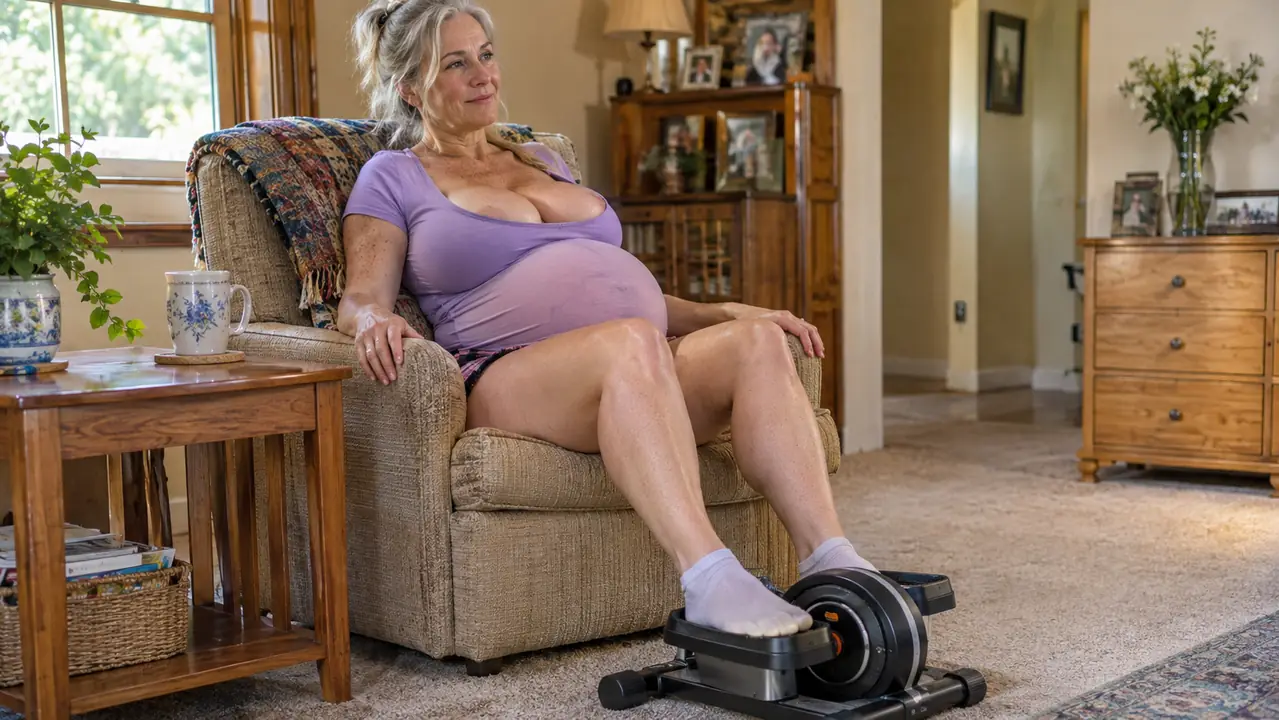
By two in the afternoon my right knee has an opinion. It stiffens up somewhere around the second cup of coffee and stays that way until I stand and move around. In February in Michigan, standing and moving around means boots, a heavy coat, and a driveway that already put me on my back once, two winters ago, on a patch of ice I never saw coming.
That fall changed how I think about a chair. Before it, sitting was rest. After it, sitting all afternoon felt like a slow leak. My doctor was plain with me. Keep moving, build the muscle around the knee, and do not spend the whole day in a chair. The first two are easy to agree with. The third one is hard when you are 68, the chair is soft, and the wind is coming across the field behind the house.
What finally worked was not a gym and not a class. It was a small machine on the floor beside my armchair, a seated elliptical called the Cubii JR1, and a routine plain enough that I was still doing it in March when the novelty had worn off. This is that routine, in five steps, in the order I would hand it to a friend who asked.
The machine that made the five steps possible
The Cubii JR1 is the seated elliptical I keep beside my armchair. Eight manual resistance levels, a small display, and a footprint that tucks under the front of a chair. Mine has not moved since October.
Amazon Check Today's Price on Amazon →Step 1: Put It Where Sitting Already Happens
Do not build the new habit in a new room. I have a converted spare bedroom I call the exercise room, carpeted, with a chair and a window that looks at the neighbor's shed. I like that room. I use it about half as often as I use the living room, and I have stopped feeling guilty about that.
The living room wins because I already sit there. The machine lives on the carpet beside my armchair, close enough that my feet find it without my brain having to decide anything. That is the whole trick. If using it requires standing up, walking to another room, and turning on a light, then on a tired Tuesday it will not happen.
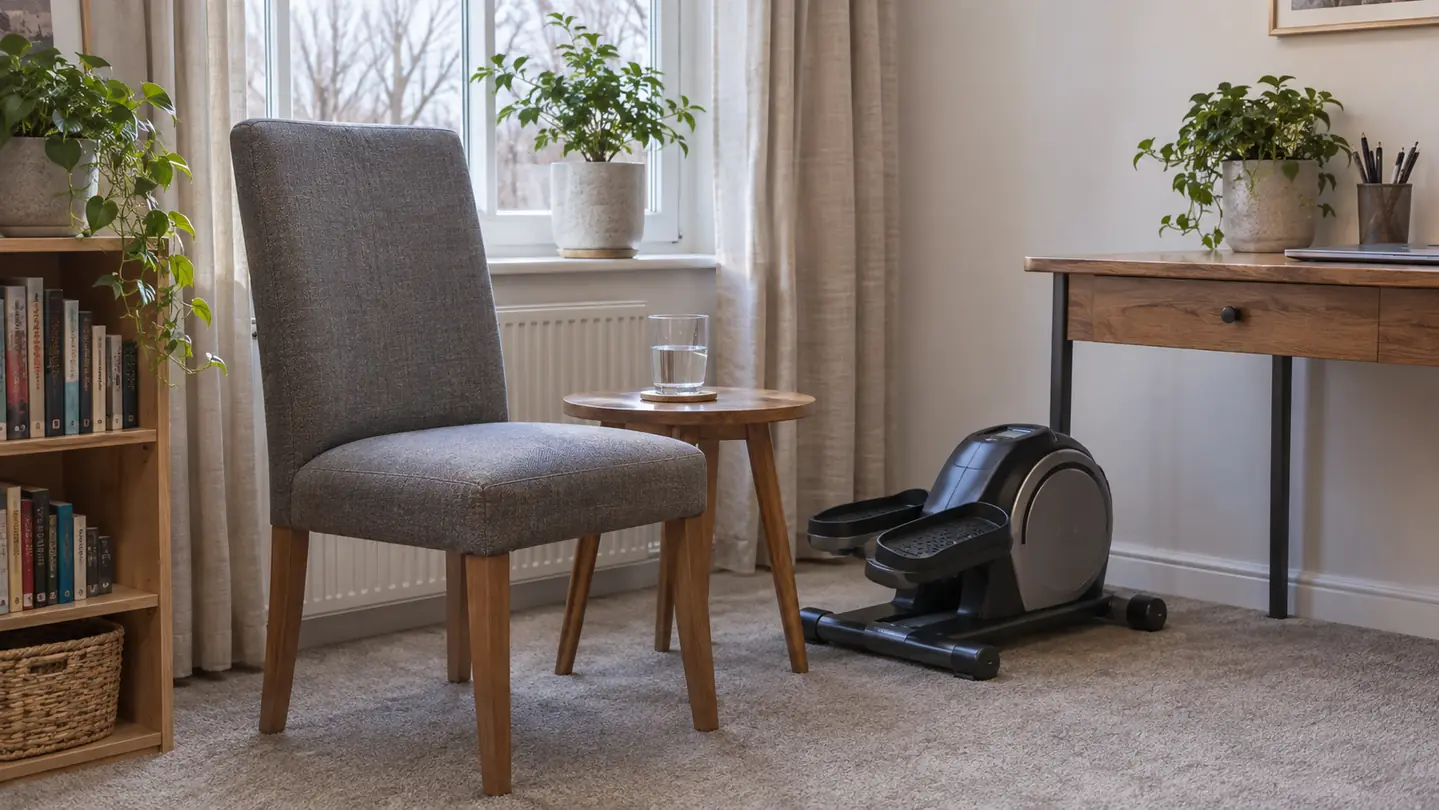
Size is the reason it can live there. The JR1 measures 23.2 inches deep, 17.56 inches wide and 10 inches tall, and it weighs 25.4 pounds. That reads like a lot of machine until you picture it: it sits under the front of a chair and stays put. It runs on batteries, so there is no cord stretched across the carpet for Gene to catch a foot on.
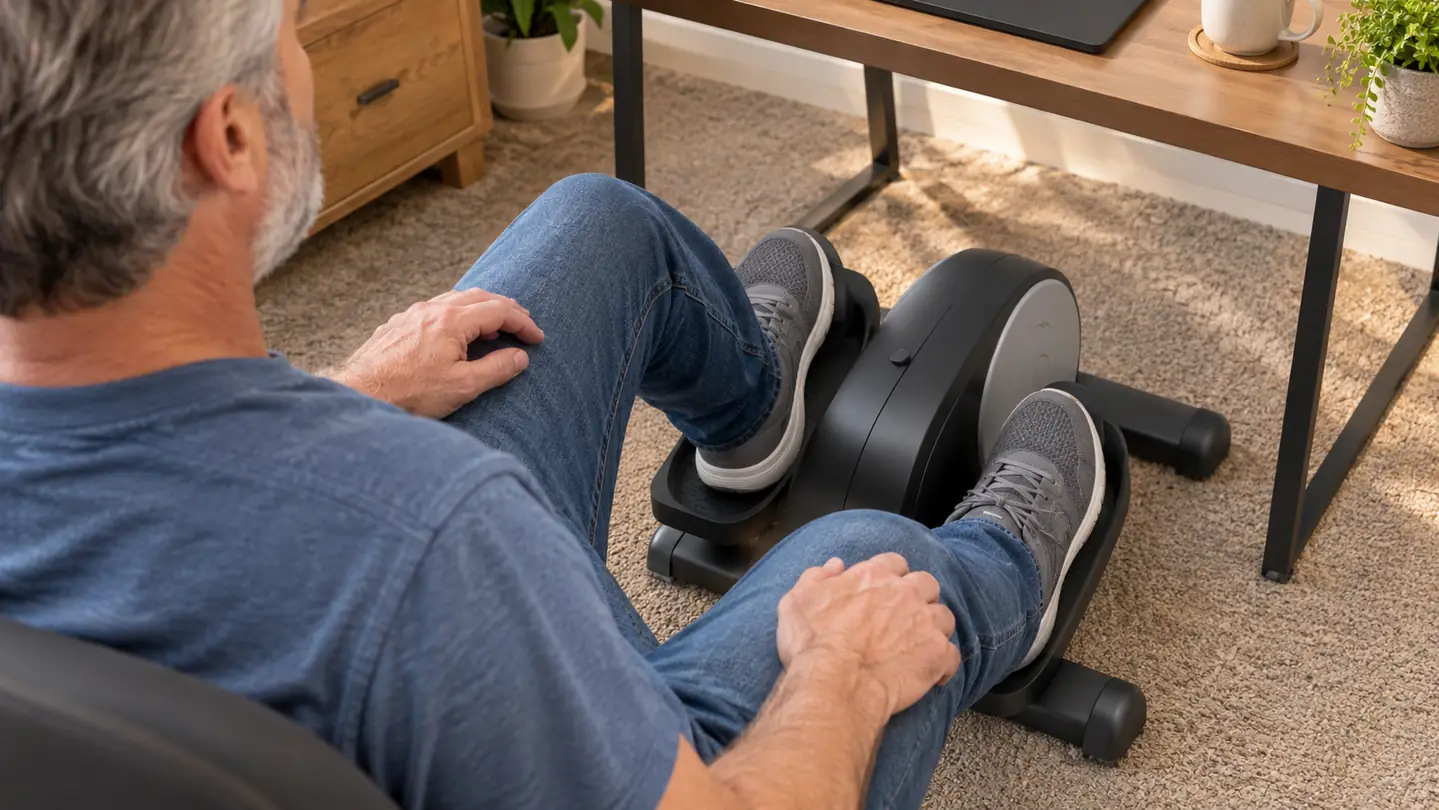
One thing to check before you settle on the spot. Sit down, put your feet on the pedals, and see that your knees are not locked straight and your heels are not straining to reach. If the chair is too tall or set too far back, you will feel it in your lower back inside five minutes and you will blame the machine. Move the chair. In my experience it is almost always the chair.
Step 2: Start at the Lowest Resistance and a Length That Feels Silly
The JR1 has eight resistance levels and the resistance is manual, which means you reach down and change it by hand before you start. Nothing is running a program for you and there is nothing to learn. Level one is genuinely easy. That is the entire point of level one, and I wish someone had said that to me the first week instead of letting me assume easy meant pointless.
I started at level one for four minutes a day. Four minutes. The neighbor who walks with me in the summer laughed when I told her, then she came over and tried it and did three. But four minutes is a session you cannot talk yourself out of, and a session you actually do is worth more than the forty-minute plan you keep postponing.
The rule I use is the one my doctor gave me. If the knee is sore in a hot, sharp way two hours later, that was too much. If it feels warm and loose and a little tired, that was right. Osteoarthritis likes motion and does not care for load, so in the first month your goal is minutes, not resistance.
I added about two minutes a week and did not change the resistance setting until the middle of the second month. By then twenty minutes at level three felt like nothing, which is exactly how it should feel. If you are gritting your teeth and watching the clock, you have set it too high and you will quit by Friday.
Step 3: Fix the Chair Before You Fix the Machine
A kitchen chair with a firm seat and a straight back is better than a deep armchair for this, and it took me three weeks to admit that. The armchair is comfortable, but it tips you back. When you tip back, your feet push forward and your lower back quietly takes the work. Try both for five minutes each. Your body will tell you which one lets you pedal without bracing.
If you do use an armchair, put a firm cushion behind your lower back so you are sitting tall instead of slouched. Keep your feet flat on the pedals rather than up on your toes. Rest your hands in your lap or lightly on the arms without gripping, because gripping the arms is how you end up with a sore shoulder and no idea why. The test I use is simple. If I can look down and see my knees roughly level with my hips, I am set up right.
One more chair note, from experience. Do not do this in a chair with wheels. The motion will push the chair backward an inch at a time and you will spend the whole session chasing your own furniture across the room. Four feet on the carpet stays where you put it.
Step 4: Hook It to Something You Already Do Every Day
A new habit needs a handle, and the easiest handle is something you already do without thinking about it. For me it is the first cup of coffee and the morning weather report. Coffee goes on, I sit down, my feet find the pedals, and I am eight minutes in before the forecast is finished. I never once had to talk myself into it, because I was going to sit down with that coffee anyway.
Pick your handle before you pick a time. After the mail. During the evening news. While the potatoes boil. A time on a clock is easy to miss. A thing you already do every single day is very hard to miss.
Twenty minutes is my usual session and I rarely go past thirty. Some mornings I do ten and call it done, because ten is not zero. On weekends the grandchildren visit and the whole routine goes out the window. I have stopped pretending otherwise. Two days off does not undo five days on, and I can pedal and talk at the same time, so Sunday phone calls to my sister in Arizona are now twenty minutes I would otherwise have spent sitting still with a phone against my ear.
Step 5: Track a Little, Then Stop Staring at the Numbers
There is a small LCD display on the machine that keeps up with calories burned, and for the first month I checked it after every session like a woman expecting a grade. Then I stopped, because the number I actually needed was simpler. Did I get on it today or not. Four out of seven is a good week for me. Five is a very good week.
There is also a Cubii mobile app, and it works by you typing the numbers from the display in by hand. No pairing, no syncing, no fuss. I enter my sessions on Sunday evenings while the coffee is brewing and I can see the week at a glance. If you are the sort who enjoys a chart, it is there for you. If you are not, skip it and use a paper calendar on the fridge, which is what Gene does for his walking.
Whatever you use, keep it where you can see it and then leave it alone. This is not a weight loss program and it is not a competition with anybody. It is a way to keep a joint moving on the days when the weather wins.
I started at four minutes a day in October. By February I was doing twenty-five without thinking about it, and I could get out of the car without that wince.
What Else Helps
The machine is one piece of a week, not the whole week, and the other pieces cost nothing. Stand up every half hour, even if you only stand for a count of twenty. Do a couple of chair stands while the kettle heats: rise from the chair without using your hands, sit back down, repeat five times. Those work the same muscles that get you off the toilet and out of the car, and those are the muscles that matter after a fall. Water is boring advice and I am going to give it anyway, because I can feel the difference in my knee on the days I forget.
Two honest limits. First, this is seated motion, not balance training. It will not teach your ankles and hips to catch you on an icy driveway. For that you need to practice standing on one foot at the kitchen counter with a hand on the counter, and you need to ask your doctor or a physical therapist what is safe for you specifically. Second, the manufacturer lists a maximum weight recommendation of 150 pounds, which is worth checking before you buy rather than after. I would also say this plainly. If you have a heart condition, a recent surgery, or a knee that is swollen and hot to the touch, call your doctor before you start, not after.
What I did not expect was how much the machine changed the shape of a winter. Michigan keeps me indoors from November to March, and those used to be five months of sitting. Now they are five months of short sessions by the window, with the neighbor's shed in the background and the weather report on, and my knee is looser in April than it used to be in July. That is not a cure and I would never call it one. It is a small machine, a firm chair, and twenty minutes I finally stopped arguing with myself about.
Start with four minutes, not forty
If your doctor has told you to keep moving and the weather has other plans, this is the smallest first step I know. Level one, four minutes, a firm chair, and a spot beside the seat you already use.
Amazon See the Cubii JR1 on Amazon →