
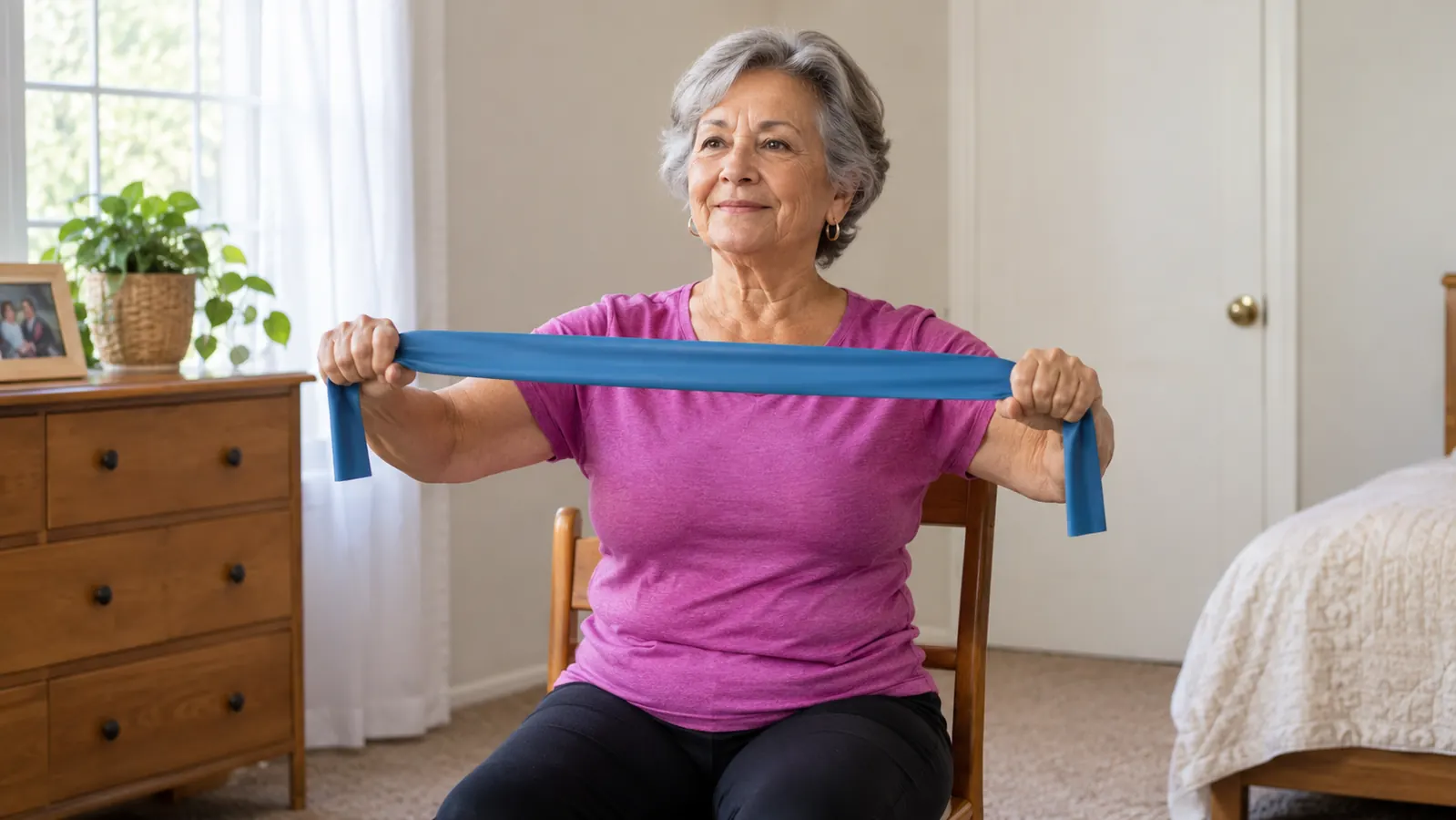
The first thing my doctor said after she looked at the X-ray of my right knee was not rest. It was keep moving. That was the winter after I went down on an icy driveway in front of our house outside Flint, and a few months after the osteoarthritis diagnosis that finally explained why my knee complained on the stairs and why I had started pushing off the arms of the kitchen chair to stand up. She handed me a photocopied sheet of exercises and told me the muscles around the joint needed to do more of the work. What she did not tell me was which band to buy. I worked that out the slow way, and the set I keep coming back to is the THERABAND Resistance Bands Set.
If you have stood in the fitness aisle of a sporting goods store lately, you know the problem. There are loops and flats, tubes with handles and long strips with no handles at all, and every package promises something different. Very few of them tell you on the front how hard the band actually pulls. I bought two sets before this one and both ended up in a drawer, because the lightest band in each was still too much for my knee on a bad morning. That is the whole reason the THERABAND set works for me: the three tensions in the box are genuinely light, and they were designed for physical therapy rather than for someone trying to look impressive.
The Quick Verdict
Three honestly light tensions built for therapy, not for show. Six months of three mornings a week and nothing has torn, but plan on adding a heavier band later if you stick with it.
Amazon Check Today's Price →Start With the Lightest Thing in the Room
Yellow at 3 to 4.3 lbs, red at 3.7 to 5.5, green at 4.6 to 6.7. All five feet long and four inches wide, all non-latex, and every one of them light enough that starting slow is the only option they give you.
Amazon Check Today's Price on Amazon →How I've Used It
I am sixty-eight, retired after thirty-one years teaching third grade, and I do not have a gym membership. What I have is a spare bedroom with carpet on the floor that I call the exercise room, a television in the living room, and a husband named Gene who is seventy-one and who tells me regularly that I am overdoing it. Michigan keeps me indoors from November to March, so between the weather and my knee, walking outdoors is a fair-weather friend.
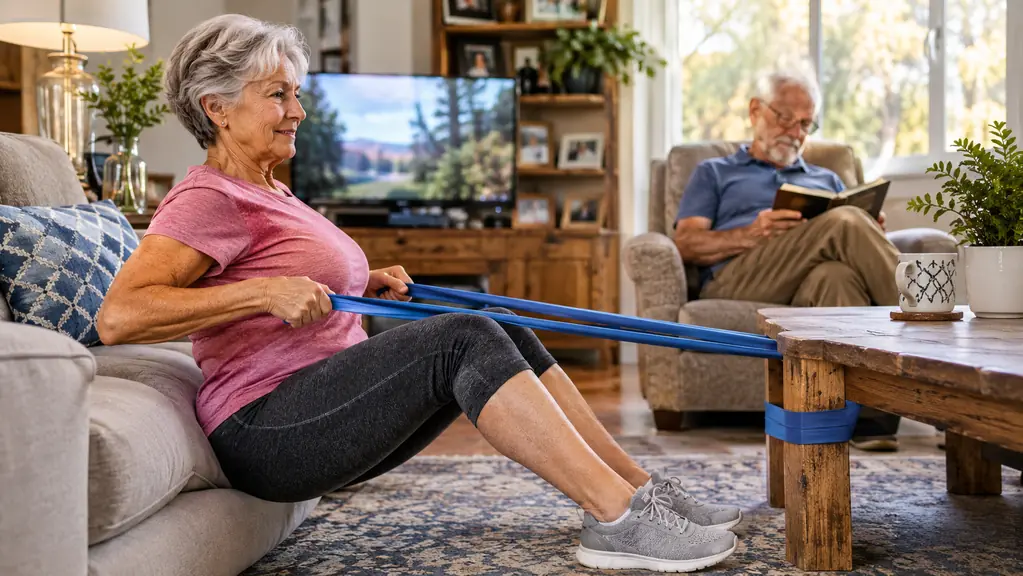
My routine is short and unglamorous. Coffee first. Then twenty to thirty minutes, three mornings a week, sometimes four. I sit on a kitchen chair in the exercise room and loop a band around my ankles for side steps. I tie one into a loop, hook it around my foot, and do seated leg extensions. I anchor a long band around the leg of the heavy oak table in the living room and do rows while the morning news is on. Nothing in that list takes skill. That is the point of it.
The bands are five feet long and four inches wide, which matters more than it sounds. A flat band that wide does not cut into the back of the leg the way a narrow tube does, and it does not snap back at you when your grip slips. I have had that happen with a cheap loop band, and it is the reason I stopped using loop bands for anything where my hands are involved.
I keep all three in the top drawer of the dresser in that room, folded flat, next to a pair of socks I only wear for exercise. That is the entire storage system. Nothing has gotten tangled and nothing has gotten lost, which is more than I can say for the ankle weights I bought the year before.
What Is Actually in the Set
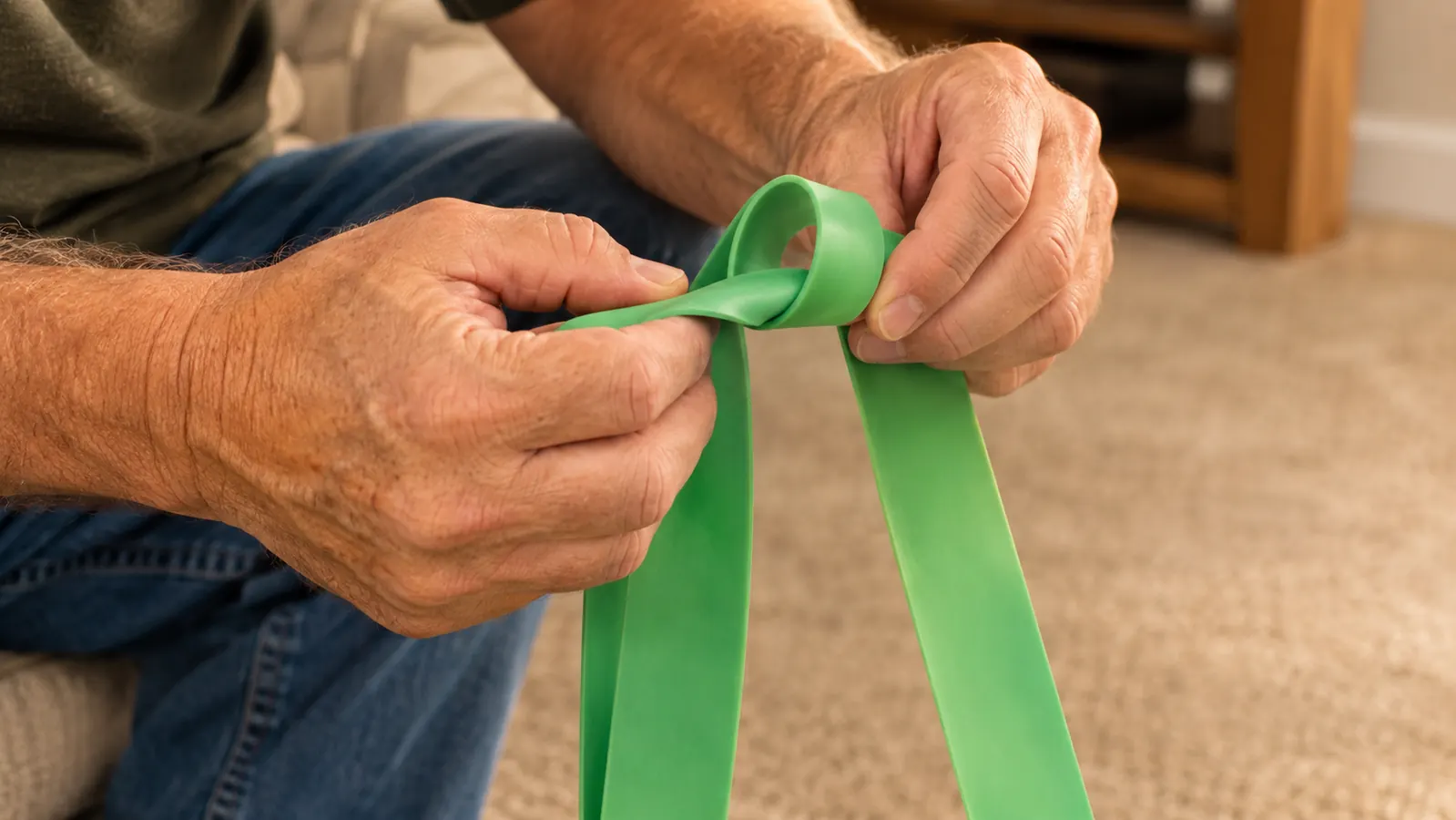
Three flat bands, no handles, no door anchor, and no instruction booklet worth reading. Yellow is rated 3 to 4.3 lbs of pull. Red is 3.7 to 5.5. Green is 4.6 to 6.7. All three are non-latex, made from a synthetic rubber and thermoplastic elastomer blend, and the whole set weighs about 1.6 ounces, which is less than a letter.
Those numbers are low and I want to be plain about that. If you are forty-five and lifting at a gym, these are not your bands. If you are sixty-eight and your knee has opinions, they are exactly right. My first session with the yellow band, I did twelve seated leg extensions and felt like I had done nothing at all. The next morning my thigh muscle let me know it had noticed. That is the level this set is pitched at, and it is the level a lot of us need to begin at.
The three tensions overlap more than the numbers suggest. Yellow tops out at 4.3 lbs and red begins at 3.7. So red at its easiest is barely harder than yellow at its hardest. In practice I use yellow on a stiff morning and red on a good one, and the difference is small enough that I do not have to think about it. Green I use for the anchored rows and for nothing else yet.
What the Three Tensions Feel Like in Real Life
Here is the plain version. Yellow is a stretch, not a struggle. I can hold it at full extension and count to three without my leg shaking. Red asks a little more and I can feel the muscle working by the tenth repetition. Green, for me, is two sets and then I am done.
The overlap has one downside. Because the steps between the bands are small, there is not a big jump waiting for you when yellow starts to feel easy. That is where the honest limitation of this set lives. It is a starting set and a maintenance set, not a progression set. Somewhere around month four I stopped feeling yellow at all, and I had to decide whether to add a heavier band from the same line or accept that I had reached a plateau. I added one. That is not a knock on the original three. It is simply what happens when a set is honestly rated and you keep showing up.
One more thing about how they feel. The flat band rolls on itself when you wrap it around an ankle and pull at an angle. It is not dangerous, it is just annoying, and it took me a few weeks to work out that I need to keep the pull straight and centered on the band rather than letting it ride to one edge. If your hands are not as strong as they used to be, that is worth knowing before you start.
Six months in, I can stand up from a kitchen chair without pushing off the arms. That is not a dramatic sentence. It is the whole reason I kept going.
Six Months Later: What Changed and What Didn't
I started in March and I am writing this in September, so six months is accurate. Three mornings a week most weeks, four when the weather was bad and there was nothing else to do. What changed is small and specific, and I would not trade any of it. I stand up from a chair without using my arms. I take the stairs in our house one foot after the other instead of leading with my left. I can get down on the floor to play with a grandchild and get back up without a hand from Gene.
I kept a paper calendar on the wall of the exercise room and marked each session with a check mark. That sounds fussy, but it is the only reason I know the numbers I am giving you. Looking back at March, there are gaps. A week where my knee swelled after I spent a Saturday on my feet at a granddaughter's birthday party. A stretch in April when I had a cold and did nothing for nine days. The bands did not care. I picked the yellow one back up at the end of each gap and started at twelve repetitions again.
What did not change is the arthritis itself. Some mornings my knee is stiff before I start and stiff for the first five minutes after. The bands did not fix the joint and I never expected them to. What they did was build enough muscle around the joint that the joint has less of the job to do on its own. My doctor was right about that and I have told her so.
The other thing that did not change is my balance. I want to be honest here, because a lot of us come to these bands after a fall. The bands helped my leg strength and the leg strength helped my balance, indirectly. They are not a balance program. I still hold the back of a chair for anything on one foot, and I still do not walk quickly on wet pavement. If balance is your main concern, ask your doctor about physical therapy first. That is what I did, and the therapist is the one who showed me which exercises to do with these bands in the first place.
Where They Held Up and Where They Fell Short
After six months of regular use, all three original bands are still in one piece. No tears, no thin spots, no change in how they pull. I check them before every session, running each one through my hands and looking for nicks or cloudy patches, because a band that is going to fail usually warns you first. So far there is nothing to report. The THERABAND bands have outlasted both of the cheaper sets I bought before them. They get wiped with a damp cloth and a little mild soap every couple of weeks, and they live in a drawer rather than on a hook in the sun.
One honest defect. The red band developed a small rough patch near the spot where I had been tying it in a knot to make a loop. That was my doing, not the band's, and it has not spread in two months. It did teach me to tie the loop using the flat of the band rather than cinching a hard knot in one place and leaving it there for weeks.
The bigger shortfall is the one I keep coming back to: there is not much room to grow. Three light tensions are a wonderful thing for someone starting out and a limiting thing for someone six months in. If you are the sort of person who will stick with this, plan from the beginning on adding a medium band at some point. If you are the sort who needs one purchase and no further decisions, this set will carry you a long way, but you may find yourself adding repetitions rather than resistance.
What I Liked
- Three genuinely light tensions rated under 7 lbs of pull, which is what a therapy-minded start actually looks like
- Five feet long and four inches wide, so the band does not bite into the leg or fold under load
- Non-latex, which matters if you are sensitive to latex
- Weighs about 1.6 ounces, so it goes in a suitcase or a bedside drawer and you forget it is there
- Six months of three sessions a week with no tears, no thin spots, and no change in tension
Where It Falls Short
- The light tensions are the only tensions, so there is nowhere to progress without buying another band
- Yellow and red overlap enough that the difference between them is barely noticeable
- The band rolls on itself when wrapped around an ankle and pulled at an angle
- No handles, no door anchor, and no useful instructions, so you need exercises from your therapist or doctor
Who This Is For
This set is for someone who has been told to build strength slowly and who needs a tool that will not let them overdo it. If you are recovering from a knee replacement, or managing arthritis, or you have not exercised in ten years and you are nervous about starting, the three light tensions here are a feature and not a compromise. My therapist had these exact THERABAND bands in her office. That is not a coincidence.
It is also a good fit if you exercise in a small space. My exercise room is a converted spare bedroom with a bed and a dresser still in it, and there is no room for a machine. Three flat bands in a drawer take up nothing, and I can do a full session in a space the size of a bath mat.
Who Should Skip It
Skip it if you are already strong and looking for resistance you can grow into. Three bands that top out at 6.7 lbs will not challenge a healthy fifty-year-old for long, and you will be shopping again by spring. Buy a set with a wider range of tensions instead.
Skip it also if you need instructions to get started. There is no useful workout guide in the box. If you are not working from a therapist's sheet or a program you trust, begin somewhere that gives you one, or ask your doctor for a handout. The bands are a tool, not a plan.
The Set My Physical Therapist Already Had in Her Office
Non-latex flat bands, five feet long, rated 3 to 6.7 lbs of pull. Light enough that starting slow is the only thing they let you do, and small enough to disappear into a dresser drawer between sessions.
Amazon Check Today's Price on Amazon →