
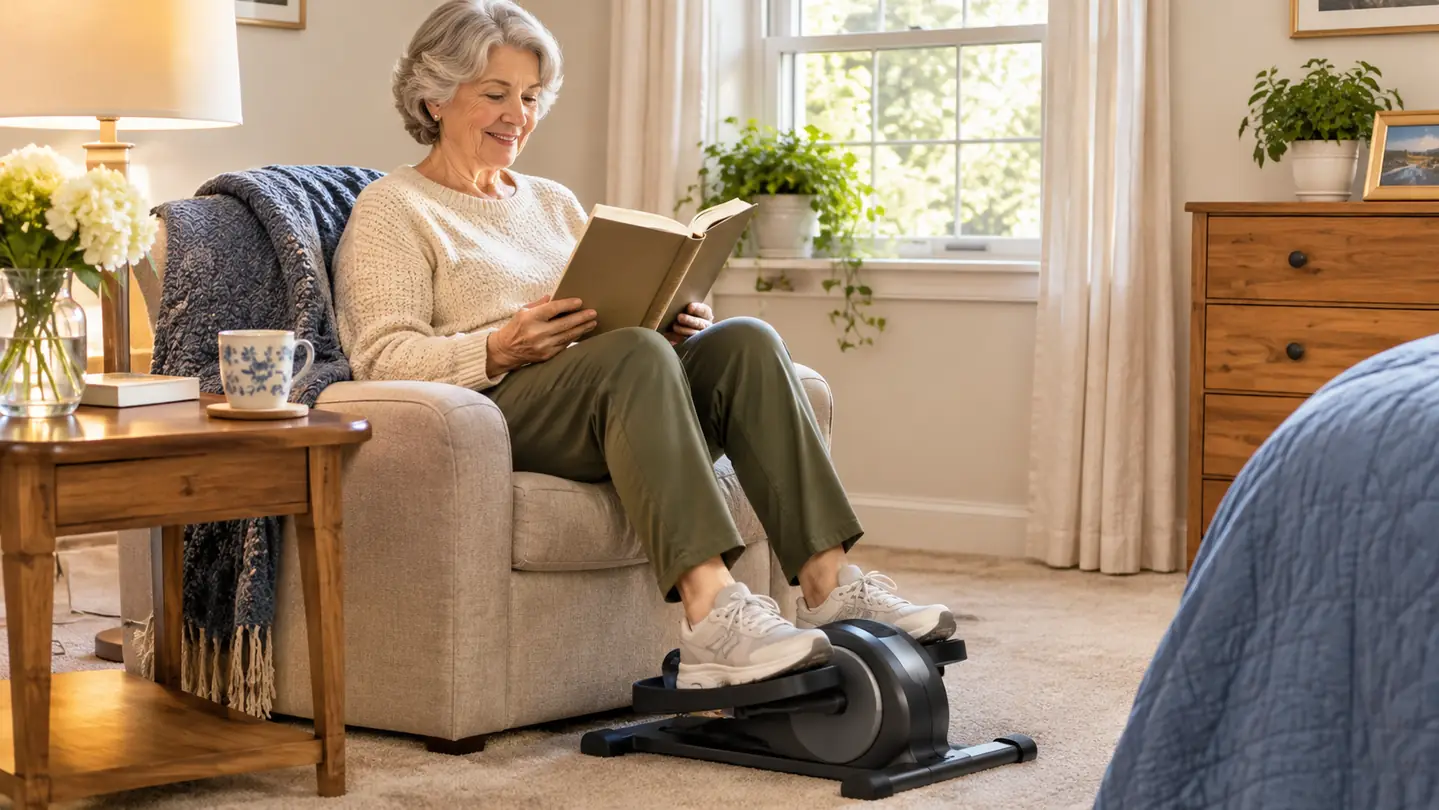
The thing nobody tells you about getting older is how fast your legs stop trusting you. Two winters ago I went down on an icy patch of my own driveway outside Flint, and after that I found reasons not to walk to the mailbox. My right knee had already been carrying a mild case of osteoarthritis since my sixties, and the slip gave me an excuse to sit. My doctor was blunt about it: keep moving or lose ground. She did not say join a gym. She said find something you will actually do.
What I actually did was buy a Cubii JR1, the under-desk elliptical, and park it in the spare bedroom I call the exercise room. That was months ago. I have pedaled it most mornings since, twenty to thirty minutes after coffee, sometimes in the living room with the TV on. This is not a first-week review. These are my notes from the long haul, including the parts that annoyed me.
The Quick Verdict
A quiet, sturdy seated elliptical that got my knee moving on mornings I would otherwise have sat still. It will not replace walking, and the resistance tops out sooner than I expected.
Amazon Check Today's Price →If your knees have started making decisions for you, this is the gentlest way back in
The Cubii JR1 sits on the floor in front of any chair you already own. You sit, you pedal, you stop when you are tired. No balance required, nothing to fall off of.
Amazon Check Today's Price on Amazon →How I've Used It
My routine is boring on purpose. Coffee first, then down the hall to the exercise room, which has carpet and a window that faces the neighbor's bare maple. I sit in an armchair, pull the Cubii close with my heels, and pedal for twenty minutes while the local news plays on a small radio. Two or three mornings a week I go thirty minutes. I take Sundays off because I decided early that a streak I could not keep was worse than no streak at all.
Before this I tried two other things and both are in a drawer. The first was a set of resistance bands the nurse handed me at my checkup, which required me to get down on the floor and then get back up, and the getting up was the part I could not do reliably. The second was a cheap set of floor pedals I ordered one January, the kind with a tension knob, and it walked itself across the carpet every session because nothing held it in place. I gave it to my neighbor's son. The Cubii stayed put from the first morning, which sounds like a small thing until you have spent twenty minutes chasing a machine around a room.
I started with the resistance where it came out of the box, which felt like pedaling through warm pudding, and I stayed there for the first two weeks. That was deliberate. My knee had been stiff for months and I did not want to be sore enough to quit. After two weeks I moved up one level. I am now on level three of the eight, and I suspect I will sit at three or four for a long while. The higher levels are genuinely harder, not decorative.
The unit itself is 25.4 pounds and measures 23.2 inches deep by 17.56 inches wide by 10 inches high, so it lives against the wall between sessions and I do not trip over it. I have never once moved it while pedaling, which was my main worry about a machine that sits loose on the floor rather than being bolted to anything. The maximum stride is 18 inches, which is a short, easy circle. If you have ever used a full-size elliptical at a hotel, expect a much smaller motion, closer to a smooth pedaling loop than a stride.
What the Display and the App Actually Do
The built-in LCD display tracks your time and calories burned and keeps a running record of your sessions. It runs on battery power, so there is no cord to route under a chair and nothing to plug in. I keep a pair of reading glasses on the windowsill because the numbers are small and my eyes are sixty-eight years old, but that is a complaint about me, not about the screen.
On my first session the display read four minutes when I would have sworn I had done ten, and that was humbling in a useful way. For two weeks I never got past eight minutes before the knee asked me to stop, and I wrote each number on the kitchen calendar because I wanted proof I was not imagining progress. By the end of January the numbers were twenty and twenty-two and the calendar had a column of check marks down the side.
Here is the part I want to be careful about, because I have read reviews that get it wrong. The Cubii mobile app does not talk to the machine on its own. You manually enter the numbers from the LCD display into the app if you want a digital log. That is the whole relationship. For the first month I dutifully typed in my minutes. Then I stopped, because a paper calendar on the wall with a check mark does the same job and I do not have to find my charger. If you are the kind of person who loves a graph, the app will give you one. If you are not, you are not missing a feature that changes your knees.
What Months of Use Changed, and What It Didn't
The honest answer is that my knee did not stop having arthritis. It still clicks going up stairs and it still complains on damp days, and anyone who tells you a pedal machine fixes that is selling something. What changed is smaller and more useful. The first ten minutes of the morning stopped being stiff. I could get out of a low chair without pushing off the arms. When my granddaughter wanted to walk to the end of the block and back, I said yes without doing the arithmetic first.
One morning in February I noticed it without meaning to. I came down the hall, sat, and pedaled twenty-two minutes while the weather report ran, and my knee never once entered my mind. That had not happened in a year. Gene noticed before I did. He said I had stopped doing the thing where I put a hand on the door frame to come around the corner into the kitchen, and I had not realized I was doing it at all.
What it did not do is build the balance I lost on that ice. Pedaling while seated does not ask anything of your ankles or your hips in the way that standing and walking does. I still walk outdoors with my neighbor when the weather allows, and I stretch at the kitchen counter every morning. The Cubii fills the months when Michigan does not allow it, November through March, and it fills the rainy weeks the rest of the year. That is a real job. It is not the whole job.
The other thing months of use taught me is that consistency beats intensity at my age, and by a wide margin. My most ambitious week, when I pushed to level five and forty minutes, ended with a sore knee and four days off. My best week, by how I felt, was five short sessions at level three. The machine rewards the second approach because it is easy enough to get on when you do not feel like it. That sounds like faint praise. For someone who spent a year avoiding movement, it is the entire point.
The machine that helps you at sixty-eight is not the one with the best features. It is the one sitting in the room when you walk past in your slippers.
Build, Noise, and the Small Annoyances
The Cubii JR1 is built from metal and plastic and feels denser than the price suggests, and it has held up through months of daily use without a wobble or a rattle. It is quiet. I have pedaled it in the living room while Gene read the paper three feet away and he never once looked up. The one noise it makes is a soft whir that speeds up with your pace, and I only notice it when I stop.
The rug incident deserves a full sentence. The exercise room has a thin throw rug near the closet door, and the first week the front edge of the Cubii caught it and bunched it up under the pedals halfway through a session. I rolled the rug up and put it in the closet and have not missed it. Carpet itself is fine, better than fine, because the unit does not travel on it. When I tried it on the bare floor in the living room it crept an inch or two over half an hour, so I keep it on the carpet and stop worrying about it.
The annoyances are real but small. The maximum weight recommendation is 150 pounds, which is worth checking against your own weight before you order and is the kind of thing I wish I had looked at first instead of last. It does not fold and there is no way to pick it up by anything but the frame, so at 25.4 pounds I move it once and leave it where it sits. And you do need to think about the chair. A low overstuffed chair put my knees above my hips and made the whole motion feel wrong. I moved a straight-backed kitchen chair into the room and everything improved the same afternoon.
I also want to say something about the shape of the motion, because I did not understand it before I bought. You are not standing on this. Your heels rest on the pedals and the movement is entirely in the lower leg and knee, with some work in the front of the thigh. Gene tried it and said it felt like nothing. For him it was. For a woman who had been sitting for months, it was the first exercise in a year she could do without fear of falling. The same machine, two completely different reports. That is worth knowing before you decide.

Who It Suits Better Than a Full Elliptical
Gene and I looked at a full-size elliptical before I bought this, and the reason we did not get one is not price. It is that a standing elliptical requires balance, and balance is the exact thing that sent me to the doctor in the first place. You cannot fall off a machine that you are sitting down to use. For anyone with a knee that has opinions, a hip that has been replaced, or a history of near-falls, that difference matters more than every other spec on the box.
It also suits small houses. Our spare bedroom holds a chair, a radio, and this unit against the wall, and there is still room to walk past. A full elliptical would have taken the room and probably the hallway too. If your winters look like mine, that is a real argument.
What I Liked
- Quiet enough to use in the same room as someone reading
- Stable on carpet, does not slide or rock at a steady pace
- Eight resistance levels, and the jump between them is noticeable
- Sits against a wall and takes up almost no floor space
- Battery powered, so there is no cord to trip over
- Gentle enough to use on mornings when everything else hurts
Where It Falls Short
- The maximum weight recommendation is 150 pounds, which will exclude some buyers
- The app requires manual entry of the numbers from the display
- It does not fold, so it stays in the room you put it in
- The stride is short, so do not expect a walking-like motion
- The numbers on the LCD are small for older eyes
Who This Is For
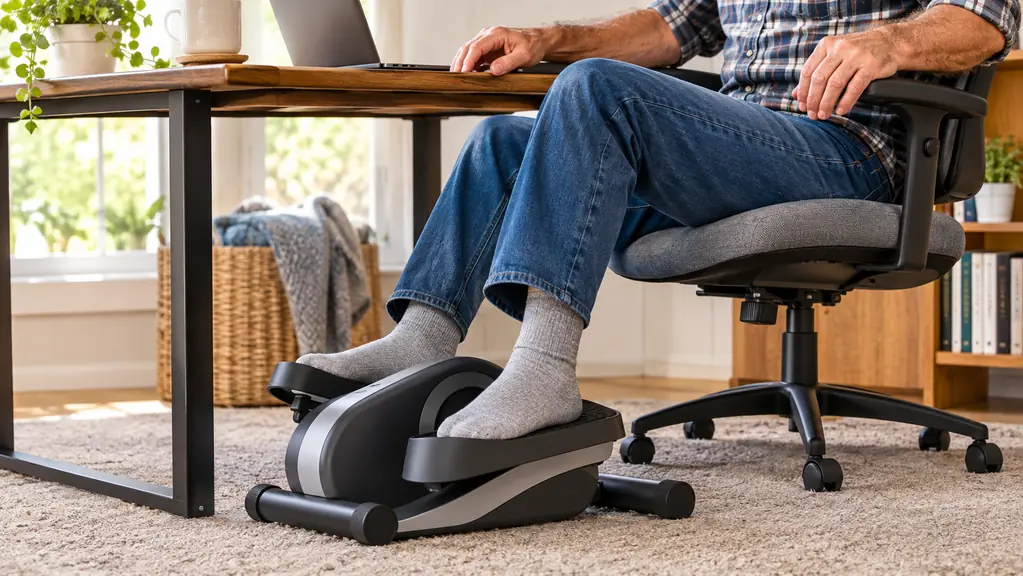
The Cubii JR1 is for the person who has been told to keep moving and has quietly stopped moving. If you are over sixty, if you have a knee or hip that does not enjoy bearing weight, if you have had a fall or a near-fall and your confidence has not caught up, this gives you a way to put in twenty honest minutes without leaving the house or risking your balance. It is also for the person stuck at a desk or in a recliner for long stretches who wants to stop sitting completely still.
I would also hand it to a spouse. Gene uses it occasionally in the evening while the news is on, at a low resistance, and he is not training for anything. He just likes that his legs are doing something while he sits. Two people, one machine, zero arguments about whose turn it is.
Who Should Skip It
Skip it if you weigh more than 150 pounds. That is not a suggestion, it is the stated limit, and I would not talk you around it. Skip it if what you want is a real cardio workout that leaves you winded. This machine will not do that at any resistance level, and you will be disappointed by week two. Skip it if you have no trouble standing and walking and simply want a better option for bad weather, because a used treadmill or a walk in a mall will serve you better.
And skip it if you are looking for a machine to fix your balance. It will not. It will keep your knees moving while you work on your balance separately, with your doctor's guidance and a counter to hold. I did not understand that distinction when I ordered, and I would have saved myself a little disappointment if I had.
One more caution, and I mean this kindly. If you have a heart condition, a recent surgery, or a joint that is actively inflamed rather than chronically stiff, call your doctor before you start, and start at the lowest resistance for shorter than you think you should. I did two weeks at the out-of-box setting before I touched the dial, and I credit that entirely for the fact that I am still pedaling months later.
Twenty minutes, a chair you already own, and a Michigan winter you don't have to sit out
Start at the lowest resistance and stay there for two weeks. That is my whole advice. The Cubii JR1 will be sitting there when you are ready for level three.
Amazon Check Today's Price on Amazon →