
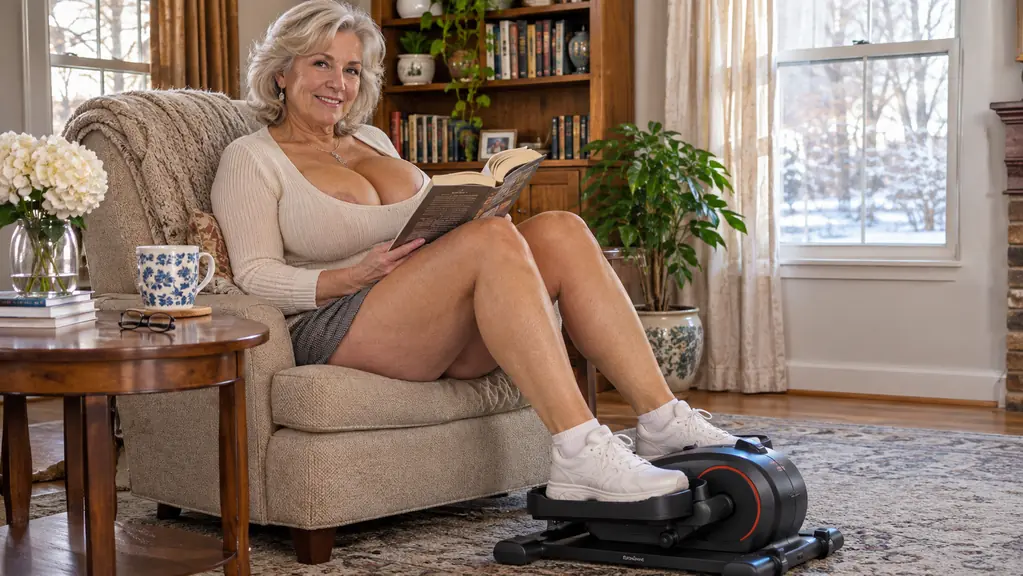
The first time I put my feet on a seated elliptical I lasted four minutes and felt foolish. I was sixty-six then, a few months past a slip on my icy driveway, and my doctor had given me the same speech she gives everyone: keep moving, build the leg strength back, and do not let fear make the decision for you. What I did not expect was that a small machine tucked under my chair would be the thing that finally got me moving on the mornings I did not want to.
That machine was a Cubii. I keep the Cubii JR1 in the exercise room off our spare bedroom, and through four Michigan winters it has become the piece of equipment I actually use rather than the one I feel guilty about. I am not going to pretend it replaces a walk or a gym. It does not. But for adults over sixty who want to keep their knees and hips moving without leaving the house, it does one specific job very well. Here are ten reasons, in the order they mattered to me.
The one piece of home equipment I still use four winters later
The Cubii JR1 is a seated elliptical that fits under a desk or beside a chair. You sit down, put your feet on the pedals, and start. No assembly, no getting up and down.
Amazon Check Today's Price on Amazon →It works with a chair you already own
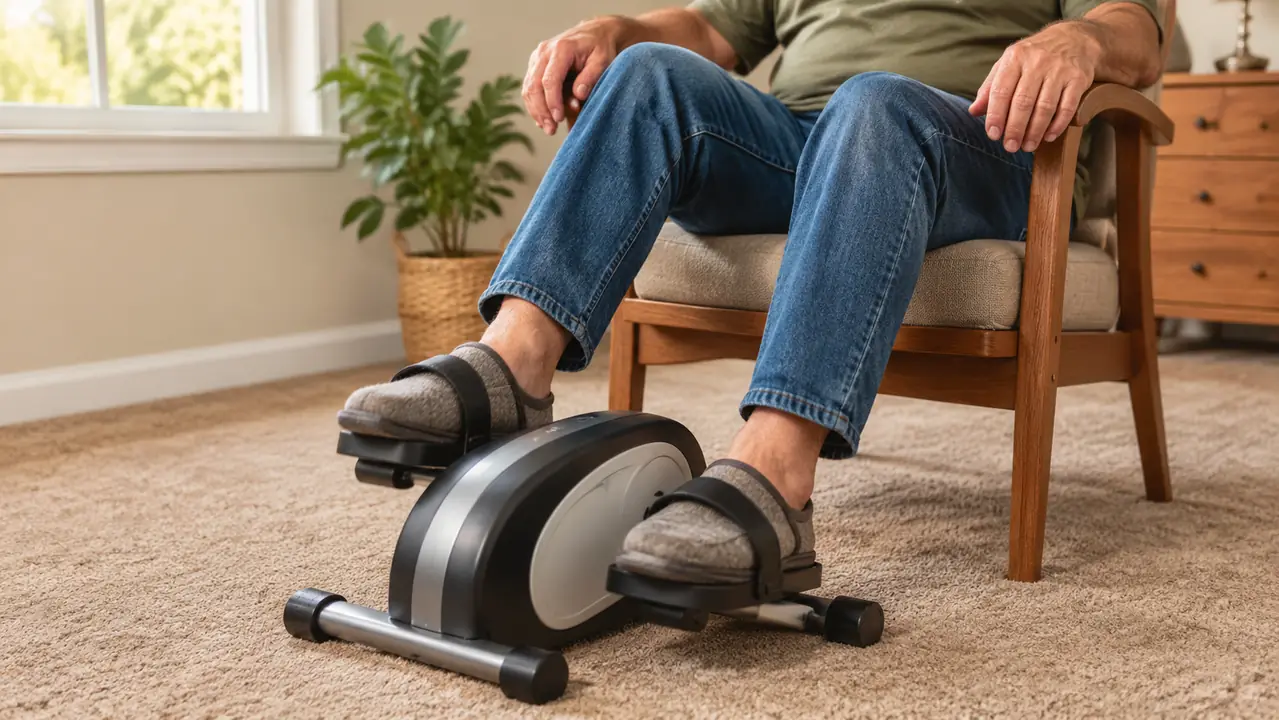
There is no seat to adjust and no straps to figure out. I set the Cubii JR1 on the carpet in front of my recliner, sit down, and put my feet on the pedals. That is the whole setup. If you have ever watched a piece of home gym equipment become a coat rack because getting it out was too much trouble, you know why this matters more than anything printed on the box. At 25.4 pounds I can move it between rooms without asking Gene for help.
Your feet never leave the pedals, so balance stays out of it
After I went down on the icy driveway two winters ago, every exercise idea came with the same question: what happens if I lose my footing? With a seated elliptical the answer is nothing. You are in a chair the entire time. There is no belt to step onto and nothing to hold you upright. I keep both hands on the chair arms anyway, because it helps me sit tall, but I am not depending on them to stay safe. That difference is why I kept this and stopped using the treadmill.
The chair carries your weight, not your knee
My doctor has been clear about the arthritis in my right knee: keep it moving, but stop pounding it. Seated pedaling lets the joint go through its range while the chair does the work of holding me up. I will not tell you it fixed anything, because it did not. What it did was let me move on the mornings when my knee was stiff and a walk around the block sounded miserable. Twenty minutes later it was looser and I could get on with my day.
Eight manual resistance levels let you start below your pride
The resistance is manual, all eight levels of it, so no motor is deciding how hard your session will be. You pick the level yourself. My first two weeks were spent near the bottom of that range and I am not embarrassed about it. What I would tell anyone starting is to choose a level where you could still hold a conversation, stay there a week, and only then move up. This is the machine to start on, not the one to prove something on.
An 18 inch stride is short enough to feel possible
The maximum stride length is 18 inches, which makes for a small round motion rather than a long reach. That is the point. Long strides are what talk people out of exercise in the first place. This lets you pedal in a narrow circle, the way you would while sitting at a desk, and your hip stays comfortable. If your knees are cranky before coffee, a short range of motion is the difference between a session you finish and one you abandon in three minutes.
Twenty minutes on a Tuesday in February does more for my knee than the forty-five minute walk I keep promising myself for May.
It tucks under a desk or beside a chair and stays out of the way
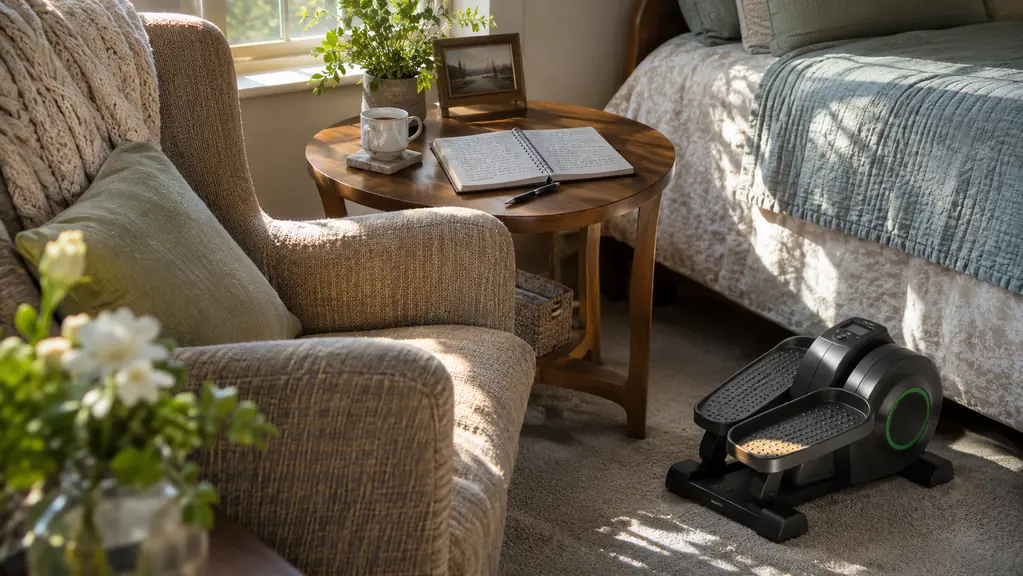
The footprint is 23.2 inches deep, 17.56 inches wide and 10 inches tall. In plain terms, about two feet of floor and less than a foot of height. Mine lives under the small desk in the exercise room and slides out when I want it. In the cold months I sometimes leave it in the living room for a week at a time. Nothing about it demands a room of its own, which is more than I can say for the treadmill it replaced.
A display that turns a vague goal into a number
The built-in LCD monitor keeps track of calories burned as you go. I am not a numbers person, but I have learned that seeing something recorded makes me more likely to come back the next morning. If you are the type who needs proof that twenty minutes actually happened, this gives it to you. It runs on battery power, so there is no cord stretched across the carpet, which at my age is not a small consideration.
Twenty minutes most mornings beats one long session
My routine is short and unglamorous. Coffee, a few minutes of stretching, then twenty to thirty minutes of pedaling while the news is on. Four or five mornings a week. That is all of it. What I have learned at sixty-eight is that consistency is the only thing that has ever worked for me, and consistency has to be easy. A session you can start in ten seconds is a session you will actually do in February.
It keeps you moving when Michigan closes the door on you
From November to March I am not walking around the block. The sidewalk is either icy or it is slush, and I have already had one fall I do not intend to repeat. A seated elliptical does not care about the weather. That is the whole reason I bought it and the whole reason I still use it. My neighbor and I pick our walks back up in April. Until then, this is how I keep the habit from dying off in the dark.
You can track it on the display or in the Cubii app
The screen shows your session as you go. If you want a longer record than that, the Cubii mobile app is there, and you type in the numbers from the display yourself. That is worth knowing before you order: this is not a machine that uploads anything on its own. I write mine in a paper log that lives on the side table, which tells you how much stock I put in apps, but the option exists if you like seeing a month laid out in front of you.
What I'd Skip
I would skip anything that promises this machine will replace walking, because it will not, and I would skip the bundles of add-on mats and straps that show up beside it. A carpeted floor is all you need. I would also skip the urge to make the first week impressive. The people I know who quit on home equipment are almost always the ones who went too hard in the first five days and then could not face it again on the sixth.
One more thing to skip, and I mean this sincerely. The machine is listed with a maximum weight recommendation of 150 pounds. If you are above that, skip this one and ask your doctor about a recumbent bike instead. That is not a knock on the machine, it is a limit in the paperwork, and you should know it before you order rather than after the box arrives. And if you have a heart condition or a joint that has been giving you real trouble, call the doctor first. I did, and it changed how I started.
Start with twenty minutes and a low resistance level
You do not need a gym membership or an empty room. You need a chair, a carpeted floor, and a session short enough that you will do it again tomorrow. Ask your doctor first if you have a heart or joint condition, then start slow and stay there for a week.
Amazon Check Today's Price on Amazon →