

If you are past 60 and shopping for a seated exerciser, the choice usually comes down to a Cubii JR1 or a basic pedal exerciser you can slide under a chair. I am 68, I have a cranky right knee, and I have used both in the spare bedroom I call my exercise room outside Flint, Michigan. Here is the short answer: the Cubii is the better choice if you want one steady machine for a daily routine and you want to adjust resistance in small steps. A basic pedal exerciser is the better choice if you want something light to move from room to room, or you are not yet sure a seated routine will stick. Neither one is a cure for anything. They are tools for keeping your legs moving when the sidewalk is icy and the couch is close. I am not a physical therapist. I am a retired third-grade teacher who has learned a few things about what I will actually do at 7 a.m. in January.
The basic pedal exerciser is not a bad machine. It is a simple set of pedals, often with a small tension knob, and it asks almost nothing of you. You put it on the floor, sit in a chair, and pedal. The Cubii JR1 is also a pedal machine, but it is built more like a piece of furniture. It weighs 25.4 pounds, it has a built-in LCD display, and it offers 8 resistance levels. That extra structure is the whole argument. The benefit is steadiness, a longer pedal path, and feedback you can see without guessing. The question is whether those things matter to the way you actually exercise. For me, most mornings, they do. For Gene, who likes to keep things simple, they do not. That is why this is a comparison and not a sermon.
| Cubii JR1 | A Basic Pedal Exerciser | |
|---|---|---|
| Resistance | Manual resistance with 8 levels, so I can start easy and add tension in small steps | Often one tension knob or a few settings, and the feel varies by model |
| Foot path | 18-inch maximum stride on an elliptical path | A short circular pedal path that can feel choppy |
| Steadiness | 25.4 pounds and a 23.2 by 17.56 inch footprint, steady on carpet | Light enough to slide, so it can shift when you push hard |
| Tracking | Built-in LCD display and manual entry into the Cubii app | Usually no display, or a simple counter on some models |
| Portability | 25.4 pounds, so I keep it in one room | Light enough to carry from living room to bedroom |
| Storage | 10 inches tall and 23.2 inches deep; it fits under my desk | Slides under a couch or behind a chair |
| Simplicity | Battery powered, with a display and resistance settings to learn | Fewer parts and nothing to set up |
| Warranty | Warranty information is on the package | Varies by brand and model |
| Best for | A daily seated routine at home with knee-friendly control | Occasional use, travel, or a very small space |
Where Cubii Wins
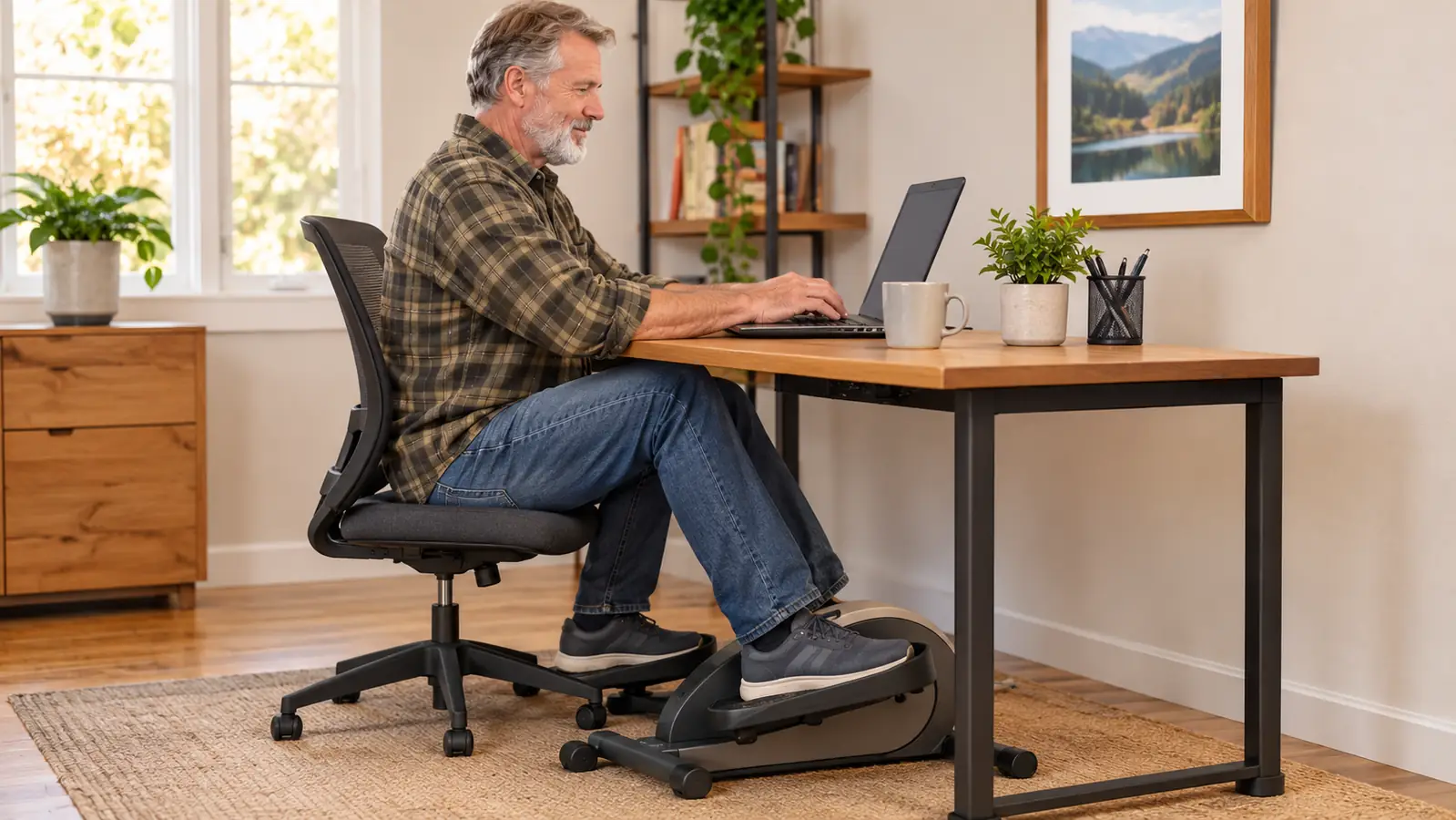
Cubii wins on the thing that matters most to me: a daily routine I can trust. I do not need a machine that folds into a closet. I need a machine that is in the same spot every morning, that does not slide, and that lets me add resistance one notch at a time. The 8 resistance levels are the reason I kept using it. In January I started at level one for 10 minutes. By March I could do 20 minutes at level three without my knee talking to me the next day. That is not a dramatic story. It is a real one. I keep a sticky note on the side table with the date and the level, because at 68 I do not trust my memory for that kind of thing. February 3 is the one I remember. It snowed nine inches that morning, the neighbor did not come by for our walk, and I still did 15 minutes at level two. That note is the closest thing I have to a training log, and it is what got me to March. The Cubii JR1 also has an 18-inch maximum stride and an elliptical path. I notice that most in my right knee. The longer path lets me push back instead of up, and I can keep my heel from lifting. It does not make the machine a medical device. It makes it easier to stay in the chair for 20 minutes.
Cubii also wins on steadiness, tracking, and the details I checked before I ordered. My exercise room has carpet, and the basic pedal unit I tried would creep forward when I pushed hard. I ended up putting a rubber mat under it. The Cubii weighs 25.4 pounds and measures 23.2 inches deep by 17.56 inches wide by 10 inches high. It sits still. I still use a mat because I like my carpet, but I am not chasing the machine across the room. The built-in LCD display tracks calories burned and other progress numbers. The machine is battery powered, so there is no cord to trip over in the dark. The Cubii mobile app does not sync by itself; you enter the numbers from the display by hand. I know that sounds old-fashioned, but I like it. I write the number in a little notebook and I can see that I did 12 minutes on Monday and 18 on Wednesday. The maximum weight recommendation is 150 pounds, so check that number before you order. The warranty information is on the package, so keep the paperwork.
Where a Basic Pedal Exerciser Wins
A basic pedal exerciser wins on portability and simplicity. It is light. You can pick it up with one hand, carry it to the living room, and put it in front of the TV. If your grandchildren visit and you need the floor clear, you can slide it behind a chair. The Cubii is 25.4 pounds and 23.2 inches deep. It is not hard to move, but you are not going to tuck it into a suitcase. The basic unit is also easier to share. If Gene wants to try it for five minutes, he can. There is less to learn. There is no display to figure out, no app entry, no resistance setting to think about beyond a knob. You sit down and pedal. When you are 71 and set in your ways, that counts for something.
The basic unit also wins if you are not sure this habit will stick. It asks less of you. I know people who bought a fancier machine and used it three times. I also know people who used a simple pedaler every day for a year because it was the only thing in the room. The right machine is the one you will actually use. If simplicity is what gets you in the chair, the basic pedal exerciser is not a compromise. It is the honest choice. My neighbor Deb loaned me hers for two weeks in November, and I kept it in the living room so I could pedal during the noon news. It worked fine. I did 12 minutes one day and 6 the next, and I never once thought about resistance levels. When she asked for it back, I noticed I missed the pedaling more than I missed the machine, and that told me something. It is also the better choice if you travel to see your grandchildren and want something that fits in the car. The Cubii is a stay-at-home machine. The basic pedaler is the one you can take with you. That is a real difference, and it is the reason I would not tell everyone to buy the Cubii.
If you want one steady machine for a daily seated routine, start with the Cubii JR1
The 8 resistance levels, the 18-inch stride, and the 25.4-pound frame are the reasons I keep it in my exercise room. Check the maximum weight recommendation and the footprint against your own space before you order.
Amazon Check Availability on Amazon →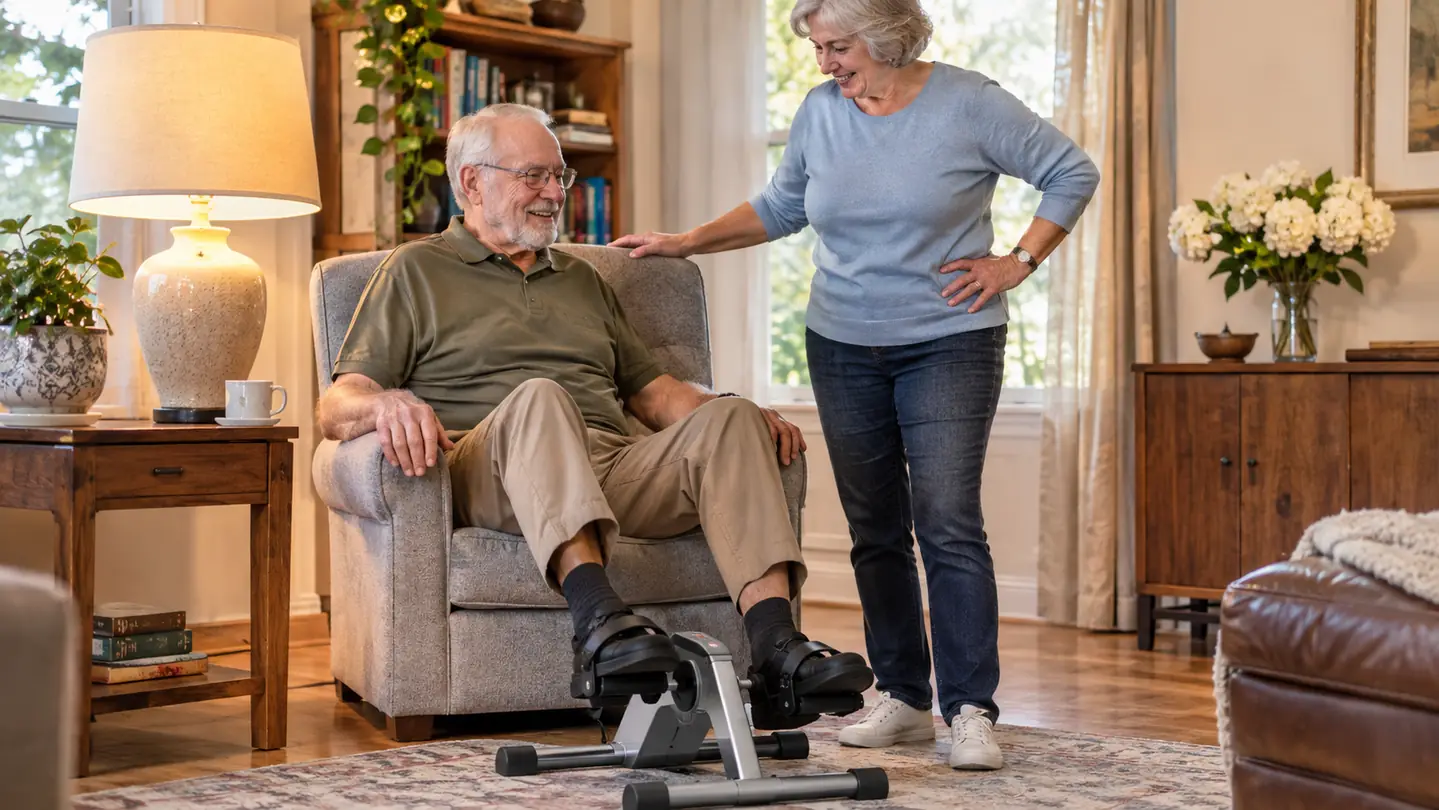
Who Should Buy Which
Buy the Cubii JR1 if you are looking for a daily habit, you have a knee or hip that does better with a longer, smoother pedal path, and you want to see progress in numbers. It is also the better fit if your machine will live in one spot and you want it to stay there. The 8 resistance levels give you room to start slow and build. The built-in display gives you a reason to come back tomorrow. The 25.4-pound frame means you are not fighting the machine for space on the carpet. My right knee has mild osteoarthritis, and my doctor's advice was to keep moving and build the muscles that support the joint. That is the whole reason I care about a smooth pedal path and a machine that does not scoot. If you have arthritic knees and you want to exercise in a chair without your feet slipping off tiny pedals, this is the machine I would point you toward.
Buy a basic pedal exerciser if you want to test the idea before you commit to a permanent spot, if you travel, or if you live in a small apartment where every piece of equipment has to move. It is also the better choice if you know yourself well enough to know that a display and an app will just be one more thing to ignore. There is no shame in choosing the simple tool. The goal is movement, not a collection of features. If you are buying for a parent or grandparent, ask what they will actually use. A machine that is easy to move may get used more than a machine with a screen.
There is a middle path, too. Some people start with a basic pedal exerciser for a month, see whether their knee tolerates seated exercise, and then move up to a Cubii. I did something close to that with Deb's borrowed unit, and I learned two things: I would actually do 20 minutes in a chair, and I hated chasing the pedals across the carpet. That is when I started reading about the Cubii JR1. You do not have to copy my path. But it is one way to be honest with yourself before you make a purchase.
One more thing: if your doctor has told you to avoid certain knee angles, or if you have had a joint replacement, ask before you start. Start with five minutes, no resistance, and your chair pulled close enough that you are not reaching. Keep your feet flat on the pedals and your back against the chair. If your knee hurts during the movement, stop. If it hurts an hour later, make the next session shorter. That advice applies to both machines. The Cubii's 8 resistance levels make it easy to forget that you are supposed to start at the bottom. I did that. I set it to level three on the first day because level one felt like nothing. My knee reminded me the next morning that I am 68, not 38. Also check the floor. A thick rug can make any pedal machine wobble. A firm mat helps. Keep the machine out of the walking path to the bathroom at night. If you have balance problems, sit in a chair with arms, and put the machine where you can hold the chair back while you get seated.
Before you decide, measure the spot where the machine will live. Write down the width of the chair, the distance to the wall, and whether you need to walk past it to reach a closet. The Cubii is 23.2 inches deep and 17.56 inches wide, and it is 10 inches high. A basic pedaler may be smaller, but it may also slide. Put a tape measure on the floor and sit in the chair with your feet where the pedals would be. I did that on a Saturday afternoon with a pencil and a scrap of paper, then made Gene stand in the doorway and tell me whether he could still get past to the closet. He could, with about a foot to spare, and that settled it. If your knees are higher than your hips, the chair is too low. If you have to lean forward to reach the pedals, the machine is too far away. This sounds fussy, but it is the difference between a machine you use and a machine you step around. I learned that the hard way with a folding treadmill that became a coat rack.
The Cubii JR1 is the one I would keep in my exercise room
It is not the smallest or the simplest machine you can put under a chair. It is the one that stayed put, let me start at level one, and gave me a number to write down. If that sounds like the routine you want, look at the specs and the maximum weight recommendation first.
Amazon Check Availability on Amazon →