
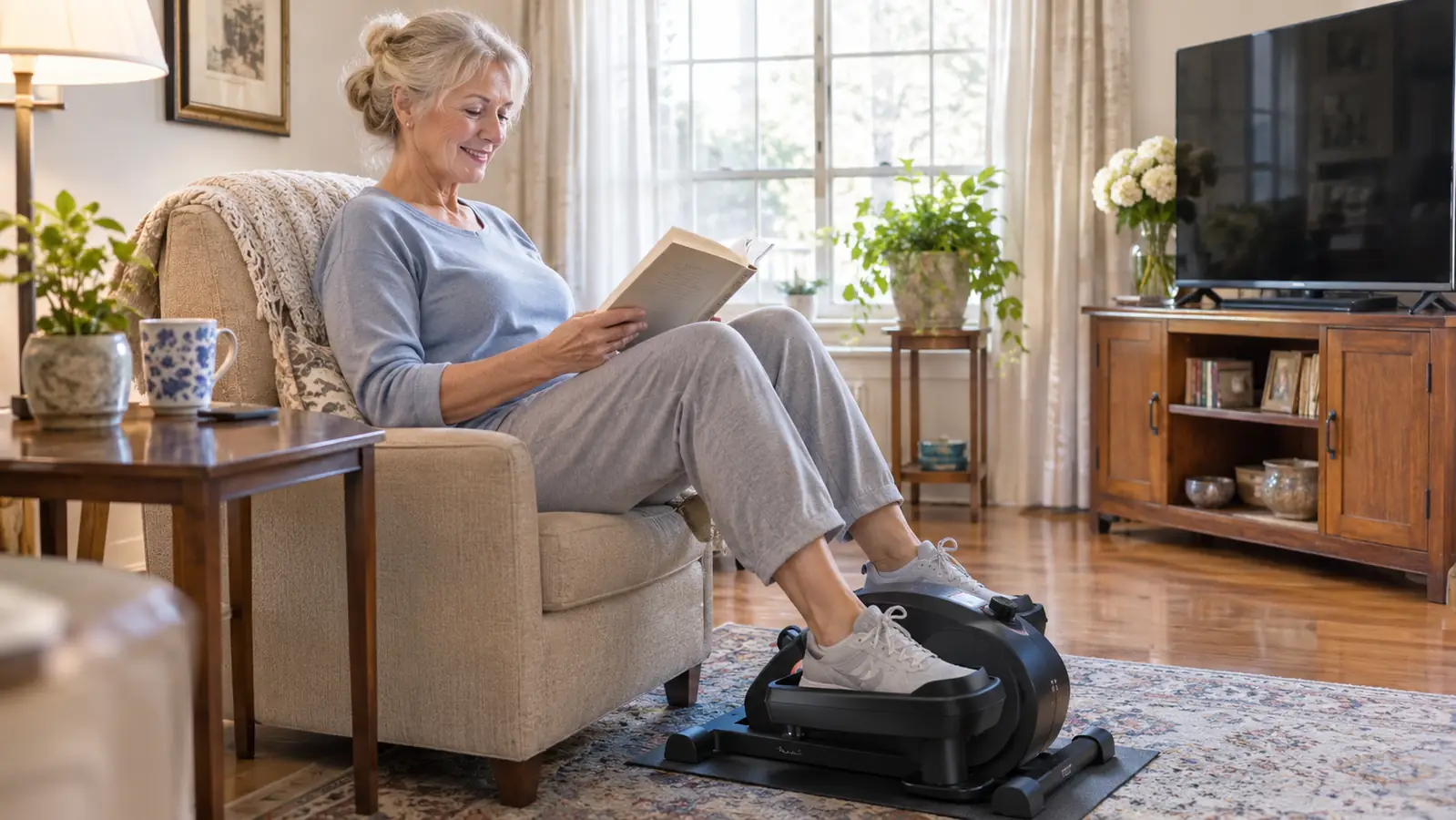
I bought the Cubii JR1 for one reason. My right knee ached every single morning, my doctor told me that sitting still was the worst thing I could do for it, and I live in a one-story ranch house outside Flint, Michigan, where the sidewalk turns to ice around the first week of November and does not thaw until March. I am 68 years old and I taught third grade for 31 years, so I know exactly how far good intentions get you when the weather is against you. Walking outdoors was not going to happen for five months of the year. So I ordered the Cubii JR1, carried the box into the spare bedroom I call the exercise room, and sat down on a kitchen chair.
That was a year and a half ago. I still use it most mornings, after coffee, for about 20 minutes. Gene tried it for a week and handed it back to me. Nothing about it is dramatic. But this is the honest review I wish I had read before I ordered, and the short version is that the Cubii JR1 is a well-built little machine with three limitations the listing does not spell out. Whether it suits you depends entirely on what you expect it to do.
The Quick Verdict
It got me moving on mornings I would otherwise have spent sitting, and it has held up for eighteen months without a repair. It is not cardio, the display is basic, and the weight limit is lower than most people guess.
Amazon Check Today's Price →The one piece of home equipment I still use eighteen months later
Eight resistance levels, a battery-powered LCD display, and no cord to trip over on a carpeted floor. Check today's price on Amazon.
Amazon Check Today's Price on Amazon →How I've Used It
The machine sits on the carpet in the exercise room, in front of a small television, beside the chair I dragged in from the kitchen. I sit down, put my feet on the pedals, set the resistance by hand, and pedal for 20 minutes while the morning news runs. Sometimes I do it in the living room instead, and that is the only real advantage of a machine that runs on batteries. There is no cord to reach for and no outlet to hunt down behind the sofa.
I set it up wrong the first time. The machine wants a flat, firm surface, and I had it half on the carpet and half on the edge of a doormat I had dragged in to keep the carpet clean, and it rocked under me. It took an embarrassing while to work out that the doormat was the problem and not the machine. Once it sat flat on the carpet it was steady, and it has been steady in that same square of floor for eighteen months. The other thing I got wrong was the chair. I started with an armchair, which put my knees too high and made the pedals feel like they were in the wrong place entirely. I switched to a plain kitchen chair with a firm flat seat, and that was the fix. If you try it from something soft and it feels wrong, try a hard chair before you decide anything.
The first week, 10 minutes was plenty. My knee did not hurt during the session, but the muscles above it were tired in a way that surprised me, and I was stiff for two days after the first few tries. I backed off to every other morning and stayed at the lowest resistance for about three weeks before I moved up. That is what I would tell anyone starting out. The machine invites you to overdo it because it feels like nothing while you are on it. The bill arrives the next day.
Eighteen months in, I am at resistance three or four for 20 to 25 minutes, five or six mornings a week. I do not track it any more closely than that. What I notice is on the stairs. There is a set of seven steps down to the basement where the washer lives, and a year ago I took them one at a time with a hand on the rail. I still use the rail. I no longer think about it first.
What Nobody Tells You About the Eight Resistance Levels
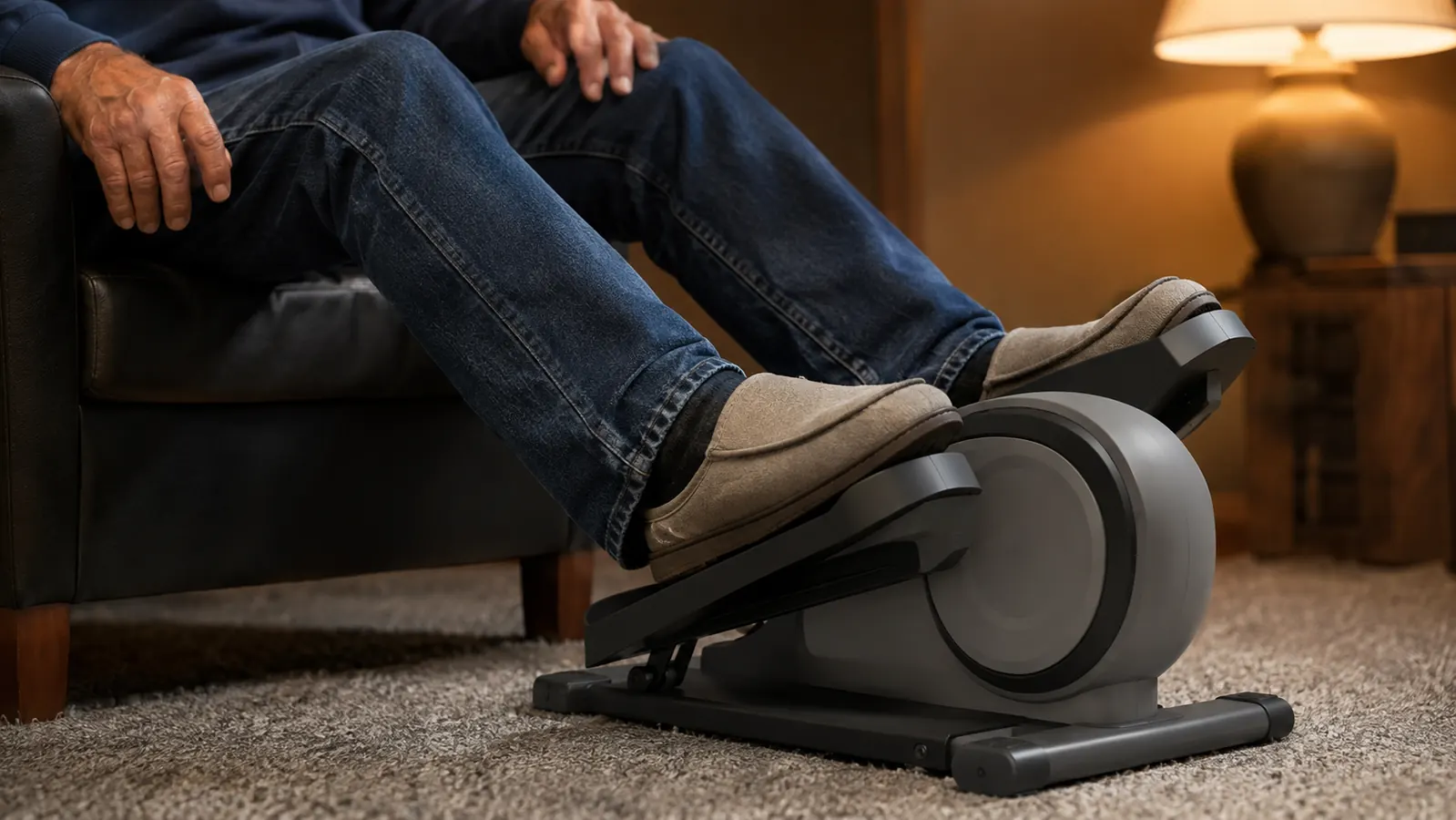
The Cubii JR1 has eight resistance levels, and you change them by hand. Nothing about the resistance is electronic. There is no program that ramps up for you and no console setting to fiddle with mid-session. That is not a complaint, since it is also the reason there is so little to break. But it does mean the session is exactly as hard as you decide to make it, and for a person who is not naturally disciplined, that is worth knowing before you buy.
Here is the part nobody mentions. Level one is extremely light. Level eight is not a gym. The whole range is gentle, which is precisely right for a 68-year-old with a cranky knee and precisely wrong for anyone hoping to replace a treadmill. I have never gone above five and I do not expect to. If you want to finish a session winded, this is the wrong machine and I would rather tell you that now.
I keep a small card taped to the side of the television with the numbers on it, because I forget where I left off. Level one for the first three weeks. Level two for the next month. I moved to three in the spring and stayed there until fall. There is no rule printed anywhere about when to go up, so I made one: if I could do 20 minutes at a level for a full week and still take the basement stairs normally on a Saturday, I moved up one. If my knee was grumbly on a Thursday, I dropped back for a day and thought nothing of it. That card has been the most useful piece of equipment in the room, and it is a piece of paper.
The other thing is the quiet. I expected a cheap squeak and got almost nothing. Gene watches the news two feet away and has never once asked me to turn it down. Around month ten I put a drop of oil on the moving joints, more out of habit than need, and it made no difference I could hear. For a house with one television and two retired people in it, that matters more than any specification on the box.
The Display, the App, and What It Actually Tracks
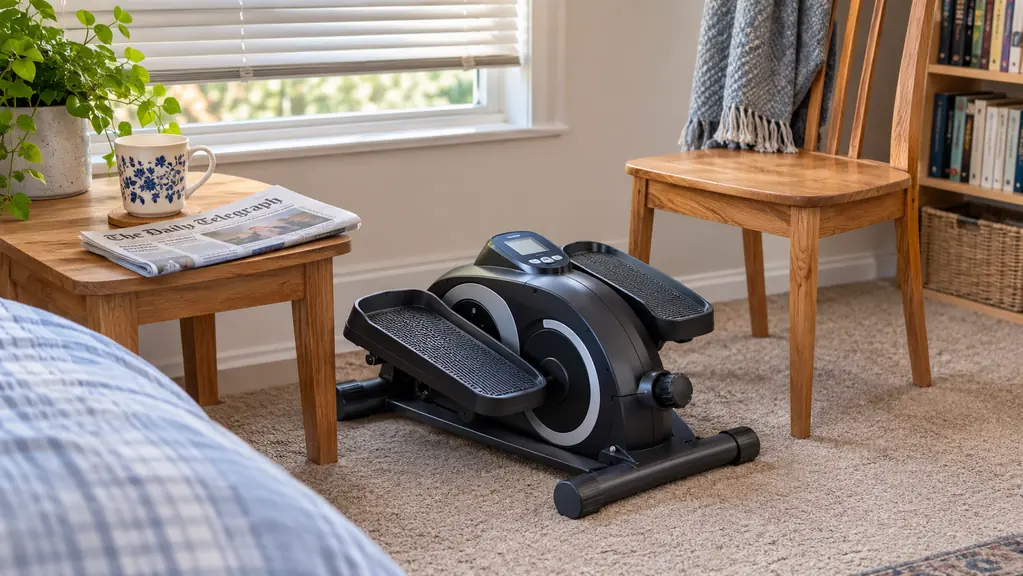
The console is a small LCD readout that runs on batteries and tracks calories burned along with the other numbers from your session. It is legible if you tilt it toward you and lean back a little. It is plain, and it does what it says. Mine has been on the same batteries since the day I bought the machine, which tells you how little power a small display asks for.
Cubii also makes a mobile app, and this is the part the listing slides past. The app does not talk to the machine. There is no pairing step, no automatic upload, no history that appears by itself. You read the numbers off the LCD display and type them into the app yourself if you want a record. I did that for about three weeks. Then I stopped, because I can see the display from the chair and I know what 20 minutes feels like.
I want to describe that honestly, because I think people picture something different. You open the app, you lean forward and read your display, and then you enter your time and the calories it shows by hand, one field at a time. Then it draws you a little chart. The chart was genuinely nice. I liked watching the columns stack up during those first three weeks, and I will admit I felt a small pang when I quit. But the columns only existed because I typed them, and there came a morning when I finished my 20 minutes, looked at the numbers, and decided I would rather go start the coffee than copy figures onto a telephone. That was the end of the chart. I do not miss it and I do not think less of the machine for it.
I want to be fair here. The manual entry is not a trick and it is not a hidden charge. It is simply what the machine is. But if you are the sort of person who needs a chart and a streak to keep going, know in advance that you will be building that chart yourself, one number at a time, from a display you have to read before you stand up.
Eight levels, no cord, and a display you read yourself
The resistance is mechanical and the machine runs on batteries, so there is nothing to plug in and nothing to pair. Check today's price on Amazon.
Amazon See It on Amazon →Three Complaints I Can't Talk Myself Out Of
First, the maximum weight recommendation is 150 pounds. That is the number in the specifications, and it is lower than most people assume when they look at a machine this size. I am well under it, so it has never mattered to me. Gene is a good deal heavier than I am and he does not use it, and that is the honest reason why. If you or the person you are buying for is above that number, this is not the product, and no amount of good reviews changes it.
Second, the machine is 25.4 pounds and about 23 inches deep and 17 and a half inches wide. That is not heavy by exercise equipment standards. It is heavy enough that I do not carry it from room to room, and it is wide enough that it lives on the floor rather than tucked away in a closet. Mine has one spot. It stays in that spot. If you pictured moving something to the couch and back each evening, lower that expectation before you order.
I will add the measurement advice nobody gives you. Before it arrived I took a tape measure to the floor between the television stand and the wall and found I had about 26 inches of depth to work with, against the 23.2 inches the machine needs, so I knew it would fit with a little room for my heels. Ten inches high is low enough that it slides under the edge of a desk, which is what Cubii built it for, but low also means it is a thing you step over rather than around. I have caught my toe on it twice in eighteen months, both times in the dark, both times my own fault.
Third, the stride is short. The maximum stride length is 18 inches, which is a great deal less than a walk and considerably less than what you would get on a full elliptical. Nobody is going to mistake this for walking. It is pedaling while seated, and the motion is small. My knee likes small. A person looking for a cardiovascular workout will be disappointed, and I would rather say so plainly than have someone find out in the first week.
One more thing that is not a defect but is worth knowing. The position takes some fiddling. I sit far enough back that my knees do not bump the front of the machine, and Gene had to move the chair back further still. It took us both about a week to find the seat distance that let us go 20 minutes without thinking about our knees. Expect that week. It is not a sign that the machine is wrong for you.
What It Changed and What It Didn't
What it changed is small and real. I move on mornings when I would otherwise have sat with the newspaper and a second cup of coffee. Twenty minutes on resistance three, five mornings a week, is six or seven hours a month of gentle movement I was not doing before. My doctor is pleased. My knee is quieter on the stairs. I have not lost weight and I did not expect to.
There is one day I can point to. It was the second week of April, the ice was finally off the driveway, and I walked to the end of the road and back with my neighbor the way I always do once the weather breaks. In past years that first long walk of the season left me sore for two days, in the shins and in the knee together. Last spring I was sore in the shins and not in the knee. That is not a study. It is one woman, one walk, and one spring. But it is the reason I have not carried the machine out of the exercise room, and the reason I still climb on it at resistance three on mornings when I could just as easily sit down.
What it did not change is everything else. It did not fix my balance, which is the thing that actually put me on the ground two winters ago. It did not replace the walking I do with a neighbor in the warmer months, and it will not replace it in April either. It is one tool, in one room, for one problem: keeping the joint and the muscles around it moving when the sidewalk is ice. Treated that way, it has earned its floor space.
What I Liked
- Quiet enough to use two feet from someone watching television
- Runs on batteries, so there is no cord to trip over on carpet
- Eight resistance levels, all of them gentle, changed by hand
- Held up for eighteen months of near-daily use with no repairs
- Short stride that a sore knee tolerates on the first try
Where It Falls Short
- Maximum weight recommendation is 150 pounds
- 25.4 pounds and about 23 inches deep, so it lives in one spot
- The app does not sync. You type the numbers in yourself
- A short stride, 18 inches at most, so it is not a cardio workout
- Finding the right chair distance takes about a week
There are seven steps down to the basement, and a year ago I took them one at a time with a hand on the rail. I still use the rail. I no longer think about it first.
Who This Is For
This is for the person who has been told to keep moving and cannot get outside to do it. If you have a sore knee, a stiff hip, or a doctor who has said the words use it or lose it, and if your alternative is a recliner and a television, the Cubii JR1 is a reasonable answer. It is also good for anyone who works at a desk at home and wants their legs doing something while they sit.
It suits people who are already comfortable sitting on a kitchen chair for half an hour and who can get down onto a low pedal and back up again without help. It suits people who like a plain machine with no screen to negotiate and no account to set up. And it suits the person buying for a parent, provided that parent is under the weight limit and willing to sit down with it five mornings a week.
Who Should Skip It
Skip it if you want to be out of breath. Eight gentle levels are not a cardio program, and there is no version of this machine that raises your heart rate the way a walk up a hill does. Skip it if you are above 150 pounds, because the specification is the specification and wanting it very much does not change the number.
Skip it if you need an app to do the remembering for you, since this one will not. Skip it if standing up from a low chair is uncertain without something to hold, because that is the transition you will make twice a day. And skip it if you want one machine that does everything, because this one does one small thing well and nothing else at all.
If your doctor said keep moving, this is the version that fits in a spare bedroom
Eight resistance levels, a battery-powered display, and a machine that has run for eighteen months in my exercise room without a single repair. Check today's price on Amazon, and start at level one.
Amazon Check Today's Price on Amazon →