
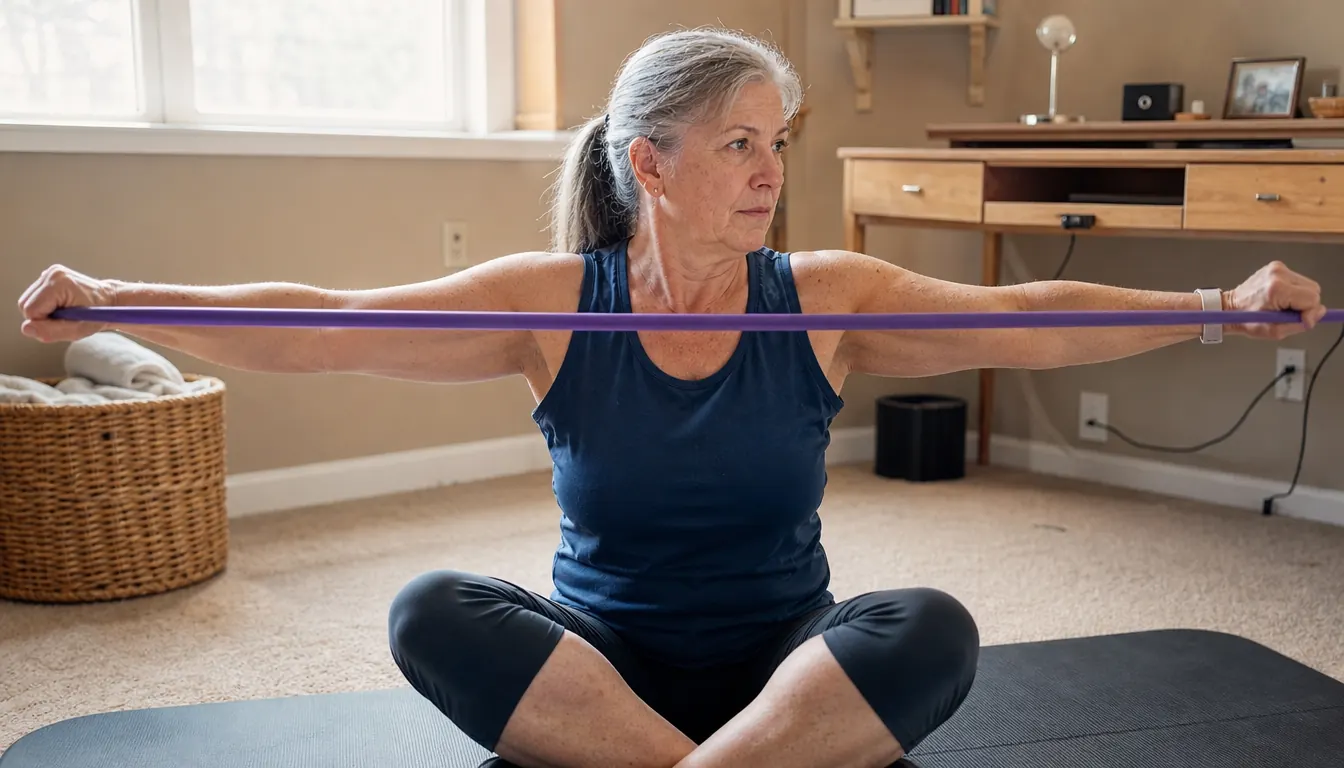
I ordered the THERABAND resistance band set in January, about three weeks after my right knee went out on the back steps, and I want to write down the parts of that purchase the glowing reviews leave out. Not because the bands are bad. They are not bad at all, and I still use mine four mornings a week. But a set of three flat rubber bands that together weigh less than two ounces is an odd thing to recommend without a warning label attached, and nearly everything I read before I ordered made it sound as though the difficult part was deciding to buy them. The difficult part was everything that came after the envelope landed on the kitchen table.
I am 68 years old. I taught third grade for 31 years, and I retired with a right knee that has mild osteoarthritis and a wariness of icy pavement I did not have before I fell on my own driveway two winters ago. My doctor's advice was plain and unexciting: keep moving, strengthen the muscles that support the knee, do not stop. Gene and I live in a one-story ranch outside Flint, and from November to March the yard is either frozen or mud, so whatever I did had to happen indoors. I turned the spare bedroom into an exercise room, kept the mat I already had, and went looking for something that would not take up space or frighten me.
The Quick Verdict
A genuinely useful starter set for anyone who needs light tension and a small footprint. I outgrew the heaviest band in about three months, and the set should come with an anchor.
Amazon Check Today's Price →Three Bands, Two Ounces, One Place to Start
Light tension, non-latex, five feet long and four inches wide. If your doctor told you to build strength slowly, this is the least intimidating way I have found to begin.
Amazon Check Today's Price on Amazon →What Nobody Tells You Before the Envelope Arrives
Nobody tells you how little there is to the product. There is no frame, no handle, no anchor, no door strap, and no instruction booklet worth the paper. What arrives is three flat bands, each five feet long and four inches wide, each a different tension, folded into a mailer. That is the whole thing. I opened it on the kitchen table and thought, for a moment, that I had been sent a sample by mistake.
The second thing nobody tells you is that this is not a defect. A band is not a machine. It cannot do the movement for you, it cannot correct your posture, and it cannot make you want to use it on a Tuesday in February. What it can do is live in a drawer without offending anyone and be ready in the ten seconds it takes to unfold. For a person whose real obstacle is dread, that turned out to matter more than any feature printed on the box.
The third thing is that the tensions are genuinely light, and the numbers read like a misprint the first time you see them. The three bands are rated 3 to 4.3 pounds, 3.7 to 5.5 pounds, and 4.6 to 6.7 pounds. I held the heaviest one up and thought, this cannot possibly be enough to change anything. It was enough. When you are rebuilding a knee at my age, the goal on day one is not a hard workout. The goal is to finish something and still be able to walk to the mailbox without thinking about it.
The fourth thing is the anchoring problem, and it is the one I most wish someone had mentioned. These are flat bands, not loops, so any movement that needs a fixed end means finding a fixed end. I have used a doorknob, the leg of the heavy oak desk in the spare room, and a loop I tied myself at one end. The first week was mostly deciding where to put the other end. That is not difficult, but it is not obvious either, and the envelope contained nothing that explained it. What I tried first was the doorknob on the exercise room door, and it failed for a reason I should have seen coming: the knob is round and smooth, and a flat band laid over it slides toward the hinge the moment you pull. The closet rod was my second attempt and it bent. What finally held was the leg of the oak desk, heavy enough not to shift and wide enough that the band sits flat against it. I measured the band out to its full 60 inches on the carpet that first week, then knotted off about a foot so the working length suited a seated position. That knot has stayed where I put it since.
How I've Used Them, Morning by Morning
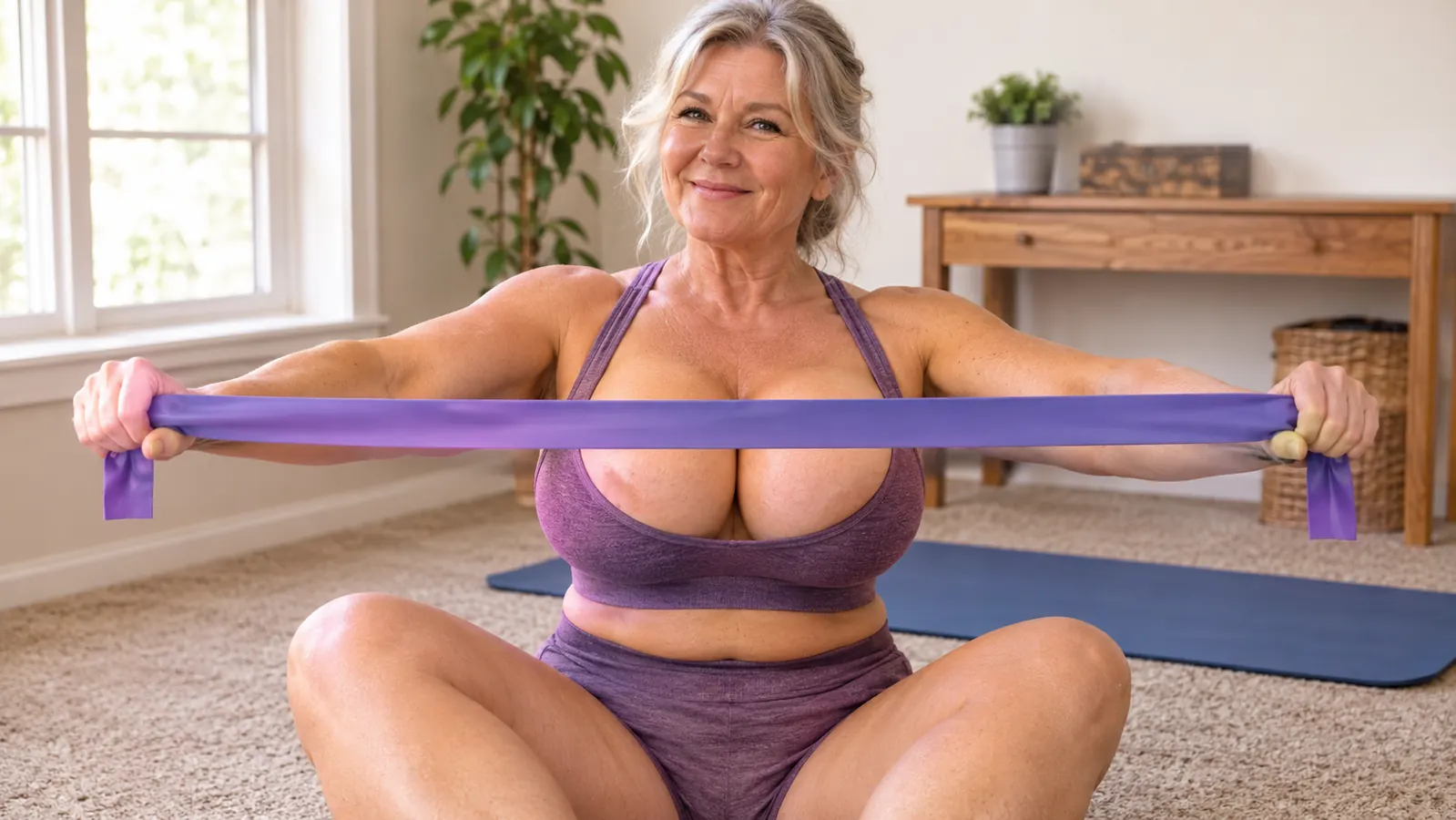
My routine is short and I am not going to dress it up. After coffee, before Gene starts the crossword, I go into the spare bedroom, unfold one band, and work for about twenty minutes. Three mornings a week I do seated leg extensions with the band knotted around the desk leg, then standing side steps with the band just above my knees, then a slow rowing motion for my upper back. On the off mornings I do a shorter version, mostly the leg work, because the leg work is the whole reason I started. I work barefoot on the carpet, which I mention only because it made a difference in how steady I felt.
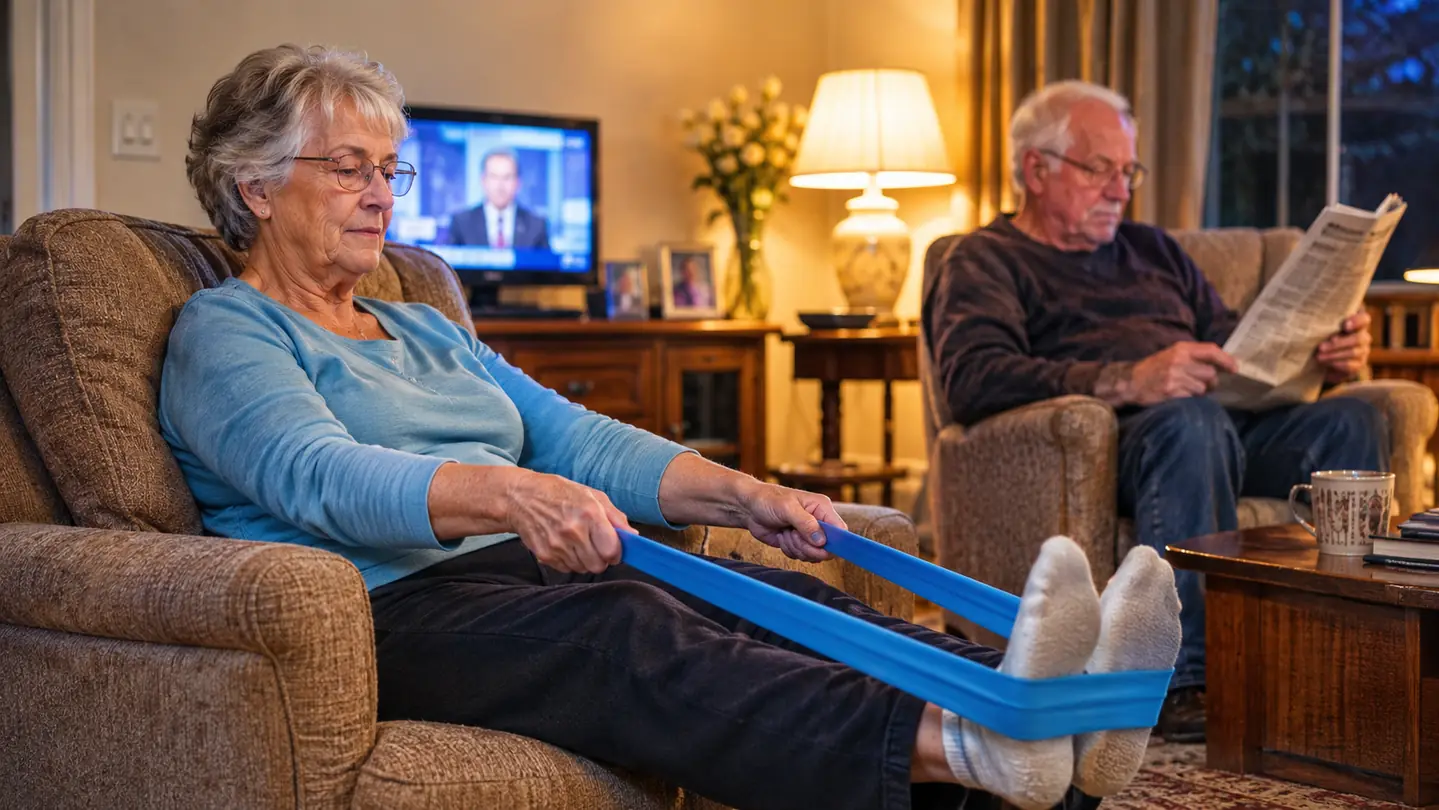
The living room is my second spot. Gene watches the news at six and I sit in the chair with a band around my feet doing ankle work while the weather comes on. Nobody would film that for a commercial, but it is the kind of thing that actually happens in a house at our age, and it has added up. Between the two rooms I have missed maybe a dozen mornings since January, and every one was because I was visiting my daughter in Grand Blanc, not because I did not want to. There was an ice storm the second week of February that kept my walking neighbor and me off the sidewalk for eleven days running. In past winters that would have been eleven days of nothing at all. That year it was eleven days of ankle work in the armchair with the weather map on the screen, and when the sidewalk finally cleared I walked to the corner without the wobble I had felt in December.
One thing I would say to anyone starting: write down what you did. I keep a small notebook on the desk and each morning gets a line, the band I used and the repetitions I managed. It looks fussy. It is not. Around week six I could see in my own handwriting that I had gone from eight repetitions to fifteen, and that was the first real evidence I had that any of it was working. The knee still ached. It ached less, and I could point to why.
What the Three Tensions Actually Feel Like
The lightest band carried me through the first month, and it taught me something I did not expect. I had assumed I would start in the middle and work up. The lightest band humbled me in the good way. I could finish a full set with it, and finishing a full set turned out to matter more to my confidence than struggling through half of one with something heavier. There is a stretch of about six weeks at the beginning where the right choice is almost always the easier band. Nobody says that out loud because it does not sound impressive.
By the third month I had moved to the middle band for legs and stayed on the lightest one for anything involving my shoulders, which have their own opinions after 31 years of writing on a chalkboard. The heaviest band is for legs only, and I still cannot do much with it. That is the honest ceiling of this set. It is a starter set and a therapy set, and the day will come when the heaviest band here is not enough for someone who keeps at it.
I can see that day from where I stand, and I do not resent it. When it arrives I will buy a heavier band and keep these three for the light days and for travel. A set that gets outgrown has done its job. What I would not do is pretend the ceiling is higher than it is, because a man of 45 who lifts on weekends will find this set useless and will say so in a review, and he will be right for him and wrong for me.
The heaviest band in the set is rated 6.7 pounds. That sounds like nothing until you are the one lifting your own foot off the floor with a bad knee, and then it sounds exactly right.
The Thing I Got Wrong First
For the first three weeks I treated the band like a weight and tried to reach the heaviest one as fast as I could. That was a mistake, and my knee told me so on a Thursday morning in February when I stood up off the mat and had to hold the door frame for a moment. I had the heaviest band knotted around the desk leg and I was doing standing side steps, counting to twenty because twenty sounded like a number a serious person would do. I sat back down, waited a minute, and stood again. It held, but it complained for the rest of the day and most of the next one. Nothing tore. Nothing was damaged. But I had been rushing, and the rush cost me about ten days of doing almost nothing, which is the worst possible outcome when the entire point is consistency.
What I do now is duller and it works. I choose a band I can move through fifteen slow repetitions with, not fifteen fast ones, and I stop while I could still do three more. My physical therapist called that leaving a little in the tank, and at 68 it is the most useful phrase anyone has handed me about exercise. If you take one thing from this review, take that. The band is a tool. The patience is the treatment.
Where They Fell Short, and I Will Be Specific
There is no anchor in the set. This is my largest complaint and it has not softened in nine months. A simple door anchor would have changed what I could do in the first month, and its absence means you improvise, and improvising with a band around a doorknob is exactly how a person my age ends up with a band that slips and a shoulder that hurts. If you buy this set, get an anchor at the same time. That advice is not in the listing and it should be.
The band I knot most often has begun to look tired at the knot. Not torn, but whitened and a little ragged where the tie sits, and I do not expect that particular band to last forever. A flat band that gets tied and untied several times a week is being asked to do something it was not made for. That is on me rather than on THERABAND, but it belongs in an honest review, because it is part of what nine months of real use looks like.
The instruction card is thin. It shows a handful of movements and leaves you to work out the rest. That was fine for me because my physical therapist had already walked me through the ones I needed. If you do not have that, you will end up on the internet, and the internet will show you a 24-year-old doing things with a band that no one in their sixties should attempt in week one. A short written progression for older adults from THERABAND would have been worth more than the illustrations.
What I Liked
- Light tensions that let a beginner or a rehab patient start on day one without fear
- Three bands, three levels, one small mailer that fits in a desk drawer
- Non-latex material, which matters if latex irritates your skin
- Five feet long and four inches wide, enough length to knot and still have room
- All three bands have survived nine months of four-mornings-a-week use
Where It Falls Short
- No anchor or door strap included, so you improvise from day one
- The heaviest band is still light, and steady users will outgrow the set
- Instructions are minimal, with no written progression for older adults
- A band that gets knotted repeatedly will start to fray at the knot
How They've Held Up
Nine months in, all three bands are still usable and none has snapped, which I half expected after reading about other sets. I store mine folded in the top drawer of the desk, out of sunlight, and I do not leave them on the floor where someone can step on them. That last point matters more than people think. A rubber band left stretched around a chair leg for a month will lose its manners and never quite come back. In March I took all three out to the window one afternoon and held them up to the light the way you hold up a bicycle tire, looking for the thin spots. The lightest one still looked new. I put them back in the drawer satisfied.
The two bands I use most have gone slightly dull where my hands grip, and the surface picks up lint from the carpet, which a damp cloth fixes. There is no cracking and no change in how they pull. For something that weighs less than a letter and lives in a drawer, I consider that fair service. I expect to replace them eventually. I do not expect it to be soon.
Who This Is For
If you are past 60, if a doctor or a physical therapist has told you to build strength slowly, and if you need something you can do in a spare bedroom or in front of the television, this is a sensible first purchase. It suits anyone whose starting point is a body that has been out of the habit for a while and who is more afraid of an injury than of not working hard enough. It also suits a traveler, because the whole set weighs less than two ounces and fits in a handbag.
Who Should Skip It
If you already train with weights, skip it. The heaviest band here is rated 6.7 pounds and you will exhaust it inside a week. If you want a complete home gym in a box with handles, anchors and a wall chart, skip it, because this is three bands and nothing else. And if you are hoping a band will fix a knee rather than strengthen the muscles around it, skip it and see your doctor, because no band on the market does the first thing and the packaging should not imply otherwise.
Start With the Lightest Band and a Notebook
Nine months, four mornings a week, three bands, one drawer. If your doctor has cleared you to move, this is a gentle way to begin and a simple thing to set aside if it does not suit you.
Amazon See Current Price on Amazon →