

Two kinds of resistance bands end up in the hands of people over sixty: the wide flat bands a physical therapist folds into your hand at the clinic, and the closed loops that arrive in a five-pack with a mesh bag. I have used both in the spare bedroom of my ranch house outside Flint, Michigan, through two winters of a stiff right knee and one lingering memory of a slip on an icy driveway. Here is the short answer. THERABAND flat bands are better for shoulders, elbows, wrists, and slow rehab work where a one-pound jump matters. Loop bands are better for hips, thighs, and any movement where you want the band to stay put around your ankles. Most people my age end up wanting one of each, but the order you buy them in matters more than I expected.
I am not a trainer and I do not play one on the internet. I taught third grade for thirty-one years, and I explain things the way I used to explain long division, one step at a time, with the slow part repeated. My doctor told me to keep moving and build the muscles that support the knee. So I did what I always do when I do not know something. I read, I asked questions, and then I bought the wrong thing first. This comparison is the page I wish someone had handed me before I spent a winter figuring it out on my own.
| THERABAND flat bands | Loop resistance bands | |
|---|---|---|
| Tension range | Three light levels, about 3 to 6.7 lbs | Usually five levels, including medium and heavy |
| Grip for stiff hands | Four-inch width gives a broad surface, and you can knot it to any length | Quick to hold, but a narrow latex loop can roll in the palm |
| Hip and leg work | Has to be tied into a loop and retied when the length changes | Ready-made loop sits above the knees or around the ankles |
| Progression steps | Roughly one-pound steps between bands | Bigger jumps between levels |
| Material | Non-latex synthetic rubber and TPE | Most are latex, which dries out over time |
| Anchoring for rows | Knot one end around a door handle or post | Awkward to shorten for a row |
| Storage and travel | Folds flat, about 1.6 ounces for the set | Bulkier, and the mesh bag is not decorative |
| Durability | Thin edges can nick on a door latch | Fabric loops resist nicks, latex loops go tacky |
| Best for | Shoulders, arms, rehab, gentle range of motion | Hips, glutes, sidesteps, standing leg work |
Where THERABAND Wins
The flat band wins on small steps. THERABAND sells this set in three light tensions, listed at roughly 3 to 4.3 pounds, 3.7 to 5.5 pounds, and 4.6 to 6.7 pounds. On paper those numbers look almost the same, and that is exactly the point. When my right shoulder is angry after a morning of raking leaves, the difference between the lightest band and the middle one is the difference between a stretch I can finish and a stretch I quit halfway. A loop set usually jumps from light to medium to heavy with bigger gaps between them, and I have watched people my age grab the heavy one because the medium felt like nothing, then pay for it for three days.
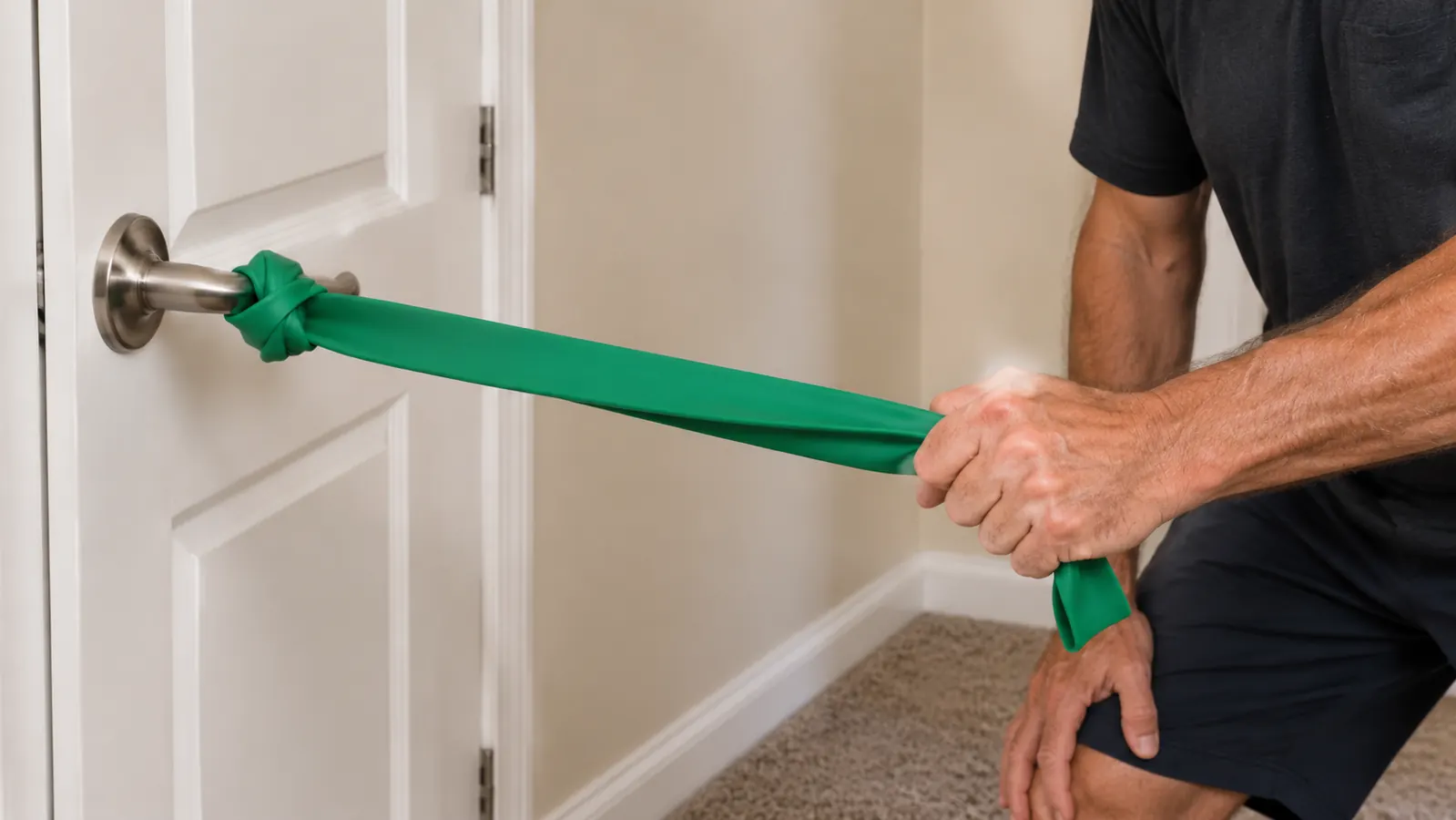
The second win is the shape. Each band is five feet long and four inches wide, which gives you a broad surface to wrap around your palm instead of a thin loop cutting into your fingers. Arthritis lives in the base of my thumb, and a narrow latex loop rolled up small is the wrong thing to squeeze first thing in the morning. With the flat band I can take up the slack in my fist, knot one end around a door handle, and do a row without a handle, a clip, or a door anchor I have to install and then explain to Gene. The set is also non-latex, made from synthetic rubber and a thermoplastic elastomer, which matters if you have ever had a reaction or if your skin is simply sensitive after a shower.
Where Loop Bands Win
Loop bands win on legs, and it is not close. My physical therapist gave me a closed loop for hip work, the kind where you put the band just above the knees and take small steps sideways. A flat band can do that job, but only after you tie it into a loop, and the knot has to be retied every time you change the length. Tied too long, it slides down toward your ankles. Tied too short, it digs in and you spend the whole set thinking about your thigh instead of your hip. The ready-made loop just sits where you put it. For clamshells, sidesteps, and the standing leg lifts I do holding the back of a kitchen chair, the loop is the tool that lets me think about the muscle I am supposed to be using.
Loop bands also win on getting started. You step into one and you are exercising. There is no door, no anchor, no knot, and nothing to shorten. On a morning when I am stiff and quietly talking myself out of the whole idea, that lower barrier is worth more than any feature on a box. I keep a loop beside the chair in the exercise room for exactly that reason. The trade-off is that most loop sets are latex, and latex has a shelf life. Mine went tacky and then snapped near the edge after a couple of summers in a Michigan house that runs hot and damp in July, which is a thing to watch for if you store yours in a garage.
The Light Band Is the One You Will Actually Use
Three light tensions, one flat band, and a knot around a door handle cover most of the shoulder work a beginner needs. That is the set I reach for on Monday mornings.
Amazon Check Today's Price on Amazon →How I Tested Both
I tested them the way a retired teacher tests anything: by doing it every morning for two winters and writing down what happened. Coffee first, then twenty to thirty minutes in the spare bedroom with the carpet and the good light. I used the flat bands on Monday, Wednesday, and Friday for shoulders, arms, and gentle rows. I used the loop on Tuesday and Thursday for hips and thighs, plus the balance work my doctor asked for. I did not test them in a lab and I did not measure anything with a machine. I measured by whether I could stand up from the low chair without pushing off with my hands, and by whether my knee complained on the stairs the next day.
Two details are worth reporting honestly. First, the flat bands are thin, about a quarter of a centimeter, and they will nick if you drag one across a door latch or let it catch in a drawer. A nick turns into a tear, and a tear turns into a band that lets go in the middle of a row, which is startling but rarely dangerous if you are not using it overhead. Second, the whole three-band set weighs about 1.6 ounces and folds into a sandwich bag, so it went with me to my daughter's house at Thanksgiving and into my purse on the mornings I knew I would be sitting in a waiting room for an hour.
The lightest band is not a starter band you graduate from. Some mornings it is the only one my shoulder will agree to.
The Numbers on the Package Confused Me at First
The numbers on the package confused me at first, and I suspect they confuse other people too. A band rated at 3 to 4.3 pounds does not mean it only ever pulls with four pounds. It means that is roughly the tension at a certain amount of stretch, and the pull goes up as you stretch it further. Double a band over and you have roughly doubled the resistance without changing bands. That is useful once you understand it. It is discouraging if you think the lightest band is too easy because you tried it with your arm fully extended and no slack to work with.
The other thing that took me a season to understand is that the three levels overlap. The lightest band tops out near where the middle band begins, and the middle band tops out near where the heaviest begins. That is not a flaw. It means the set is built for the kind of slow progress a sixty-eight-year-old body actually makes, where the change between one month and the next is small enough that you would miss it if the jumps were large. If you are looking for a band you will grow out of in two weeks, this is not that product, and I mean that as a compliment.

The Way I Use Both in One Session
These days I do not choose between them. I sequence them. I start with the flat band because it is gentler on my hands, three sets of eight for the shoulders, then a seated row with the band knotted around the closet door handle. When those are done I switch to the loop for the hip work, small sidesteps across the carpet and clamshells on my side with my head on a folded towel. The flat band warms me up and the loop finishes the legs. That order matters to me because the shoulder work is boring and the leg work is the part I would skip if I saved it for last.
If you are buying only one first, buy the flat band. It is the one a therapist is most likely to hand you, it covers the upper body, and the light tensions are the ones a beginner actually needs. I would not tell anyone to skip the loop forever, though. The hips are the part of the body that keeps you upright when the driveway is icy, and the loop makes hip work easy enough that you will actually do it on a Tuesday when you do not feel like it. What I would tell you is to buy the flat set first, use it for a month, and then decide whether you need the loop or whether a towel and a kitchen chair will do the same job for you.
A Word About Starting Slow
Nothing here replaces your doctor, especially if you have had a joint replaced, take a blood thinner, or have a heart condition. My rule is simple and I stole it from a physical therapist who had no patience for heroes. Start with the lightest band, do half of what you think you can do, and see how you feel the next morning. Soreness that shows up two days later is a sign you did too much, not a sign that it worked. Stop if anything pinches. Never wrap a band around your neck, and never use one to pull yourself up from the floor. Check the band for nicks before every session, keep it out of direct sun, and do not store it in a hot car.
Who Should Buy Which
Buy the THERABAND set if your goals are shoulders, elbows, wrists, and slow rehab, if your hands are stiff in the morning, or if you need a non-latex option. It is also the better travel band because it folds flat and weighs almost nothing. Buy loop bands if you are working on hips, glutes, and sidesteps, if tying a knot makes you irritable, or if you want the shortest possible distance between deciding to exercise and actually doing it. If you have knee osteoarthritis and a balance worry like mine, the honest answer is both, because the flat band helps the upper body and the loop helps the hips.
There is a middle ground worth mentioning. You can tie a flat band into a loop and use it for leg work, and I did that for a month before I bought a loop. It works. The knot lies on the floor and thumps the carpet every time you step, and the band has to be retied after every set if you want it snug, so I stopped pretending it was just as good. If you are testing whether you will stick with hip work at all, tie the knot and save your money. If you already know you will do it three mornings a week, buy the loop and stop fussing with the knot.
Start With the Flat Band, Then Add the Loop When Your Hips Ask for It
The flat set covers the shoulders, the arms, and the slow work. Order it today, use it for a month, and you will know whether the loop is next.
Amazon Check Today's Price on Amazon →