I bought the ProSource balance pad on a Tuesday in February, mostly because my doctor used the word proprioception and I nodded as though I understood it. What she meant, translated for the rest of us, is that my right knee and my brain had stopped comparing notes. Since the slip on my icy driveway two winters ago, I had gotten careful in a way that was starting to look like frightened. So I ordered a piece of foam and told myself it was a start.
This will not be the review where everything is wonderful. I am sixty-eight, retired from thirty-one years of teaching third grade, and I exercise in a spare bedroom with carpet the color of oatmeal. The ProSource pad has lived in that room since February and I have stood on it most mornings since. There are four things I wish someone had told me before it arrived. Two are good news, one cost me a week of sore ankles, and one is a warning about my own hallway. All four are below.
The Quick Verdict
A firm, roomy foam pad that does one job honestly. It will not balance you and it is not meant to. Eight weeks in, my morning wobble is smaller and I trust my right foot more than I did in January.
Amazon Check Today's Price →The piece of foam I would hand a friend before she tried anything wobblier
Dense TPE foam, 15.5 by 12.75 inches, 2.25 inches thick, 12 ounces. Room for two bare feet, a lunge, or a forearm plank. Limited lifetime warranty from ProSource.
Amazon Check Today's Price on Amazon →What This Pad Actually Is, and What It Is Not
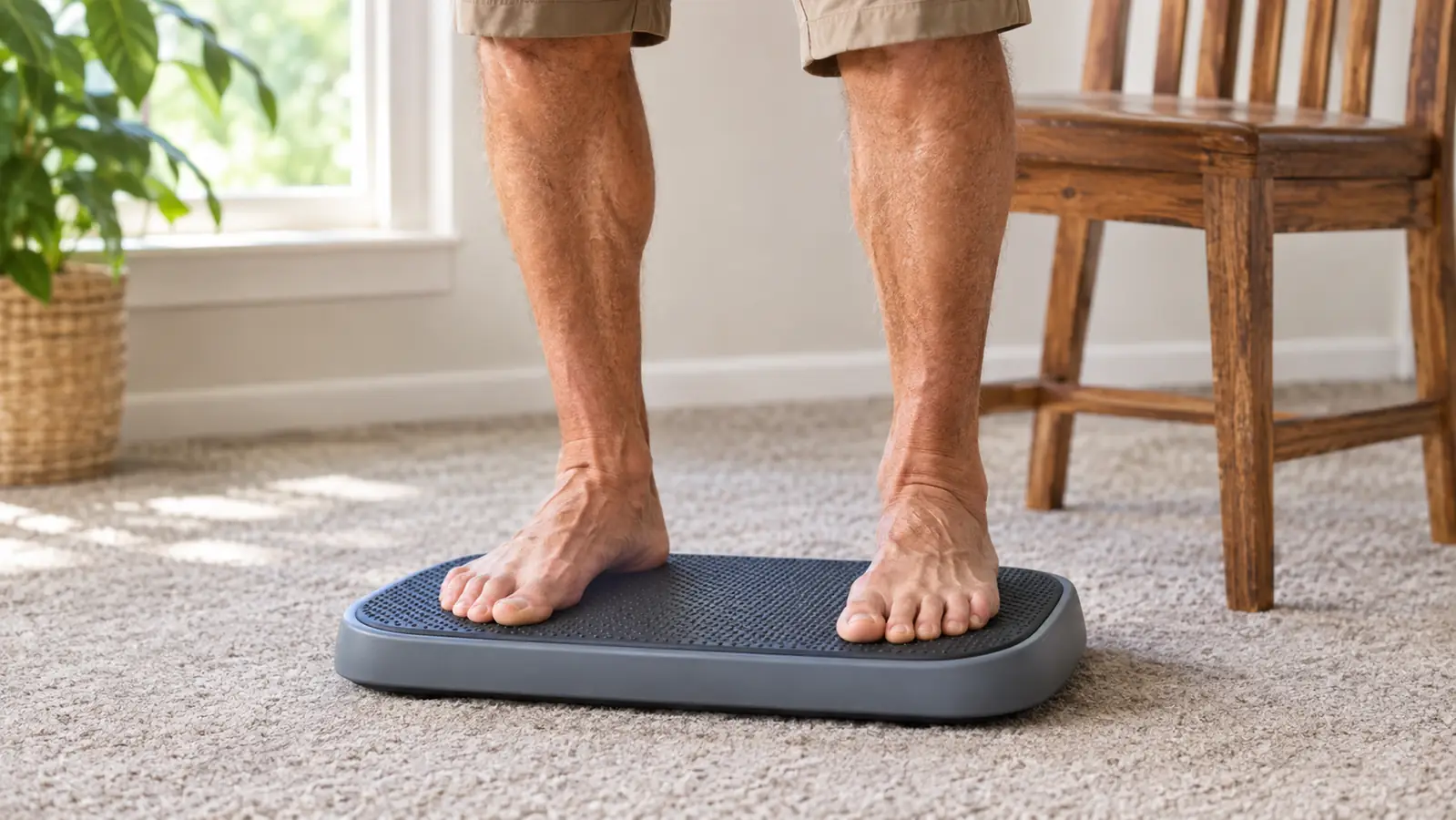
It is a rectangle of dense foam, 15.5 inches long, 12.75 inches wide and 2.25 inches thick, weighing 12 ounces, which is about what a hardcover novel weighs. The material is thermoplastic elastomer, TPE, the same family of foam that turns up in therapy wedges and yoga blocks. The surface has a texture to it, so bare feet stay where you put them and socks do not skate off the moment you shift your weight.
It is not a wobble board and it is not a machine. Nothing on it moves by itself. The entire idea is that the foam gives slightly under your weight, so the small muscles in your feet and ankles make constant corrections you are not consciously thinking about. That is the whole product, and I mean that as a compliment. It does one thing.
What it is not, also: it is not a cure, it is not a replacement for a chair back or a countertop within reach, and it is not something to step onto the first time with nothing to hold. My doctor was firm about that last one and so am I. If you have neuropathy, a recent joint replacement, or a diagnosis that affects your feet, this is a conversation to have with your physical therapist before it is a purchase.
Eight Weeks of Ordinary Mornings
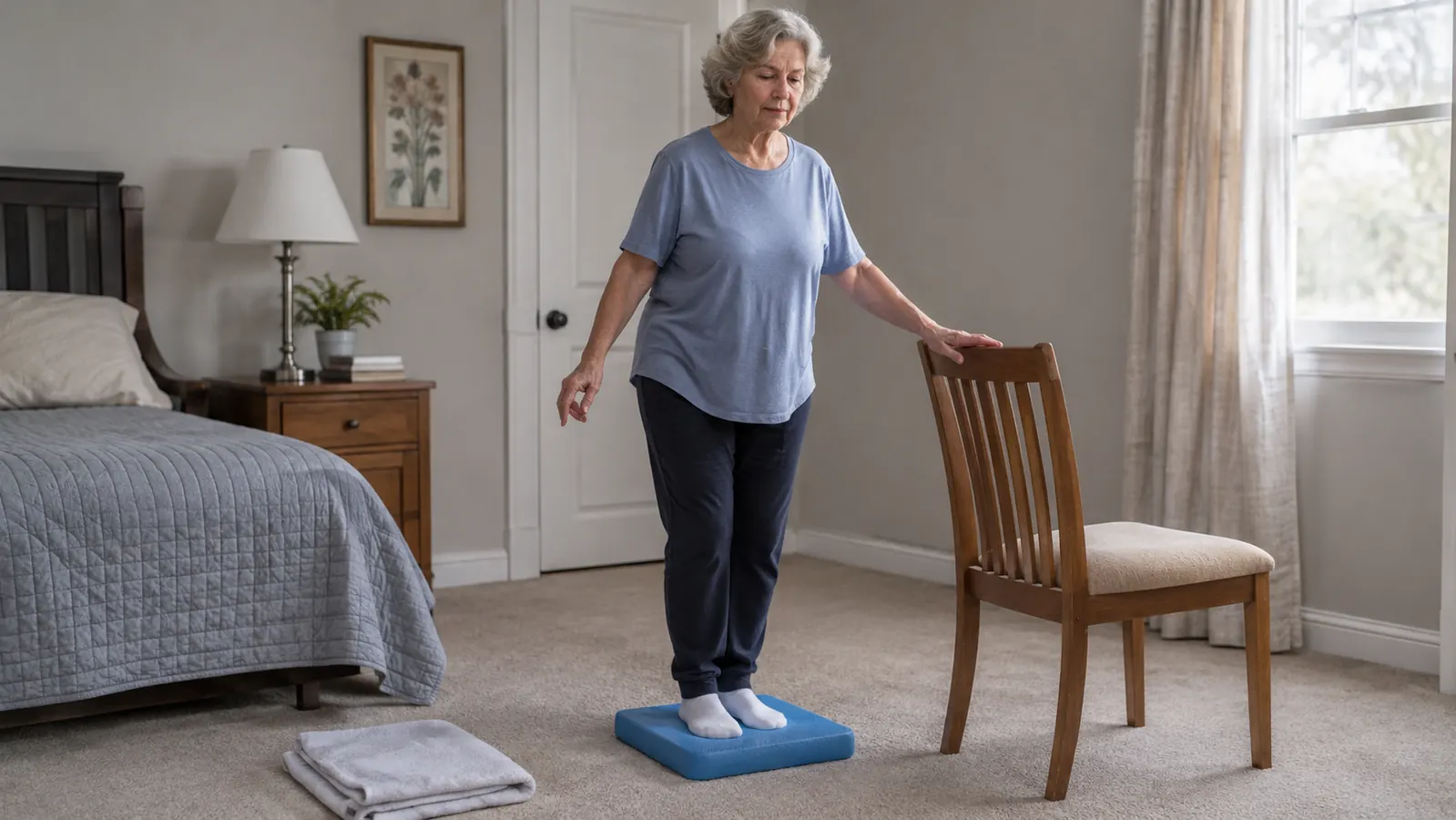
My routine is dull and I am going to describe it anyway, because dull is the part that works. After coffee, twenty to thirty minutes, in the spare room. I keep a dining chair at the edge of the carpet with its back toward me. For the first two weeks I stood on the pad with both feet, one hand on that chair, and shifted my weight slowly in four directions while I counted to sixty. No video and no music. That was the whole session.
Weeks three and four I let go of the chair for the final twenty seconds of each set. That was humbling, not in a falling down way, just in the discovery that standing still on foam is nothing like standing still on carpet. My left foot was fine from the start. The right foot, the one attached to the knee with opinions, complained quietly for the better part of a week.
By week six I was doing the things the listing actually mentions: standing exercises, a short lunge with the back foot on the pad, a squat with only my fingertips on the chair, and a forearm plank with my elbows on the foam. The plank is the one I did not expect to like. It takes some pressure off my wrists compared with the floor, and it is somehow easier to hold when the surface underneath is not perfectly still.
I measured the thing the way I used to measure bulletin board paper. My exercise room is nine feet by eleven, and the pad claims a little over a foot and a half of one wall, which leaves room for the chair behind me and space to turn around without stepping over anything. On a Tuesday in March I set the kitchen timer for four minutes and did nothing but stand and shift my weight, no counting, no chair. I lasted three minutes before my calves started talking to me. That number is six minutes now. That is the sort of progress this offers, and I have made my peace with it.
My granddaughter stood on it in her socks one Saturday and laughed at how much harder it was than it looked, which is the most useful product demonstration I have had. She is nine and plays soccer. I am sixty-eight and play solitaire. The same rectangle of foam was a challenge for both of us, which tells you it is not a gadget for one kind of person.
By week eight I noticed something in the kitchen, of all places. I turn around at the sink about forty times a day, and I had been putting a hand on the counter every single time without knowing it. I stopped. That is not a dramatic result and nobody would put it on a billboard, but it is the reason the pad lives by the window now instead of in the closet.
What Nobody Tells You Before You Buy One
The first thing is that there are two ways to be bad at this and only one of them is obvious. The obvious one is to step on, feel the foam give, panic, and step off. The other is to stand so carefully that you never let the foam do anything at all. I did the second one for most of a week and could not understand why it felt pointless. You have to let your weight travel. Slowly, but actually travel.
The second thing is your ankles. Not your balance, your ankles. There is a set of small muscles along the outside of the lower leg that have been on light duty since roughly 1994 in my case, and they will let you know they exist. Mine started on the fourth morning, a dull ache along the outside of the right ankle that I could press with a thumb. By the sixth morning both legs had it and I nearly quit. Gene talked me into one more week at five minutes a session instead of twenty, and by the tenth day it was gone. Shortening the session was the whole fix, and nobody sells you that instruction. A physical therapist friend told me it was ordinary, then gave me the rule I will pass along: sharp pain, or soreness on one side only, means stop and call somebody.
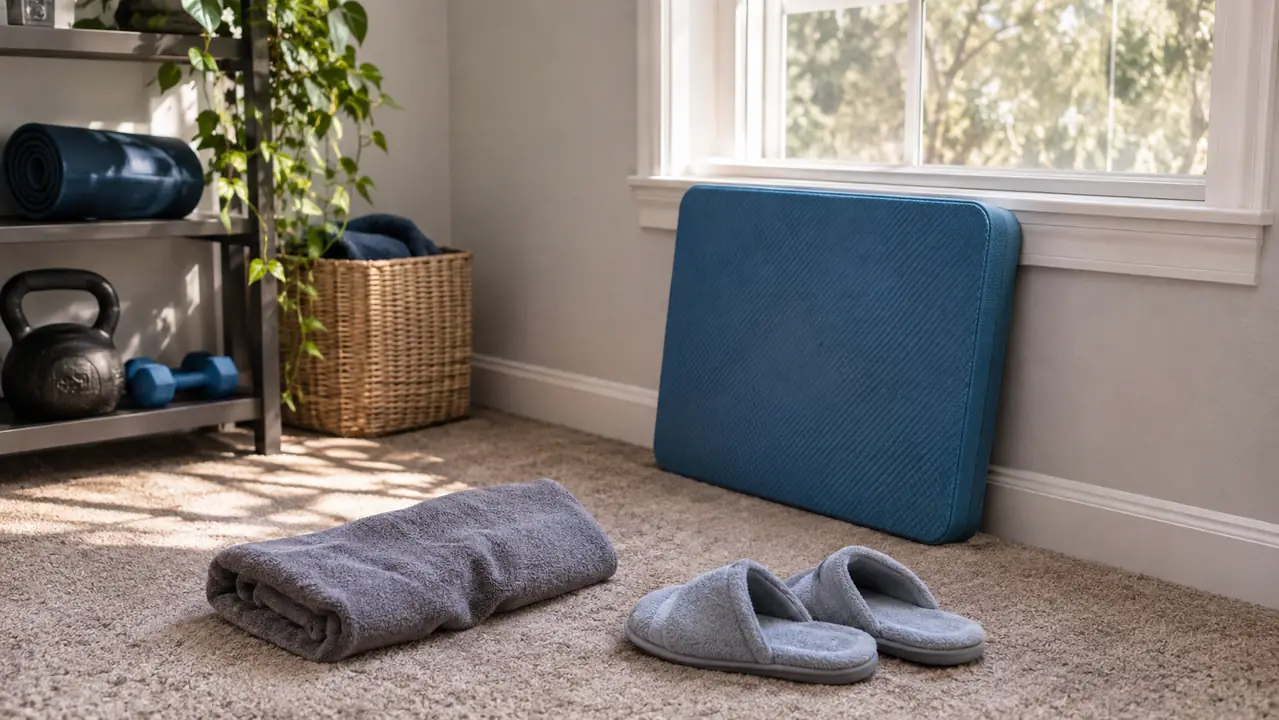
The third thing is that a 2.25 inch pad sitting in the middle of a carpeted room is a trip hazard, and I am the one who tripped. Twice, in the first month, catching my toe on the edge on my way to the closet. Now it lives flat against the wall under the window between sessions and I set it out deliberately, the way I set out a cutting board before I start chopping. It sounds fussy. It is cheaper than a fall.
The fourth thing is that progress here is invisible and nobody claps. There is no readout, no number that goes up. If you want something to watch, count how many times you touch the chair during a session. Mine started around twelve and reached zero in the seventh week. That was my entire measurement system, and it turned out to be enough.
The fifth, smaller thing is footwear. Bare feet or thin socks work and thick athletic socks do not, because the foam and the sock fight each other and you spend the session thinking about your feet instead of your balance. I tried it in my winter socks exactly once. The pad was doing its job and I was busy being distracted by it, which is not the same as training.
I counted how many times I grabbed the chair during a session. Mine went from about twelve to zero, and it took seven weeks.
The Parts I Do Not Love
The texture is good under bare feet and fine under thin socks, and it is not kind to a bare knee. If you plan to kneel on it, and the listing does call it a knee pad, put a towel down first. I tried a modified bird dog with my knee on the foam and lasted about four minutes before I went looking for a folded towel.
Second, 2.25 inches does not sound like much and it is not nothing. For two weeks it felt like standing on the corner of a mattress. That is the point of it, but it also means this is not the thing to introduce in a week when your knee or your hip is already flaring. I tried that once, in a stubborn mood, and lost four days of walking comfortably.
Third, there is one size and it is roughly the size of a large book. That is generous for standing with both feet and for lunges, and it is not generous at all if you wanted to step sideways across it. I tried a shuffle session in March, one foot out and the other following, and my right foot went over the edge twice in the first minute. What this pad does well, it does at a size that suits a person standing still or stepping forward. If side-to-side work is what your therapist has in mind, this is not the shape for it and you should know that before you order. I stopped trying to be clever with it and it stopped being annoying.
Fourth, and this is not the pad's fault: it cannot teach you a program. It is a surface, not a plan. The first week I stood on it with no idea what I was doing, and the only reason I kept going is that my doctor had given me three things to work on and this happened to fit one of them.
What I Liked
- Room for two bare feet at once, 15.5 by 12.75 inches, so a lunge is not a balancing act on a postage stamp
- Firm enough to stand on, soft enough that a knee can kneel on it with a towel underneath
- Textured surface holds bare feet and thin socks in place
- 12 ounces, so it goes under the window or into the closet without ceremony
- Limited lifetime warranty from ProSource, which I have not had to use
- Does one honest thing: it makes a flat floor slightly less flat
Where It Falls Short
- Sore ankles for the first week, which nobody warns you about
- The edge is a trip hazard if you leave it in the middle of the floor
- 2.25 inches of foam is more of a challenge than a tired knee wants on a bad day
- One size only, generous front to back and tight if you wanted to step sideways
- It cannot teach you a program. The plan still has to come from somewhere else
Compared to the Other Things in My Closet
Before the pad I tried a folded bath towel, which is the home remedy everybody suggests. I want to be fair to the towel, because it is what my mother would have used. I folded a bath towel into quarters, set it on the carpet, and stood on it after coffee for the better part of a month in January. It worked for maybe eight minutes. After that the layers shifted under my heel, one corner crept out, and I spent more time adjusting the towel than standing on it. A folded blanket behaved the same way, only heavier. Neither of them gave me the small, even wobble that wakes up the muscles in your feet, and that wobble is the whole reason to bother.
The wobble board my son left here years ago is a different animal. It tilts and it can rotate, and it wants a good deal more from your ankles than flat foam does, which is why mine went back into the closet after two tries. If you are further along than I am and want a real challenge, a board has more to offer. If you are starting from nervous, the foam is the gentler first step and I would make the same choice again.
Standing on one foot on the carpet, which was my third attempt, is free and useful and also easy to cheat. You can rest two fingers on the counter and call it done. The foam takes the cheating away, because even with a hand on the chair your foot has to work. That is the difference I paid for, and it is the whole difference.
Who This Is For
This is for the person whose doctor or therapist said work on your balance and who has no idea where to begin. It is for someone who wants one unglamorous tool that lives on the floor, takes up no space, and does not need to be plugged in, charged, or updated. If you can stand at your kitchen sink and hold a counter with one hand, you can start on this pad tomorrow morning with a chair back within reach.
It is also for the person who has stopped trusting their own feet a little. That was me. I am not going to tell you a piece of foam gave me my confidence back, because that is not true. What it gave me was twenty minutes a day of proving to myself that my feet would hold, and after eight weeks of that the driveway looks like a driveway again instead of a thing to be survived.
Who Should Skip It
Skip it if you have been told you have a balance disorder, neuropathy in your feet, or a joint that is actively inflamed, at least until you have talked it through with the person treating you. Skip it if you cannot get up from the floor without help, because a pad is not a safety device and it will not catch you. Skip it if what you actually need is a rail in the bathroom, which is a different purchase and a more important one.
And skip it if you want a workout that tells you what to do. This is a surface. It is a good surface, sturdy, roomy, and sensibly made for what it is, but the plan has to come from somewhere else, whether that is your doctor, a therapist, or a class. ProSource made a solid piece of equipment here. The getting started part is still yours.
One flat piece of foam, one chair back, twenty minutes, most mornings
That is the whole program I have been running since February. If it matches what your doctor asked you to do, the ProSource pad is a sensible place to start, and it stores flat under a window when you are finished.
Amazon Check Today's Price on Amazon →