Two winters ago I went down on an icy driveway outside Flint, and my right knee has had opinions about it ever since. My doctor's advice was plain. Keep moving, build the leg strength back, and practice your balance on purpose instead of letting the ice test it for you. So that January I cleared a corner of the spare bedroom, rolled out a mat on the carpet, and started a short morning routine. Twenty minutes, after coffee, before Gene turns on the news. The first thing I bought was a wobble board, because it looked like the serious choice. The second thing I bought, about three weeks later, was the ProSourceFit balance pad.
Here is the short answer before the long one. For most adults past sixty who are starting balance work at home, the ProSourceFit pad is the better first purchase. ProSource makes a simple thing: a foam pad, 15.5 inches long, 12.75 inches wide and 2.25 inches tall, made of TPE, weighing 12 ounces, with a limited lifetime warranty behind it. It tilts you just enough to make your ankles and hips work, and not enough to take you down. A wobble board is a real training tool and it will make you stronger, but it asks for ankle speed and reaction time you may not have yet, and the cost of being wrong is a fall in a room by yourself. The pad asks less and forgives more. Where the board wins is a few months down the road.
It helps to be clear about what the two things actually are. The pad is a rectangle of TPE foam, 15.5 inches long, 12.75 wide and 2.25 tall, and the listing calls it non-slip, which matches what my stockinged feet find. You stand on it and it compresses and shifts a little. A wobble board is a rigid platform on a curved or pivoting base. The deck tilts under you and your job is to keep it level. One is soft and slow. One is hard and quick. Nearly every difference below comes out of that single fact, and once you see it you can predict the rest of this table yourself.
| ProSourceFit Balance Pad | Rocker wobble board | |
|---|---|---|
| Stability challenge | The foam compresses and shifts slightly under your feet | The deck tips much further, in every direction |
| If you lose your footing | The surface gives and your foot stays close to the carpet | The far edge drops away and the deck can slide out |
| Room to stand | 15.5 x 12.75 inches, room for both feet, lunges and squats | Usually a smaller round deck, often one foot at a time |
| What it asks of your ankles | Slow corrections, at a speed you can manage | Fast corrections, or you step off |
| Strength ceiling | You outgrow it once two-footed standing gets easy | Keeps asking for more, for years |
| Other uses | Knee pad, forearm cushion in a plank, yoga and therapy work | Balance work only |
| Weight and storage | 12 ounces, slides behind a chair | Heavier and wider, needs clear floor space |
| Warranty | Limited lifetime warranty from ProSource | Varies by maker, read the terms |
| Learning curve | Usable the day it arrives | Weeks of short sessions holding a chair |
| Best for | First balance work, sore knees, exercising alone at home | Steady ankles and a hard challenge |
How I Tried Both, and What My Knee Said
I started with the wobble board in the second week of January and I held the back of a dining chair the entire time. Three weeks, twice a day, and it never stopped feeling like a negotiation between me and my right ankle. My foot would find the balance point, the deck would roll half an inch, and I would grab the chair. That is not training. That is surviving. Nothing about it hurt. It was simply faster than I was, and no amount of wanting it to slow down made it slow down.
Let me be specific about how those three weeks went, because I think the details are the useful part. I gave it four minutes in the morning and four in the afternoon, which does not sound like much until you have spent four minutes gripping a chair back with both hands while your forearms ache. By day nine I could let go with my left hand for about five seconds at a time before the deck rolled and I grabbed it again. Day fourteen, I tried standing with my feet closer together, which is what the pamphlet that came with it suggested, and I stepped off twice in one session. Not fell. Stepped off. But stepping off a board that is tipping under you is not a controlled movement, and my knee did not care for it. On the morning of day twenty-one I stood there on the thing and thought, I do not look forward to this. That was the end of it for me, at least as a daily habit. If I dread a piece of equipment, it goes in the closet, and then I have wasted the money and learned nothing.
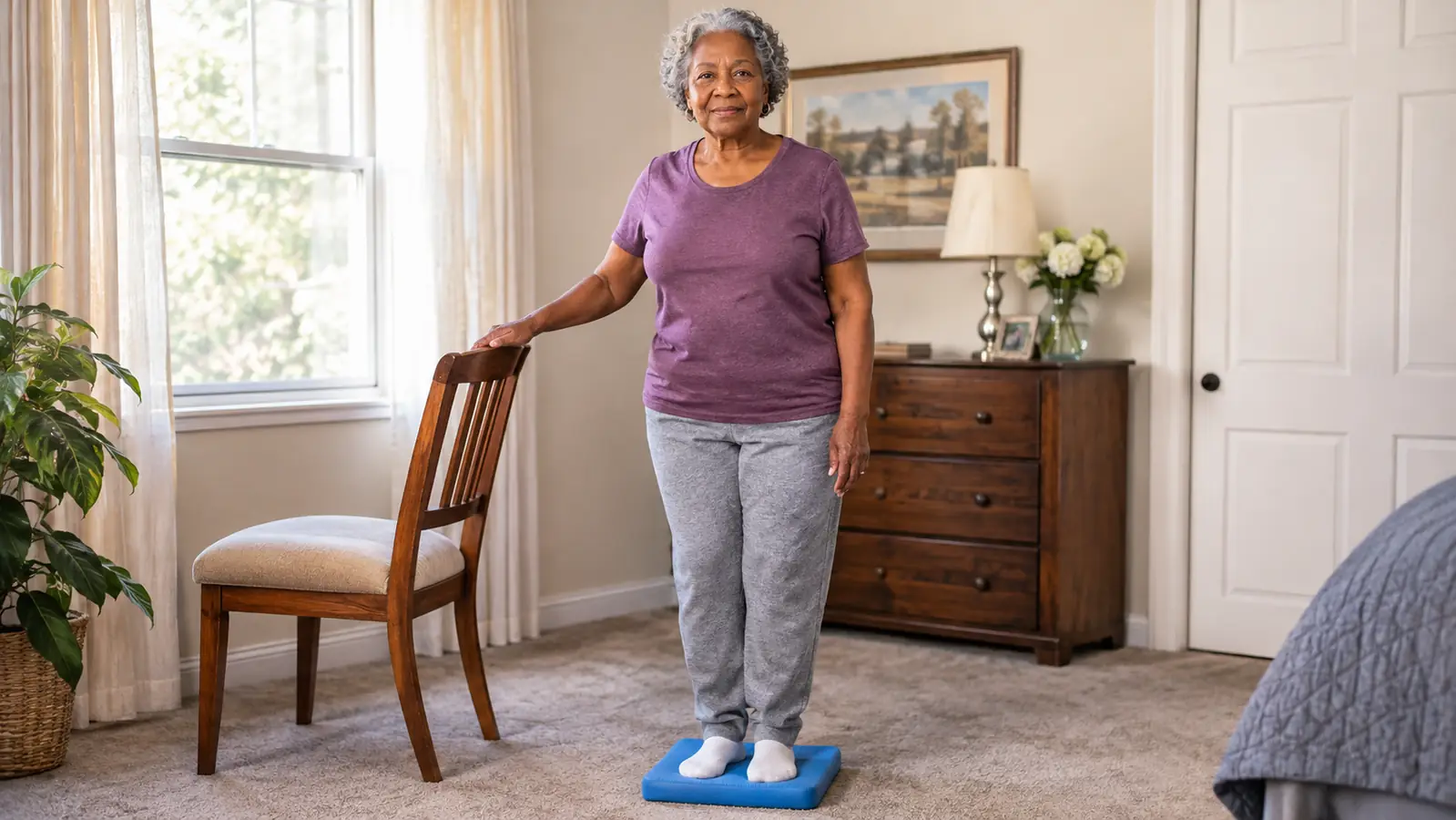
The pad arrived on a Thursday and I stood on it that afternoon with no chair at all. What I noticed first was how little the surface moved, and how much time that gave me to feel the shift and answer it. The foam compresses under your weight, your feet stay close to level, and your ankles do the work at a speed a sixty-eight-year-old body can actually answer. The sheet of exercises the clinic handed me after my knee check listed standing balance work and said to hold a counter if I needed one. I did not need the counter on the pad that first day. On the board I needed it for three weeks.
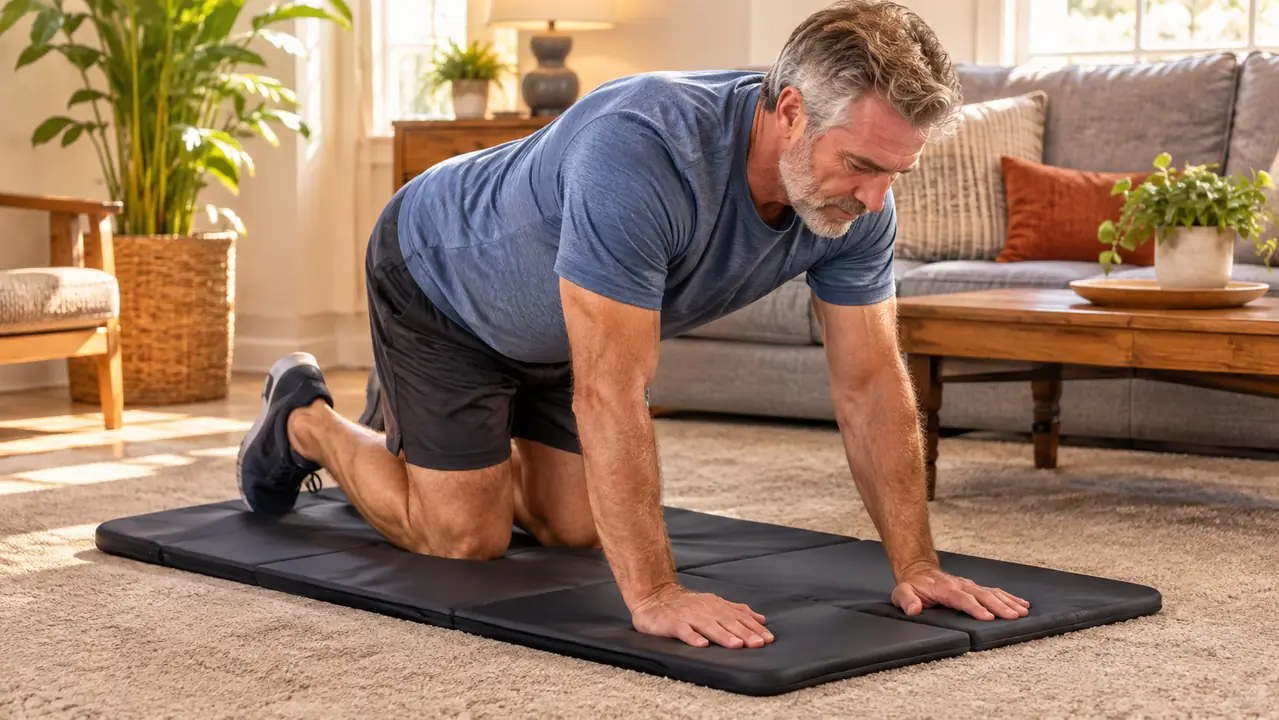
What surprised me was how quickly the pad became part of the room. The first week I used it only for standing, both feet, ten minutes while the coffee went cold on the counter. By the second week I had moved it to the floor for the knee-friendly squat routine the clinic gave me, because standing on a bare carpet for fifteen squats made my knee throb and standing on the foam did not. The difference is small and hard to explain to anyone who has not felt it. Carpet over a concrete slab is not much of a cushion. Two and a quarter inches of TPE foam is. By March I was kneeling on it for the floor exercises, and my knees stopped complaining about that part of the morning entirely, which was a surprise and not the reason I bought it.
Where the ProSourceFit Balance Pad Wins
The pad wins first on the consequence of a bad moment. Standing on foam, when you wobble, the surface gives and your foot stays close to the carpet. You are only a couple of inches off the floor the whole time. Standing on a wobble board, the deck tips and the far edge drops away from your toes. The correction has to happen in a fraction of a second or you step off, and stepping off a tipping board at sixty-eight is how a nervous knee turns into a hurt hip. I am not saying nobody should use one. I am saying the pad is the version you can use alone in a spare bedroom without wondering whether Gene will find you on the carpet.
Second, the pad does more than one job. Mine lives in the exercise room and gets used as a knee pad for floor work, as a cushion under my forearms in a plank, and as a soft surface under the lunges and squats my knee tolerates on good days. ProSource lists it for standing exercises, lunges, squats and planks, and that matches what I do with it. The size is what makes this work. At 15.5 inches by 12.75 inches there is room for both feet side by side, and room to step back into a lunge without your heel hanging off the edge, which is not true of the smaller round pads I looked at before I bought this one. It weighs 12 ounces, so I carry it to the living room in one hand when I want to work in front of the TV. Board or no board, a piece of equipment that only does one thing tends to sit in the corner. This one does not.
Where a Wobble Board Wins
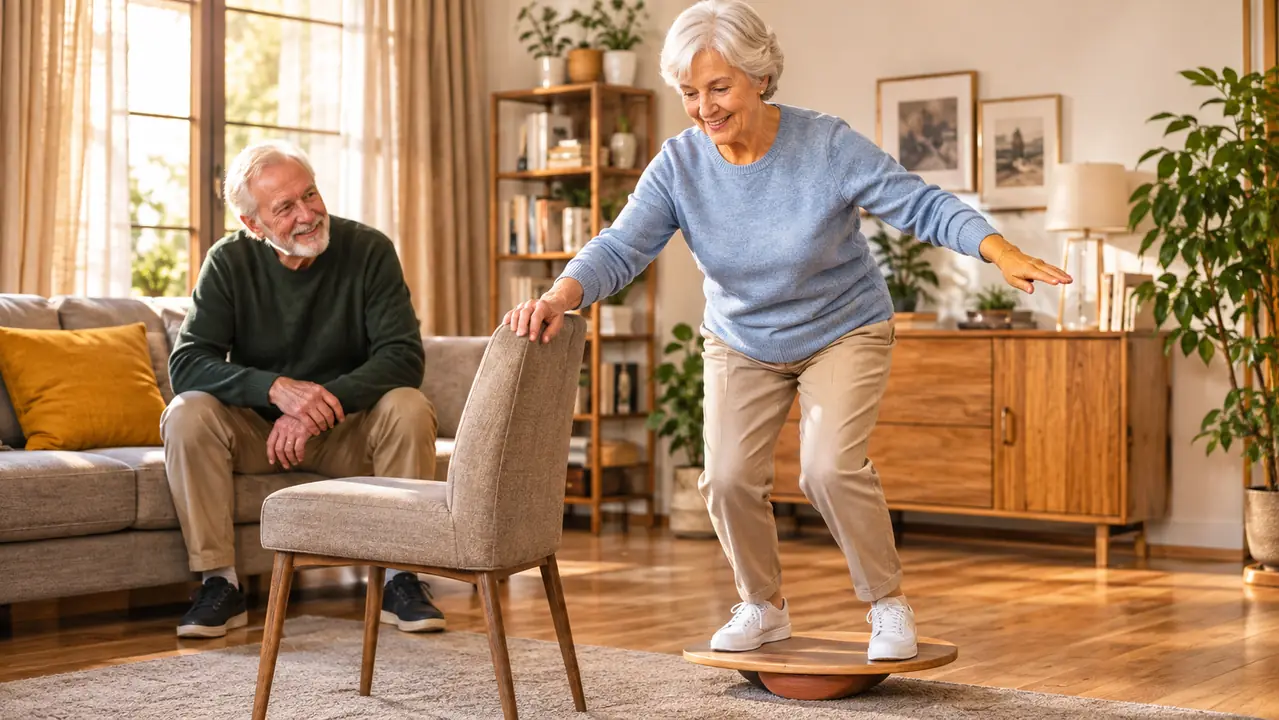
Now the honest part, because a comparison that gives everything to one side is not a comparison, it is an advertisement. A wobble board wins on the ceiling. The pad is a starting surface and, for some people, a finishing one, but there is a limit to how much stronger a piece of foam can make you, because it only asks so much and then stops asking. A board keeps asking. It teaches your ankle to answer fast, and that fast answer is the actual skill that saves you when a foot lands on a patch of ice in a parking lot. My own fall was not a slow tipping problem. It was a fast one. The board trains the fast thing.
The board also wins on the day the pad stops being enough. That day comes. About four months in, standing on the pad with both feet felt about like standing on the carpet, and I had to add single-leg work to make it mean anything again. What that looked like, practically, was standing on one foot on the foam for as long as I could manage, first beside the dresser with a hand hovering, then with the hand down at my side. Fifteen seconds on the right was a struggle for two weeks. On the left I could do forty almost straight away, which tells you something about which leg was doing the work all those years. That single-leg work is what keeps the pad useful past the four-month mark, and I would not have known to do it if I had not noticed the two-footed version had gone quiet on me. The board never goes quiet. What it does have is a narrow group of people it suits. If your ankles are steady, you have some athletic history, and someone is usually home while you exercise, it is the better long-term tool. If any of those three is missing, start on foam and stay there a while.
A wobble board asks your ankle to answer in a tenth of a second. The pad asks in a second and a half. For a sixty-eight-year-old knee, that gap is the whole argument.
If a slow surface sounds like the right place to start
This is the pad I reach for on a stiff morning, and the one I would hand to a friend who has never done balance work. ProSource backs it with a limited lifetime warranty. It weighs 12 ounces and it stores behind a chair.
Amazon Check Today's Price on Amazon →Who Should Buy Which
Buy the ProSourceFit pad if you are starting balance work for the first time, if you have a knee or a hip that has been talking to you, if you exercise alone in a spare room or a living room, or if you want one piece of equipment that also makes floor work comfortable. That covers most of the people who write to me about this, and it covers me. My pad has been in the exercise room for well over a year now, and it is the one thing in there I would replace the same week if it wore out. The TPE foam has held its shape through a Michigan summer and a Michigan winter, both of which are hard on everything in a house.
Buy a wobble board if you can already stand on one foot for thirty seconds without touching anything, if you have a counter or a sturdy chair you will honestly hold onto, and if you want the harder challenge rather than the safer one. Or do what I did in the end, which is keep both. The pad is what I use on a stiff morning. The board comes out on a good one, with the chair right there beside me. Two tools, two jobs, and neither purchase was a mistake.
If you are still undecided, here is the test I would give a friend. Stand on one foot in your kitchen, next to the counter, and time yourself on each side. Under fifteen seconds and the pad is your starting point, no argument needed. Over thirty seconds on both sides, steady, with no wobble in the ankle, and a board is a reasonable thing to try with a chair nearby. Anywhere in between, buy the pad, use it most mornings for two months, and retest. Your body will give you a clearer answer than any article can, mine included.
You do not have to be brave to get stronger at sixty-eight
You have to be consistent. Twenty minutes after coffee, most mornings, on a surface that will not punish you for having a bad day. That is the whole plan, and the ProSourceFit pad is the piece of it I would buy first.
Amazon Check Today's Price on Amazon →