Two winters ago I went down on my own driveway. Black ice under a dusting of snow, my right foot slid forward, and I sat there in my coat for a good minute before Gene came out to help me up. Nothing broke. But something in my confidence did, and for the rest of that winter I walked like a woman on a boat, one hand always near a wall.
My doctor is younger than my daughter and endlessly patient with me. She said the answer was not to stop moving. She said it was to keep the muscles around my right knee working and to practice being slightly off balance on purpose, in a safe place, so my body could relearn what to do when it happens for real. That is how a piece of foam came to live beside my exercise room chair.
The ProSource Exercise Balance Pad is a slab of TPE foam, 15.5 inches long, 12.75 inches wide and 2.25 inches thick, and it weighs 12 ounces. I can pick it up with two fingers and drop it wherever I want to work that morning. There is nothing to plug in, nothing to adjust, no buttons and no screen. It is a soft surface that makes ordinary standing exercises harder to do, and after six months of using it five mornings a week I have a fair amount to say about where it helps and where it does not.
The Quick Verdict
Six months in, the ProSource pad is the equipment I reach for most and think about least. It sits by my chair, it has not cracked, torn or slid out from under me, and ten minutes of standing work on it still makes my ankles and hips earn their keep. I dock it a little for the width, which is snug for anything wider than my own two feet.
Amazon Check Today's Price →The piece of equipment I stopped thinking about, in a good way
The ProSource Exercise Balance Pad is 15.5 by 12.75 inches of TPE foam with a textured, non-slip surface, rated 4.8 out of 5 across more than 17,000 Amazon reviews and backed by a limited lifetime warranty. It is the least complicated thing in my exercise room and the one I would replace first.
Amazon Check Today's Price on Amazon →How I've Used It
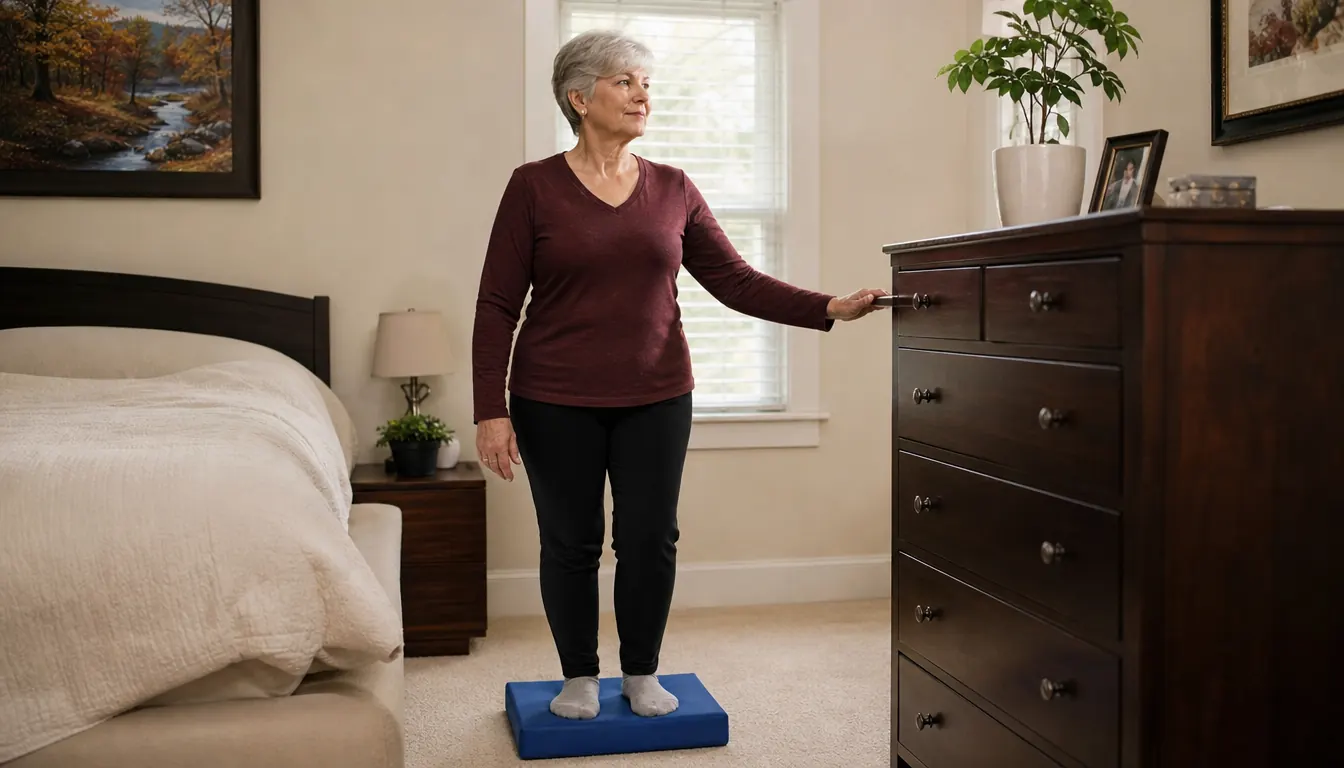
When the pad arrived I put it on the carpet in the exercise room, that converted spare bedroom with the old dresser still in it, and stood on it holding the dresser edge with both hands. Thirty seconds. That was all I could manage before my ankles started talking to me. I want to be honest about that, because product photos make it look like something you stand on while doing something else. It is not. For the first two weeks, standing still on it was the entire exercise.
By the third week I could stand there for a minute with one hand on the dresser. By the end of the first month I was doing short knee bends on it, the kind where you lower yourself two or three inches and come back up, and by month two I was lifting one foot off it for five seconds at a time. These are small numbers. They are also the numbers that matter when you are 68 and the ground has become something you no longer entirely trust.
I use it two other ways. It moves to the living room on the days I want to work in front of the television, and I kneel on it for the floor exercises my doctor gave me, which is kinder to the knees than the carpet and keeps my full weight off that right kneecap. Gene, who is 71 and does not exercise so much as he putters, tried it once, declared it wobbly, and went back to his chair. That is a fair review too. It is wobbly. That is rather the point.
Before the pad I tried a folded bath towel on the carpet, because it cost nothing and I am thrifty in the way of someone who taught school for thirty-one years. A towel is not unstable. It is just lumpy, and it slides, and after a week the corner had curled and I stepped on the curl and turned my ankle a little. Then I tried one of the couch cushions propped on the carpet, which was worse: too soft, and it bottomed out under my heel so that my foot was basically on the floor with a fabric hat on. The foam pad is firmer than both and it stays where you put it, and that difference is the whole reason it works. You need a surface that gives a little and then pushes back, not one that collapses.
Why Standing on Foam Is Harder Than It Looks
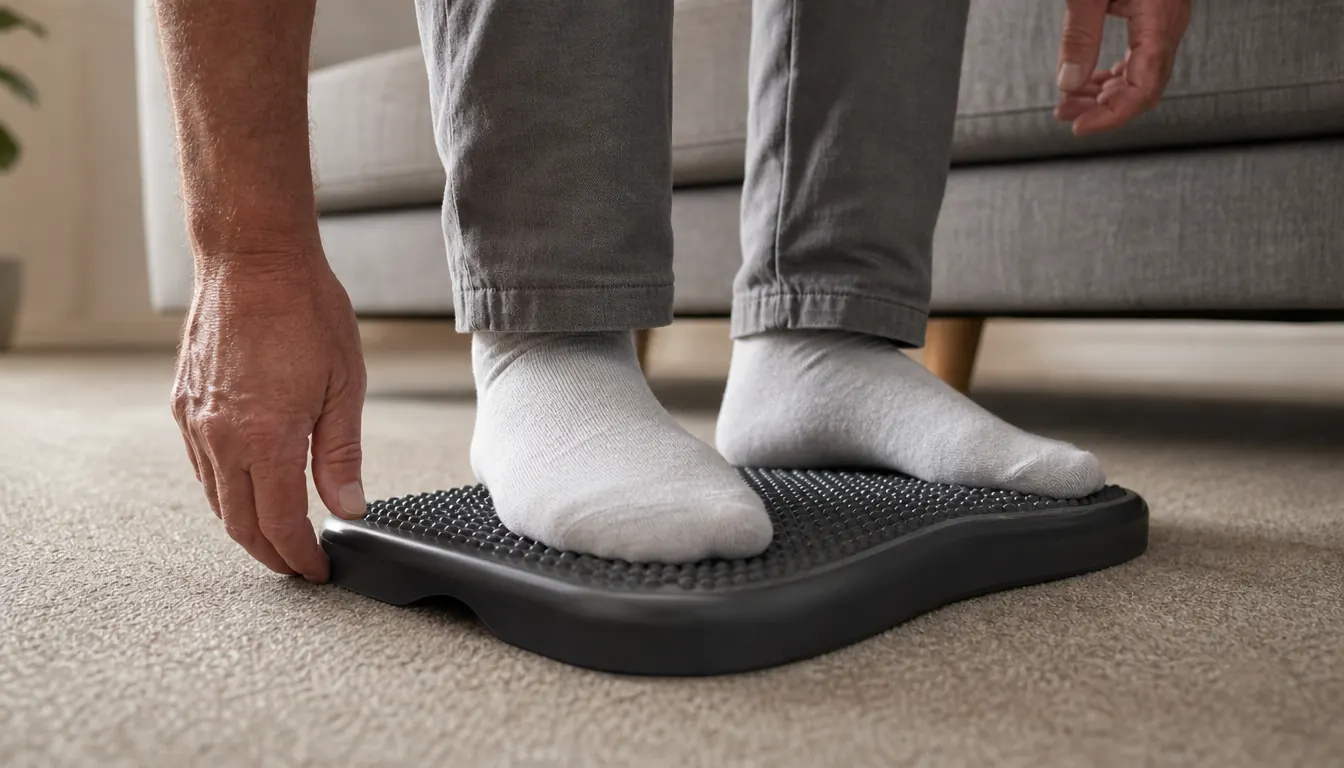
On a hard floor, your feet report back that everything is flat and stable, and your body gets lazy. On two and a quarter inches of foam, the surface gives under your weight and shifts a little, so the small muscles in your ankles and hips have to make constant corrections. You will feel it in your shins the first week. Those corrections are the exercise. Nothing dramatic happens. You are not lifting anything. You are teaching your body to catch itself, which is exactly what failed me on the driveway.
The first week, my shins ached in a way I had not felt since I was a girl learning to skate. That sounds alarming and it was not. It was the feeling of small muscles that had been on vacation for a decade being asked to come back to work. By the second week the ache was gone and I could stand for two minutes instead of thirty seconds. If you try this and your calves or shins complain, that is normal and it passes, but I would still tell you to keep the first sessions short and to hold something. Do not be brave on a foam pad.
I want to be careful here, because I am a retired schoolteacher and not a physical therapist. What I can tell you is what my doctor said and what I felt. She described this kind of work as rehearsing the recovery, not preventing the fall. You practice the wobble in a carpeted room with a dresser within reach, so that when it happens in a parking lot your legs have some memory to draw on. That is a modest promise, and I trust it more than any page that promises perfect balance in thirty days.
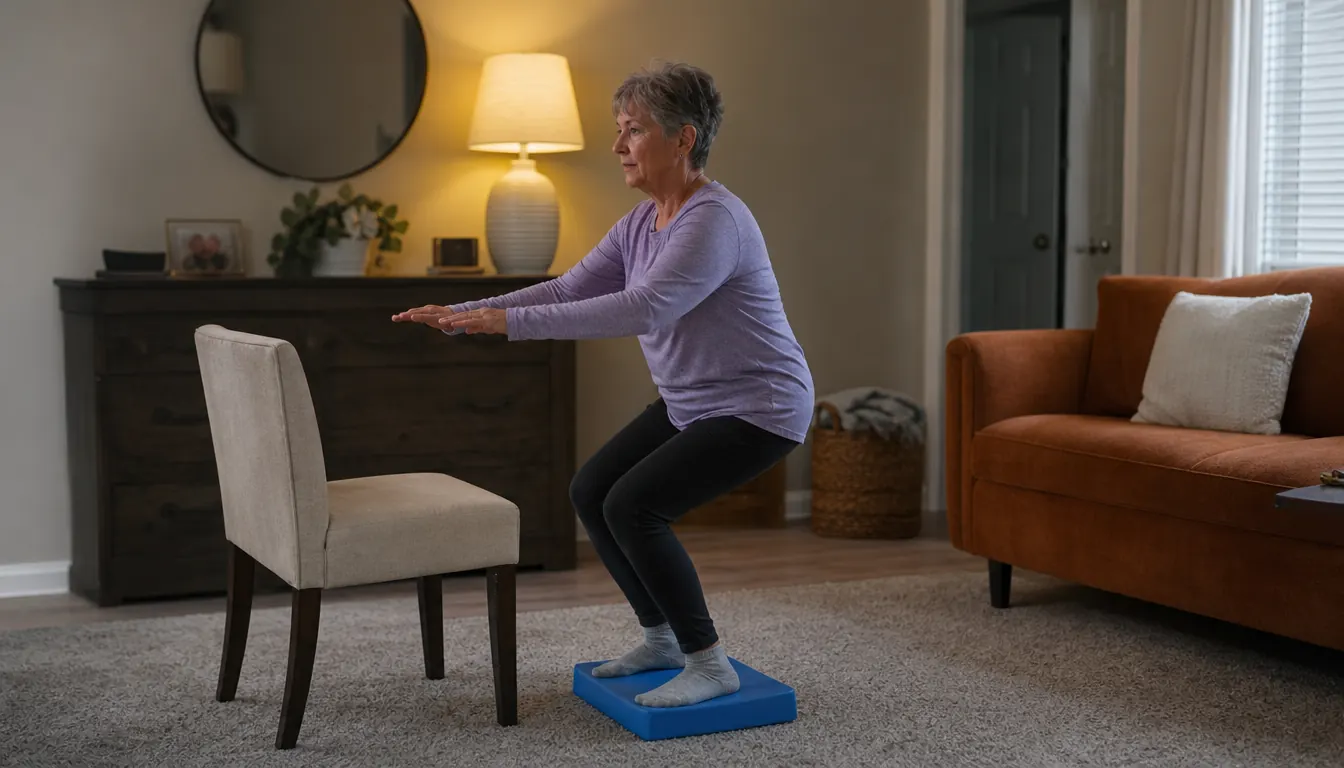
There is a second thing the foam does that nobody talks about much. Standing and doing small squats on a forgiving surface is easier on the knees than doing them on a bare floor. My right knee has mild osteoarthritis, diagnosed in 2024, and the cushion takes the edge off the landing. It is not a cure and it is not a brace. It is just a softer place to put your weight while you work.
Six months in, I can stand on one foot on the foam for forty seconds and put my sock on standing up without touching the wall. Two winters ago I could do neither.
Size, Weight, and How It Lives in the Room
At 15.5 inches long and 12.75 inches wide, the pad is big enough for both feet with room to shift, and big enough to kneel on for floor work. At 12 ounces it is light enough to carry from room to room, and mine leans against the wall between the dresser and the door when I am finished. It takes up less space than a pair of winter boots.
One practical note about the width. My feet are ordinary width, and when I stand with them square on the pad there is a couple of inches of foam showing on either side, which is comfortable. But the day I tried a lunge I put my front foot on the pad and my back foot on the carpet, and the pad shifted a half inch under me. It did not slide out, but it moved, and I felt it. Since then I do my lunges entirely on the carpet and keep the pad for standing work, squats and kneeling. That is not a complaint about the product. It is a note that 12.75 inches is a footprint, not a floor.
The top surface has a texture to it that keeps socks from sliding, and the bottom grips carpet well. On the bare floor in the front hall, where I tried it once out of curiosity, it moved an inch or two under me and I did not try that again. That is less a flaw in the pad than a fact about hard floors. If your exercise space is not carpeted, put a mat under it or work on a rug. My exercise room is carpeted, and there it has not shifted once in six months.
Daily use has not put a mark on it. No cracks, no tearing at the edges, no flat spot where I always stand. It wipes down with a damp cloth when it collects dust, and the TPE does not hold an odor the way some foams do. ProSource backs it with a limited lifetime warranty, which for a twelve-ounce piece of foam is a generous promise and one I have not needed to test.
What Six Months Actually Changed
Month one, I stood on it. Month two, I stood on one foot on it. Month three, I could do eight shallow squats without holding on, and I noticed I had stopped reaching for the kitchen counter when I turned around at the sink. That is the kind of change nobody puts in a review, but it is the one that mattered to me. Months four through six, I mostly maintained. I did not get dramatically better. I got more confident, which is a different thing and harder to measure.
There was one morning in February that I keep coming back to. Gene had gone out to start the car and I was in the exercise room doing my eight knee bends, and somewhere in the middle of them I realized I was counting out loud the way I used to count with a class, and that I had not thought about the driveway once. Six months earlier every session on that foam was a small argument with my own nerves. That morning it was just something I did after coffee, like brushing my teeth. I do not know how to put a number on that, and I would be lying if I said the pad did it by itself. But the pad is where it happened.
Here is what it did not do. It did not make my knee stop aching in damp weather. It did not make me steady on ice, and I still wear the cleats Gene bought me for the walk to the mailbox. It did not replace the walking I do with my neighbor in the warmer months, and I would not skip that walking in favor of this pad. What it did was give me a way to keep working on my legs from November to March, when Michigan keeps me indoors and the sidewalk is the last place I should be.
The surprise was the mental part. Standing on that foam with the dresser two inches from my hand, I had to trust my own feet in a way I had stopped doing since the driveway. The first few mornings I held on the whole time. Somewhere in month two I noticed I had let go with one hand without deciding to. I do not think a piece of equipment can give you your confidence back. I think it can give you a place to practice being confident, which is close enough to be useful.
What I Liked
- Grips carpet well and has not shifted in six months of daily use
- Light at 12 ounces and small enough to lean against a wall
- Large enough for both feet, for kneeling, and for shallow squats
- Soft enough to spare an arthritic knee on small knee bends
- No setup, no buttons, no charging, nothing to break
- Backed by a limited lifetime warranty
Where It Falls Short
- 12.75 inches wide is snug for wide lunges with both feet planted
- Slides on bare hard floors, so it needs carpet or a mat beneath it
- The wobble takes getting used to and feels unstable at first
- It does one thing, so it will not help if you need a rail or a counter to hold
Who This Is For
Adults who have been told to work on balance or leg strength and who want to do it at home, in a carpeted room, without equipment that needs setting up. People whose knees complain on hard floors and who want a forgiving surface for small squats. Anyone who has had a scare, a slip or a near miss and wants a safe place to practice being unsteady. If you can stand at a kitchen counter for ten minutes, you can use this pad, and you will probably feel it working before the first week is out.
Who Should Skip It
Skip it if your balance is unsteady enough that you need something to hold at all times. A foam pad will not catch you, and standing on one unassisted when you are not steady is how people get hurt. Talk to your doctor or a physical therapist first, and consider a rail or a sturdy chair instead. Skip it if you have a hard floor and no mat, if you want a device that counts or measures anything, or if you are after a real workout rather than a small daily practice. This is a modest tool. It does not do much on its own, and it does not need to.
Six months in, it still lives beside my chair
The ProSource Exercise Balance Pad is the smallest and most-used thing in my exercise room. 15.5 by 12.75 inches, 2.25 inches thick, 12 ounces, rated 4.8 out of 5 by more than 17,000 reviewers. If your doctor has told you to work on balance this winter, start here, start with thirty seconds, and keep a dresser within reach.
Amazon Check Today's Price on Amazon →