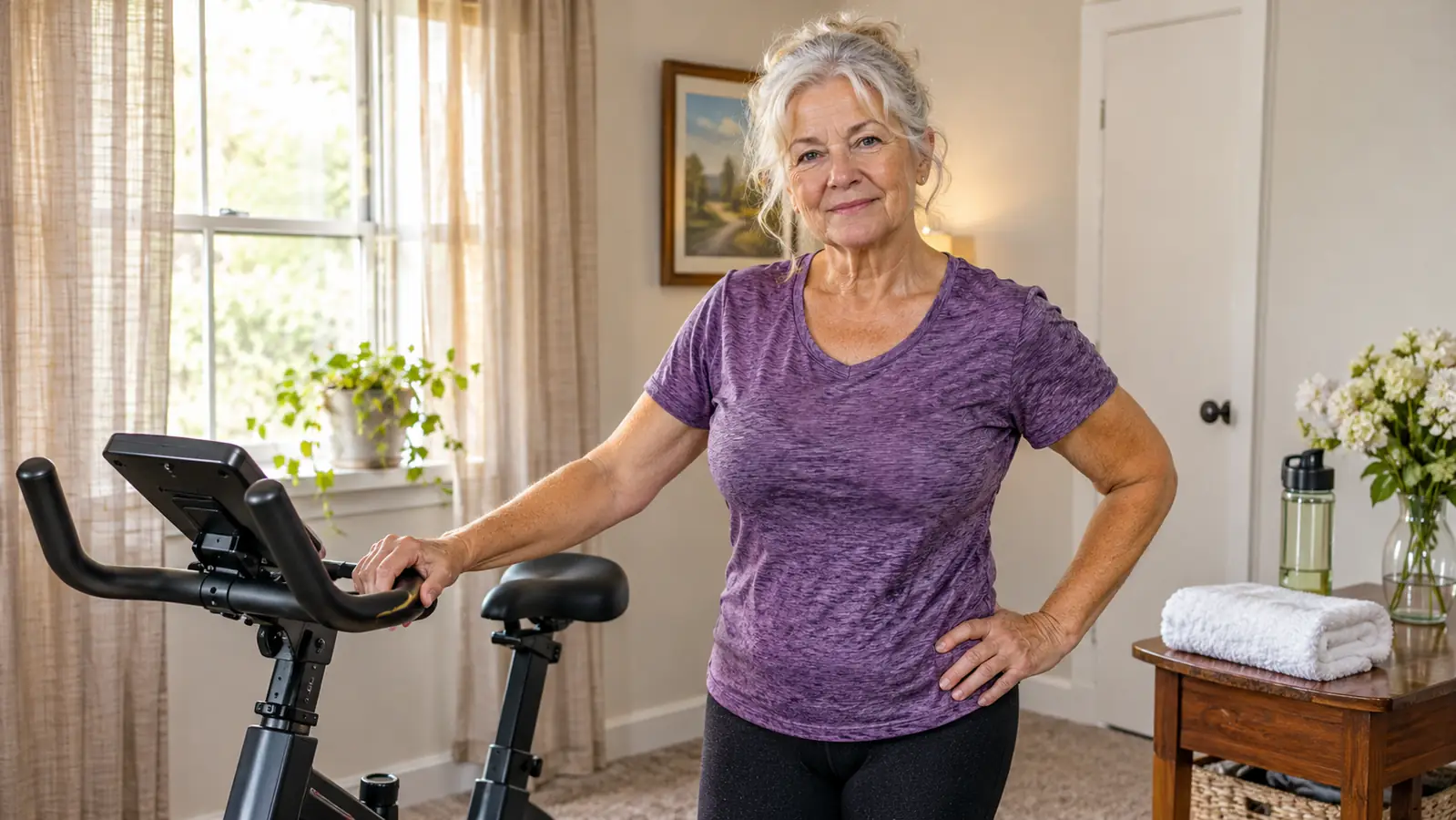
The first thing I want you to know is that I did not take up indoor riding because I love exercise. I took it up because my right knee has mild osteoarthritis, and two winters ago I slipped on an icy driveway and landed hard enough that I stopped trusting my own feet for a while. My doctor's advice was not complicated: keep moving, build the muscle around the knee, and do not let the nervousness win. That is easy to say in an exam room in September. It is much harder to do in a Michigan January, when the sidewalk is a sheet of ice and the sun is down before supper.
So I cleared a corner of the spare bedroom, put a folding bike in it, and started with eight minutes. Not thirty. Eight. The bike is a BARWING, and what follows is the sequence I wish someone had handed me at the start, in plain steps, including the parts I got wrong. Before the bike, I tried the things people suggest to women my age. I walked laps at the mall until the mall got depressing. I did a chair exercise DVD for three weeks and quit because the instructor kept saying feel the burn and I felt nothing but silly. I paid for a gym in 2021 and went four times, because the drive, the parking lot and the locker room were more work than the workout. What finally worked had nothing to do with willpower. It had to do with distance.
Put the bike ten feet from your coffee cup
That is the entire reason this became a habit here. The BARWING folds into a corner of a spare room, carries up to 350 pounds, and runs quiet enough to ride before your husband is awake.
Amazon Check Today's Price on Amazon →Step 1: Have the doctor conversation, then measure your corner
Call your doctor before you buy anything. Ask three specific questions: is there any reason I should avoid a stationary bike given my knee, my hips or my balance; is there a heart rate I should stay under; and does any medication I take change how hard I should push. My own answer was encouraging, with one caveat about not leaving the knee bent too long under heavy resistance. That caveat shaped everything below, including the resistance levels I started at and the ones I have still never touched.
Then measure. The BARWING is 36 inches deep, 18 inches wide and 45 inches tall, and it weighs 40 pounds, so it is not a machine you will want to wrestle up a staircase alone. Mine sits on carpet in the spare bedroom with about two feet of clear floor in front of the pedals, so nothing is jammed against a wall when my feet come around. If you plan to ride in the living room in front of the television, measure the gap between the coffee table and the sofa and be honest about whether you will actually move that table every morning. I moved mine exactly twice before I gave up and went back to the bedroom.
There is one more measurement people forget, and it matters if you are short in the leg like me or long in the torso like Gene. You want to know before delivery day whether the machine adjusts far enough in both directions. The BARWING gives you eight seat height adjustments, two seat angle adjustments and a backrest, which is more range than the folding bikes I looked at in stores, most of which offered one lever and a hope.
Step 2: Set the seat, the backrest and the straps before your first pedal stroke
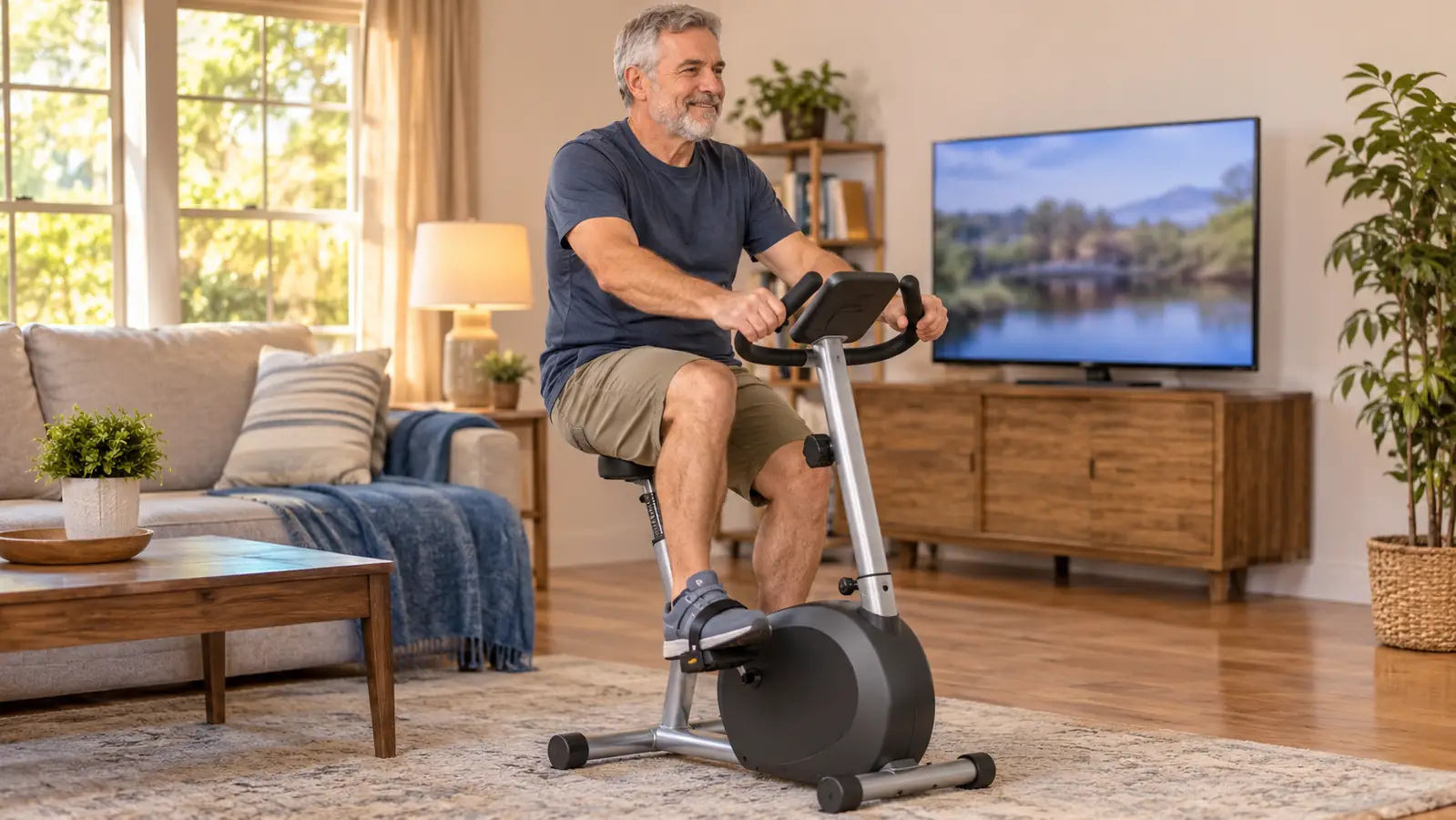
The most common mistake I see in reviews, and the one I made myself, is riding with the seat too low and then deciding the bike hurts your knees. Here is the check I use now. Sit on the bike. Put your heel on the pedal at the bottom of the stroke, the pedal furthest from your body. Your leg should be almost straight, with just a soft bend left in the knee. Then move the ball of your foot onto the pedal and ride. If your hip rocks side to side while you pedal, the seat is too high. If your knee is sharply bent at the bottom, it is too low. On the BARWING that adjustment is a pin and a sliding post. It took me three tries across two days to land where I wanted it, so do not expect to get it right in one.
The backrest is the reason I chose this style over a plain spin bike. With it against my lower back I can ride twenty-five minutes without my back complaining, and on the mornings the knee is grumpy I sit more upright and let the seat carry my weight instead of my arms. The listing describes three riding postures. I use two: upright against the backrest for most sessions, and a slight forward lean on days I want to work a little harder. I have never used the third and I am not going to pretend otherwise.
Strap your feet in. The bike has adjustable footstraps and they are not decoration. On a low-impact ride your foot can slide forward on the pedal, and a sliding foot is how a sixty-eight-year-old ends up with a bruised shin and a bad attitude. Set the strap snug across the top of your shoe, not tight enough to pinch. Then set the console to the plainest display it has and stop looking at it. I spent my first week watching the timer crawl, and it made eight minutes feel like an hour.
Eight minutes on a Tuesday in February counts. It counts more than the thirty minutes you were planning to do in March.
Step 3: Make the first two weeks almost embarrassingly easy
This is the step people skip and then quit. Your first session is eight minutes at resistance level two out of sixteen. Not because you cannot do more, but because you are building a habit, and habits are built by repetition, not by heroics. Level two on a magnetic bike with a belt drive feels like pedaling down a very slight slope. You should be able to hold a conversation the whole time. If you cannot get through a sentence without gasping, you are at the wrong level and there is no shame in dropping one.
I rode eight minutes on Monday, Wednesday and Friday of my first week. The second week I went to ten. The third week, twelve. It felt almost silly, and that is exactly why it worked. The old version of me would have done thirty-five minutes on day one, been sore and discouraged on day two, and quit by day nine. The woman writing this did eight minutes for a week and is still riding two years later, which is not a story about discipline. It is a story about starting smaller than your pride wants to.
Two practical notes about those first rides. First, the machine is quiet. The belt drive and the 6.6 lb flywheel mean the loudest thing in the room is usually the television, and the listing puts the ride under 20 decibels, which matches my experience: Gene has slept through a six a.m. session in the next room. Second, attach the ride to something you already do. Mine is after coffee, before I let myself check the news. Hanging a new habit on an old one is the only scheduling trick that ever stuck for me.
Step 4: Build a week you can keep in a bad week
Anyone can follow a plan in a good week. The test is February, when somebody in the family gets sick, the car needs brakes, and the driveway ices over again. So build the smallest version of the week that still counts. Mine is three sessions of at least ten minutes. That is the floor and I do not negotiate it. On a good week I ride four sessions of twenty-five to thirty minutes. On a bad week I do three sessions of ten and I do not call it a failure.
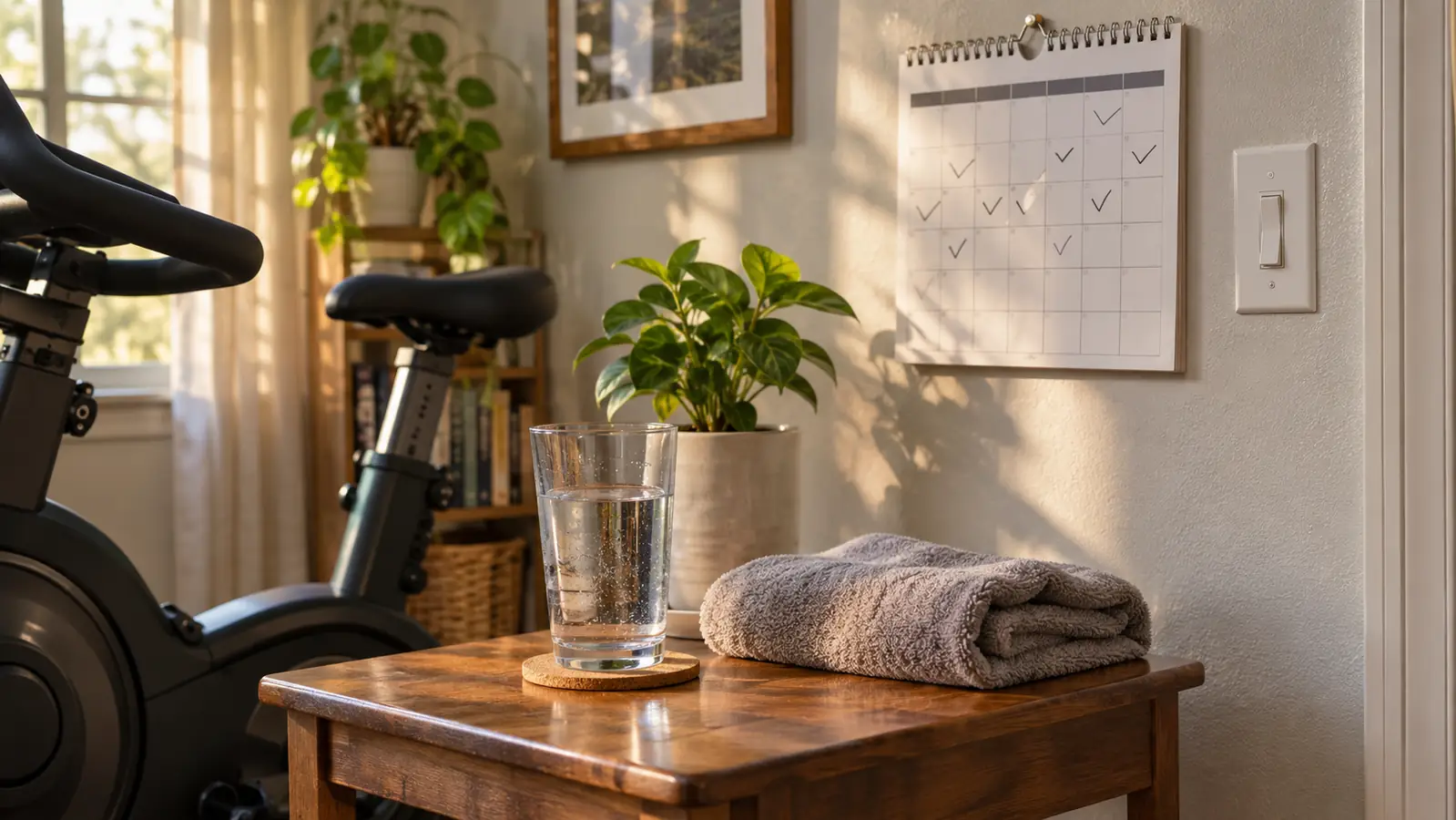
Put the week on a paper calendar on the wall, not in your phone. I say that as a retired teacher who spent thirty-one years watching people ignore reminders. A paper calendar with a check mark is visible from the doorway. Mine is taped beside the light switch, and there is something about seeing eleven checks in a row that makes me unwilling to break the chain.
Decide now what you will do when you miss. The answer is ride the next morning and say nothing about it, not even to yourself. The women I know who stuck with exercise are not the disciplined ones. They are the ones who stopped turning a missed Tuesday into a verdict about their character.
Step 5: Add resistance and time slowly, and know when to stop
Once three sessions a week feels normal, which for me took about six weeks, start adding. Change one thing at a time. Add two minutes to each session and hold that for two weeks. When the time feels comfortable, add a single resistance level and hold that for two weeks before touching anything else. With sixteen levels you have years of room to move, and there is no prize for reaching level twelve in one season.
Use the talk test instead of a gadget. During a low-impact ride you should be able to speak in short sentences. If you are down to single words, back off a level. If you could sing, add one. My doctor also gave me a heart rate ceiling, and I check it once near the start and once near the end rather than staring at the console for half an hour.
Then there is the part nobody puts in a fitness article. Know the signals that mean stop rather than push. Chest pain or pressure. Dizziness or a spinning room. Shortness of breath that does not settle within a minute of slowing down. A knee that swells instead of simply aching. Any of those, you get off the bike and call someone. I have stepped off twice in two years, both times because the knee felt wrong rather than tired, and both times a couple of quiet days fixed it. The bike folds and leans in the corner when the grandchildren visit, so it is never in the way long enough to feel like a reproach.
What Else Helps
A handful of small things made the difference between a machine I used and a machine I walked past. A fan, because even a low-impact ride warms you up more than you expect in a carpeted room with the door shut. A water bottle within reach, because reaching down mid-pedal is exactly the kind of thing that throws an older rider off balance. A pair of flat-soled shoes that live beside the bike, so there is no excuse-hunting. A folded towel over the handlebars. And a plain chair within arm's reach for the first month, not because you will need it, but because knowing it is there makes getting on easier.
The other thing that helps is not making the bike your only movement. I still walk outdoors with a neighbor from April to October, and on days I cannot face the machine I do ten minutes of standing leg raises in the kitchen while the kettle boils. The bike is the anchor of the winter, not the whole boat. If you want the longer version of how this particular machine has held up over two years, there is a full BARWING exercise bike review on this site, and a separate piece comparing this bike against a recumbent if you are still deciding which style suits your back.
The hard part is not the pedaling. It is the distance between the sofa and the bike.
Close that distance and the rest is just eight minutes at a time, three mornings a week, with a backrest behind you and a quiet belt drive under you. That is the whole plan that worked here.
Amazon See the BARWING Bike on Amazon →