
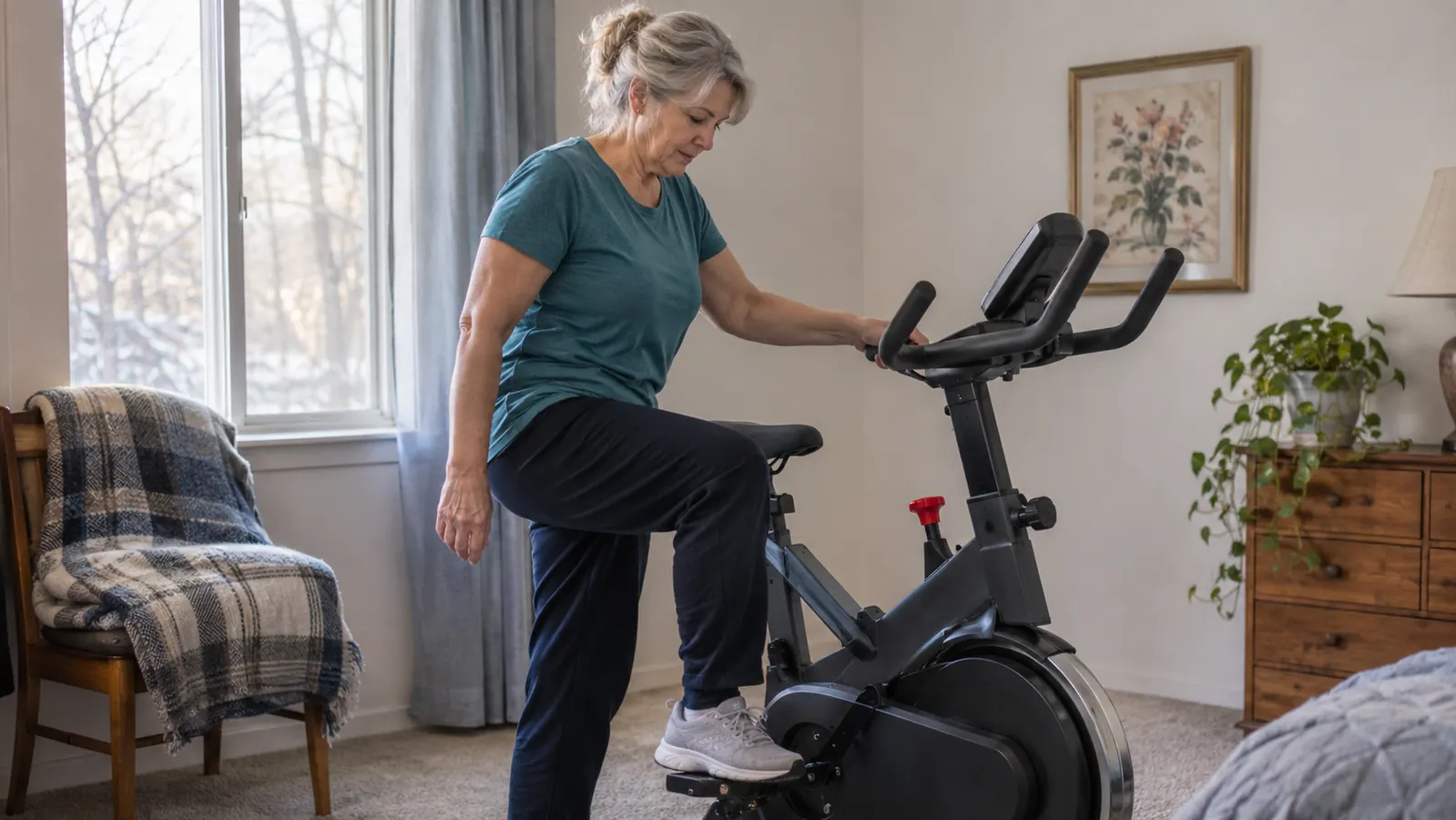
Two winters ago I went down on the ice at the end of my driveway, and nothing has felt quite the same since. Nothing broke. But my right knee, which had been grumbling at me for a couple of years already, started grumbling louder, and my confidence went off somewhere I could not easily find it. My doctor gave me the usual speech. Keep moving. Build the muscles around the knee. Do not spend the winter in a chair. That is easy advice to give in October in Michigan and much harder to follow in February. I am 68, retired after 31 years in a third-grade classroom, and I live in a one-story ranch house outside Flint. I am not a gym person. I do not want to drive anywhere in the dark to exercise. So I cleared out the spare bedroom, did a fair amount of reading, returned one bike that did not suit me, and bought the BARWING foldable exercise bike. That was well over a year ago. This is what long-term use actually looks like.
I want to be clear about what this review is and is not. I am not going to read the box aloud to you and call it a day. What I can tell you is what changed over a year of mornings: the settings I actually use, what my knee does the day after a longer ride, the parts that annoyed me, and who I would and would not recommend this to. If you are over 60 and trying to keep your legs under you through a cold winter, that is the information that matters. Everything else is packaging.
The Quick Verdict
The backrest and the footstraps are what make this work for a knee that complains. I ride it four mornings a week and my knee is better than it was a year ago. It loses half a point for the fold, which is a two-handed job I would not want to do daily.
Amazon Check Today's Price →A bike built for sitting back, not leaning forward
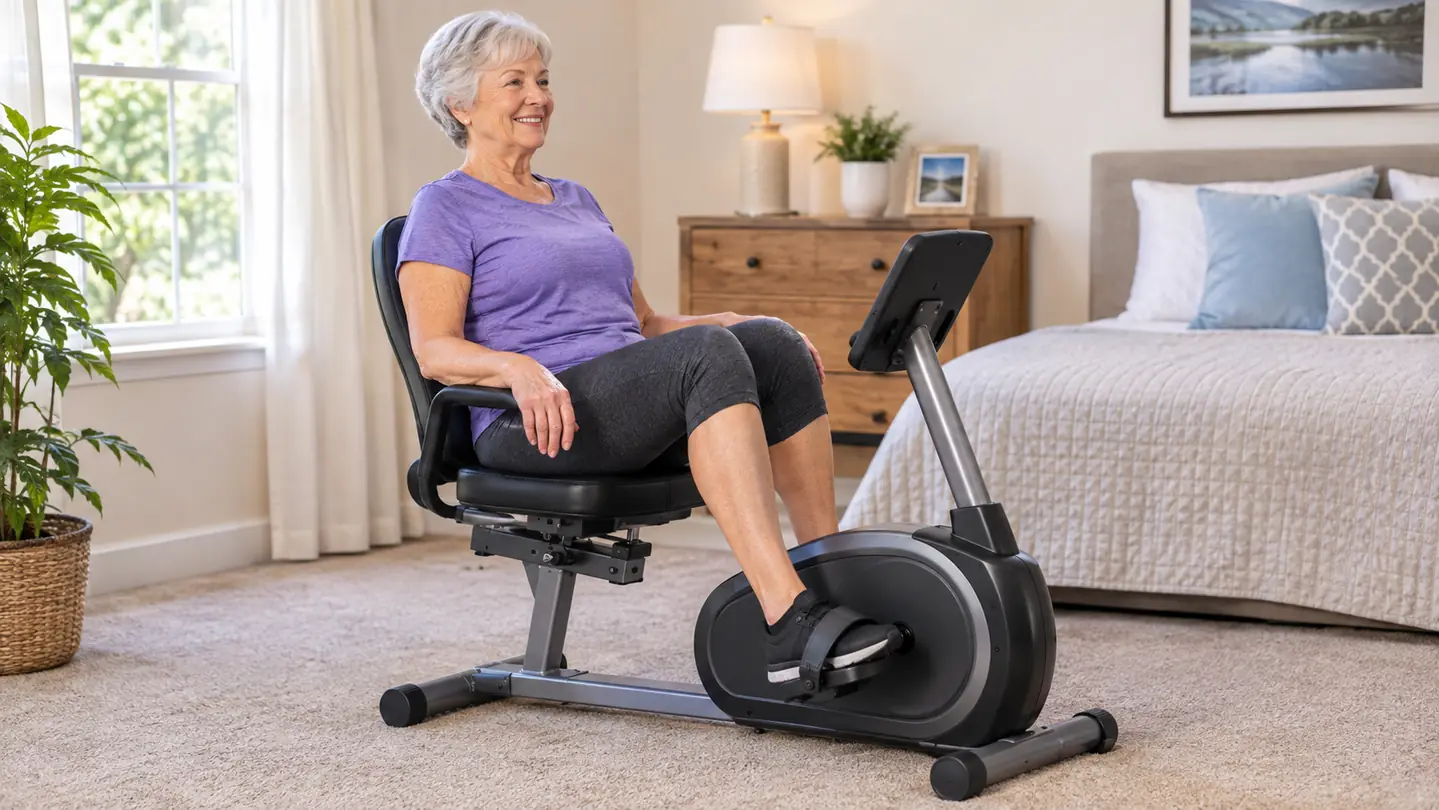
16 levels of magnetic resistance, 8 seat height settings, 2 seat angles, a backrest, and footstraps that keep your feet where they belong. It is the setup I use four mornings a week at 68.
Amazon Check Today's Price on Amazon →How I've Used It
I ride four to five mornings a week, usually right after coffee, for 20 to 30 minutes. Not an hour. I want to say that plainly, because a lot of fitness writing makes it sound like anything short of a dramatic commitment is not worth starting. My version is: I get on, I pedal, I get off, and I go about my day. In the warmer months I still walk outdoors with my neighbor, so the bike becomes the backup. From November through March it is the main thing I do, and it is the only thing standing between me and four months of sitting.
Gene timed me once, from standing in the doorway of the exercise room to actually pedaling, and it was under a minute. That matters more than it sounds. Any piece of equipment that takes five minutes to set up will lose to a recliner every single time, at least in this house. The BARWING sits there assembled and ready, I sit down on it, and I start. There is no unfolding, no moving furniture, no hunting for a part.
I have moved it twice. Once into the living room during a cold snap so I could ride in front of the television, and once back to the spare bedroom. Both moves I did myself. Forty pounds is light enough for that, which was one of my requirements going in. I did not want to wait for Gene to be available every time I felt like changing rooms.
I keep a paper calendar on the wall beside the bike and I put a check mark on every day I ride. Last winter, from the first week of November to the end of March, there were 94 check marks. I am not telling you that to impress you. I am telling you because before this bike, that same calendar had about eleven marks on it for the entire winter, and most of those were from shoveling. That is the honest measure of what changed. Not my resting heart rate, not a number on a screen. Ninety-four mornings where I got my legs moving instead of sitting down with a second cup of coffee and the newspaper.
What the 16 Resistance Levels Actually Feel Like
This is where reviews tend to overpromise, so let me be plain. The bike has 16 levels of magnetic resistance. Level 1 is close to pedaling downhill. Level 16 is a genuine grind and I have never spent real time there. I ride between level 3 and level 6, and after a year I have crept up to where level 5 now feels the way level 3 felt that first month. That is the whole point of owning the thing. The number you land on matters less than the fact that there is room above you to grow into.
What I appreciate about magnetic resistance is that it does not change the sound. A friction pad dragging against a wheel gets louder the harder you work, and there is something discouraging about that noise. This one stays quiet no matter where I set it. The listing says under 20 decibels and I cannot verify a number like that with my own ears, but I can tell you that Gene watches the news in the next room and has never once turned it up because of me.
The change between levels is gradual rather than sudden. There is no clunk, no jolt through the pedals, no moment where the bike suddenly fights back. For somebody with a knee that complains, that smoothness is worth more than a wider resistance range would be. I would rather have 16 gentle steps than 8 dramatic ones.
The jump from level 3 to level 4 happened in late January, and I remember it because it did not feel like anything at the time. I had been at level 3 for weeks, pedaling along while the radio played, and one morning I noticed my feet were going faster than the resistance wanted them to. The pedals were chasing each other. So I turned it up one notch and finished the ride. That is how it should go. No ceremony, no program to follow, no voice telling me to push harder. If you are the kind of person who needs a coach in the room, this is not that. If you are the kind who just wants the pedals to feel right on a Tuesday, it is exactly that.
The Seat, the Backrest, and My Right Knee
There are 8 seat height adjustments and 2 seat angle adjustments. I landed on setting four for height and the more upright of the two angles, and I have not touched either since about the third week. That is not a complaint. It means the adjustments did their job and then got out of the way.
The backrest is the reason I bought this instead of a plain spinning bike, and it is the reason I still use it. On a standard indoor bike you lean forward with your hands out in front of you, and that position asks a great deal of a knee that does not fully straighten anymore. Sitting back with support behind me, I can pedal for 25 minutes and my knee is fine afterward. On the upright bike I tried at a store, my knee was talking to me within 10 minutes. That was the whole decision, right there.
The footstraps matter more than I expected. I have a bad habit of letting my right foot drift toward the outside of the pedal, which throws the whole leg line off and puts a twist through the knee. Strapping in keeps the foot where it belongs. The difference in how my knee feels the next morning is not dramatic, but it is real and it is consistent, and after a year of mornings I have stopped discounting it.
Finding the right seat height took me about a week of fiddling, and I will save you the same trouble. Sit on the bike with your heel on the pedal at the bottom of the stroke. Your leg should be nearly straight, but not locked. I started at setting three, which felt comfortable for the first two minutes and cramped by minute twelve, and moved up to four. That was the fix. The first week my right knee was a little sore the evening after a ride, not sharp, just tired, and I cut back to 15 minutes for a few days until it settled. If your knee swells or the soreness lasts past the next morning, stop and call your doctor. That is not something to push through.
The Fold, the Noise, and a Spare Bedroom
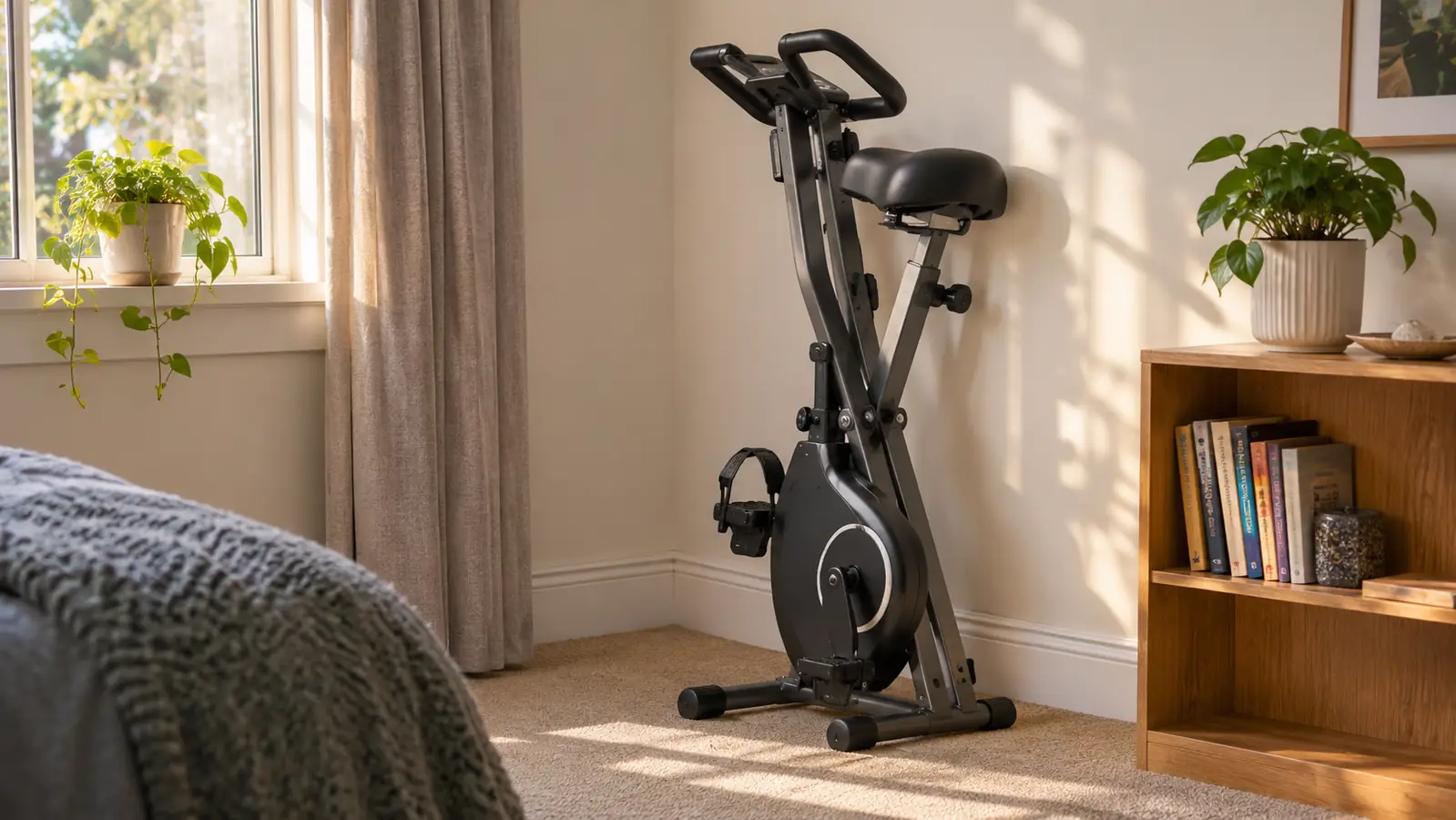
The bike measures 36 inches deep, 18 inches wide and 45 inches tall, and it weighs 40 pounds. In my exercise room it sits against the wall and I do not think about it. When the grandchildren visit and need floor space to spread out, I fold it and stand it in the corner. Folding takes me around half a minute and it is a two-handed job. I would not want to do it twice a day. Twice a month is nothing.
The frame is alloy steel and it does not wobble. I have never felt it shift underneath me, not once, and I am not a small woman. The listing gives a 350 pound capacity and I have no reason to doubt it. What I notice more than the weight rating is the absence of creaking. A cheap bike starts groaning at the joints after a few months, and then you begin skipping rides because the sound gets on your nerves. This one has been silent for a year.
The console is basic and I mean that kindly. It tells me what I need at a glance and it does not ask me to pair anything, download anything, or create an account. For a 68-year-old who does not want a second phone in her life, that is a feature. I glance down once or twice a ride. The rest of the time I am watching the clock on the wall or listening to the radio.
Before I bought anything I measured the room with a metal tape and put two strips of masking tape on the carpet where the bike would sit. Thirty-six inches deep and eighteen wide. That tape stayed down for a month while I decided, and it was worth the trouble, because the first bike I ordered was wider than the tape and I knew it the moment I stood it up in the doorway. The BARWING fit inside the marks with a couple of inches to spare. At 45 inches tall it comes up roughly to the window sill in that room, so it does not block the light, which sounds like a small thing until you are riding in February and the only daylight you get all day is coming through that window.
What I Liked
- The backrest lets me ride 25 minutes with a knee that cannot fully straighten
- 16 resistance levels with gradual steps and no jolt through the pedals
- Quiet enough that Gene watches the news in the next room without turning it up
- 8 seat heights and 2 seat angles, so I found my setting in the first month
- Footstraps keep my right foot from drifting and twisting the knee
- 40 pounds and it folds, so I move it and store it myself
- Steel frame, no wobble, no creaking after a year of use
Where It Falls Short
- Folding takes two hands and about half a minute, so it is not a daily habit
- Levels 12 through 16 are beyond anything I will ever need
- The console is plain. If you want guided programs or tracking, look elsewhere
- At 45 inches tall it is not a compact object when it is set up
I ride between level 3 and level 6, and after a year level 5 feels the way level 3 felt that first month. That is the whole point of owning the thing.
Who This Is For
This bike suits someone who wants to keep moving through a winter without leaving the house, and who needs to do it sitting back rather than leaning forward. If your knees, hips or balance have started making decisions for you, the backrest and the footstraps are not small details. They are the reason the bike gets used instead of becoming a place to hang a bathrobe.
It also suits anyone who has tried a gym and quietly given up on it. I am not going to pretend I loved driving to a building at 7 a.m. I did not. Having the thing in the next room removed the excuse, and removing the excuse turned out to be most of the battle. Start with 15 minutes on a low setting. I did, and I stayed at 15 for the first two weeks before adding time. Check with your doctor first if you have a heart condition, a recent replacement, or anything that makes exercise a medical question rather than a practical one.
Who Should Skip It
If you want a serious training machine with guided programs, a large screen, and a standing climb out of the saddle, skip this. The BARWING is a sit-back bike with a backrest, and it is not pretending otherwise. Riders who are already fit and want resistance that escalates fast will find levels 1 through 6 too gentle and the console too plain.
Skip it too if you plan to fold and unfold it every single day. The fold is honest and it works, but it is a two-handed job, and a daily version of that would wear on me. And if you have no floor space to leave it set up at all, be realistic about whether you will actually do the folding. I have a spare bedroom. That is a luxury, and I know it.
Start with 15 minutes on level 3. Decide about the rest later.
That is how I began, and it is still roughly where I live a year on. Backrest, footstraps, 16 magnetic levels, and a fold that gets it out of the way when the grandchildren visit.
Amazon See Today's Price on Amazon →