Two winters ago I stepped out my side door onto a driveway that had iced over overnight, and my feet went out from under me before I knew what was happening. Nothing broke. But something in my head changed, and for months afterward I walked like a woman expecting the floor to move. My doctor gave me the usual speech: keep moving, build the legs back up, and work on balance on purpose instead of hoping it returns on its own.
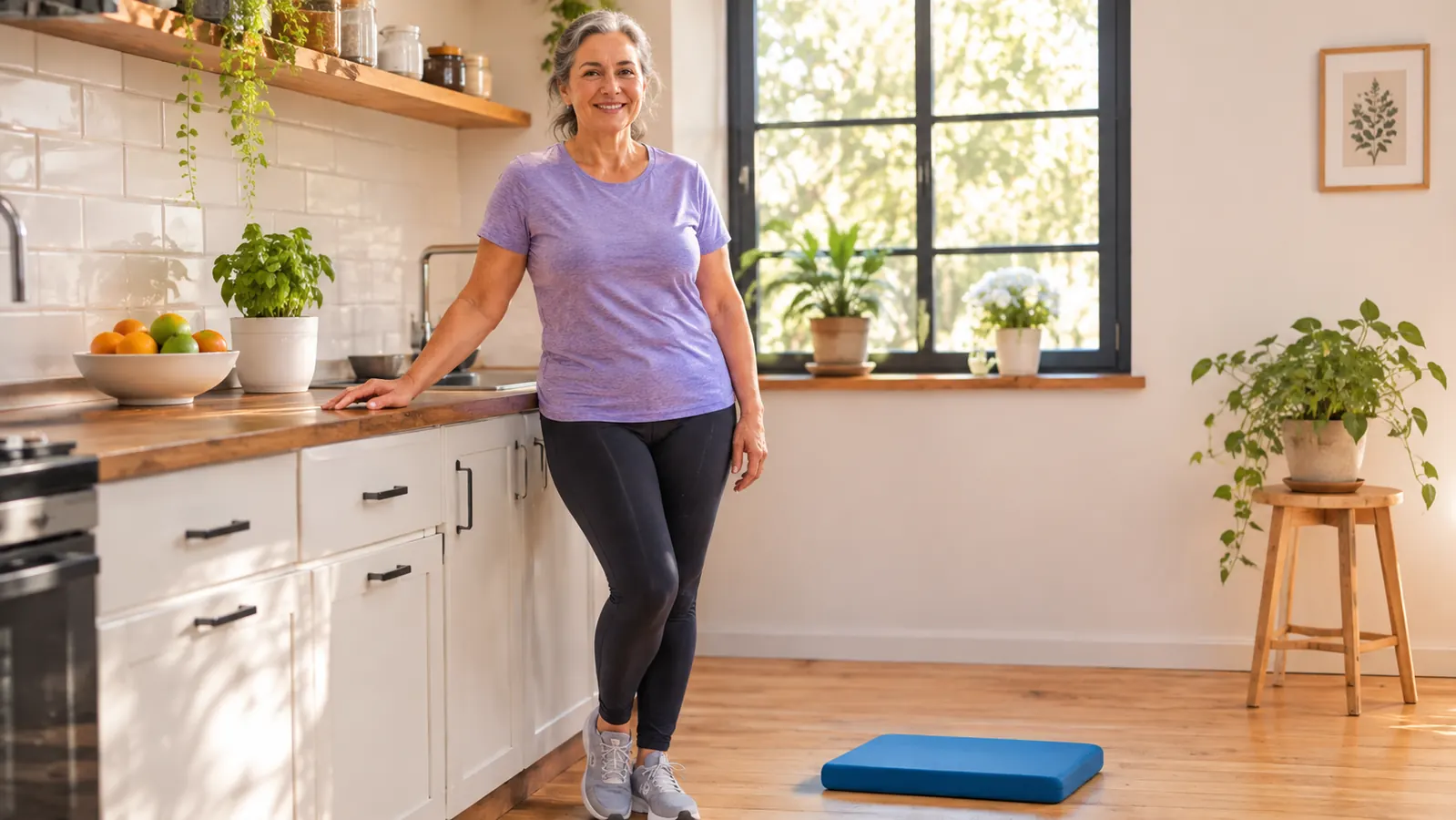
So I did what I used to do with a room full of third graders, which is break a big frightening thing into small steps and do the small steps in order. The piece of equipment that made it click was a foam pad from ProSource, the Exercise Balance Pad, 15.5 by 12.75 inches and 2.25 inches thick. It is not a gadget. It is a rectangle of dense foam that refuses to sit perfectly still under you, which is the entire point. I am 68, I have mild osteoarthritis in my right knee, and I do this on a carpeted floor in a spare bedroom outside Flint, Michigan, in February. If it works here, it will work in your living room.
One Pad, One Counter, Ten Minutes a Morning
The ProSource Exercise Balance Pad is the only piece of equipment this routine needs. It weighs 12 ounces, so it goes behind the couch when the grandchildren visit, and it comes with a limited lifetime warranty.
Amazon See the ProSource Balance Pad on Amazon →The Five Steps, In the Order I Would Do Them
Step 1: Get Cleared, Then Pick a Spot You Cannot Fall Into
Call your doctor's office before you buy anything. I know how that sounds, and I know it is tempting to skip because you are only standing on a piece of foam. But balance work is the one kind of exercise where the floor is a real risk, and there are conditions that change the math: inner ear trouble, numbness in the feet, a knee or hip replacement, blood pressure medicine that makes you dizzy when you stand up. My doctor looked at my right knee, asked about the dizzy spell I had mentioned the year before, and told me to keep a counter within reach for the first month. That was the whole conversation. Four minutes, and worth it.
The spot matters as much as the pad. What you want is a place where a wobble turns into a hand on a counter instead of a fall, so a kitchen counter, a sturdy table, or the back of a heavy chair all work. Mine is the counter beside the sink, because it sits at waist height and my hand lands there without me thinking about it. Do not use a folding chair, a walker with wheels that will slide away from you, or a doorway where somebody might come through. Clear the floor around you and keep a phone in your pocket for the first few weeks.
One more arrangement, and this comes from someone who spends her afternoons alone in the house while Gene is out. For the first two or three sessions, do this when someone else is home, or at least when a neighbor knows you are up and moving around. I did not think I needed that. It costs nothing to arrange and it means a stumble stays a stumble.
Step 2: Set a Baseline You Can Actually Measure
Before you get a number on the pad, get a number on the floor. This is the part people skip, and it is the main reason people quit in week three. Balance gains are slow and quiet, and by the time you finally notice them you have already talked yourself into believing nothing is happening. A baseline fixes that.
Here is the test I use, all of it done barefoot or in flat shoes, standing beside the counter with one hand hovering and not holding. First, feet together and eyes open: count the seconds until you have to grab. Then a semi-tandem stance, which means one foot half a step ahead of the other, the heel of the front foot beside the toes of the back foot. Then one foot only, with two fingertips on the counter, and count that one too. Stop counting the moment you touch the counter, not the moment you fall over.
Write the three numbers on the calendar in the kitchen. Mine, the first week of January two years ago, were twenty-eight seconds with feet together, eleven in semi-tandem, and four on one foot. Writing them down felt silly and childish, like a spelling test posted on the refrigerator. It is also the reason I stuck with it, because six weeks later the one-foot number was nine, and I could see the change in my own handwriting.
Step 3: Start With Standing Holds on the Pad
Now the pad. The ProSource pad is 15.5 inches long, 12.75 inches wide and 2.25 inches thick, and at 12 ounces you can move it with two fingers. It is made of a foam called thermoplastic elastomer, which gives just enough underfoot that your ankles have to make constant small corrections. That is the whole trick of it, and it is why a folded towel will not do the same job. A towel squashes flat and you stop working.
Set the pad on carpet or a rug that will not slide, near your counter. Step on with both feet about hip width apart and let your hands hover at waist height over the countertop. Stay for twenty to thirty seconds, step off, and rest for a full minute. Three rounds is plenty. The first time I did it, thirty seconds felt like a very long time and my ankles were having a loud conversation with me. That is normal. It settles.
When standing with both feet starts to feel boring, narrow your stance before you add anything else. Feet closer together is harder than feet apart, which surprises people who assume progress always means adding movement. Next, try a staggered stance with one foot half a step forward, and switch which foot is forward on the second round, because most of us have one side that is noticeably worse and it helps to know which. Save eyes-closed work for much later, and never do it without a hand on the counter.
Step 4: Add Slow Movement Once the Holds Feel Steady
Once you can stand on the pad for thirty seconds without grabbing, add movement. The rule is slow. Not slow-ish, not a normal pace with good posture, actually slow, the way you would carry a full cup of coffee across a room. Slow is what forces your legs to work on the wobble instead of riding straight through it.
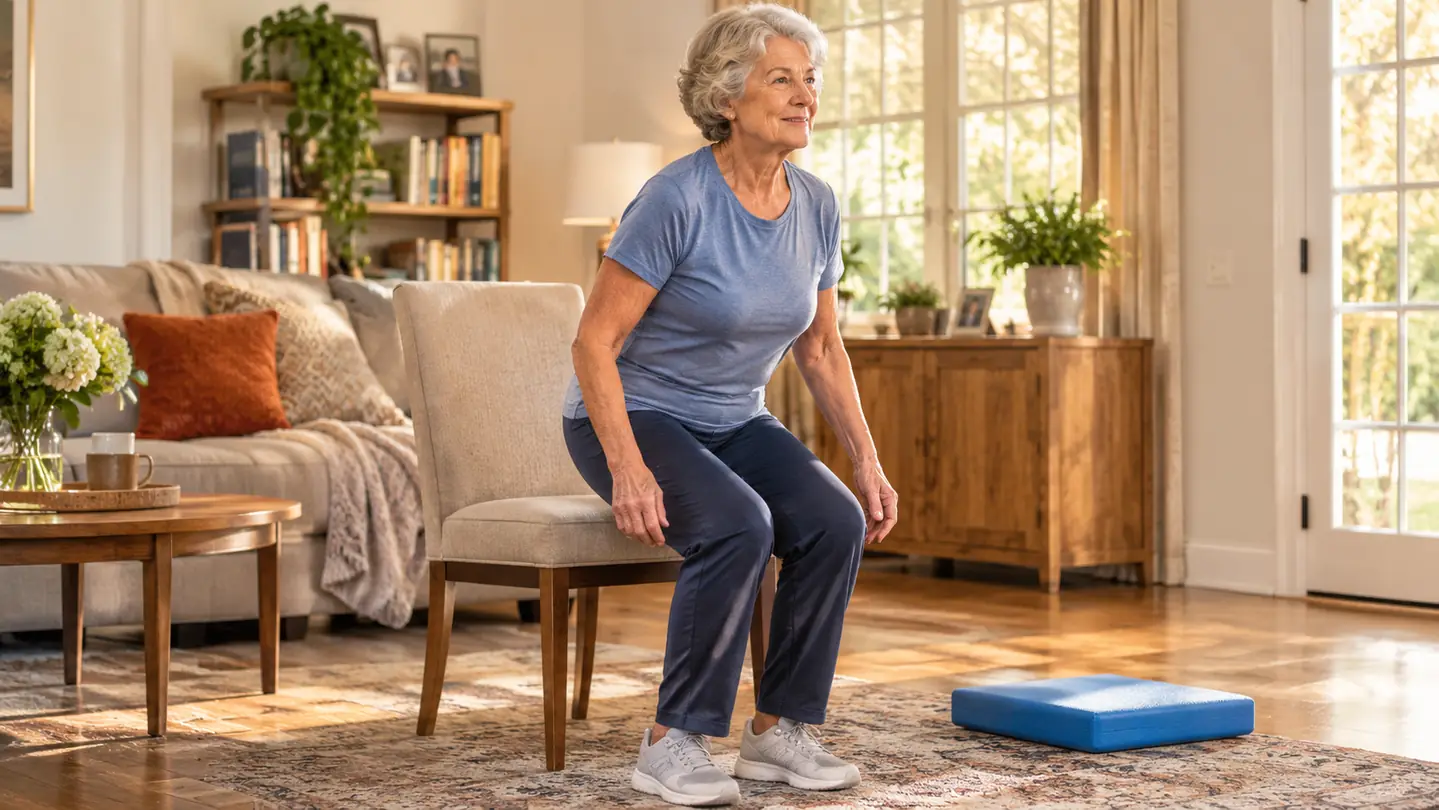
Four movements cover it. First, weight shifts: lean toward one foot and back to center, eight times each side, counting three seconds out and three seconds back. Second, slow marches: lift one knee to about the height of a step, hold it for a beat, set it down. Third, a shallow squat, no deeper than a chair would take you, knees staying over the toes, weight through the middle of your foot. Fourth, step taps: tap one foot off the front edge of the pad onto the floor and bring it back, which is harder than it sounds because of the change in height.
My right knee is the reason I am specific about the squat. Osteoarthritis does not care for a deep bend or a knee that caves inward, so I keep the range small and watch the kneecap in the hallway mirror. If your knee complains during the movement rather than after it, stop and shorten the range. If it complains the next day, you did too much, and you should cut the repetitions before you cut the whole routine.
Step 5: Progress One Variable at a Time and Write It Down
Change one thing at a time and give each change two weeks before you judge it. The things you can change are seconds, foot position, eyes open or eyes closed, and whether you add movement on top. If you change all four at once and it goes badly, you have no idea which one was too much, and the temptation is to decide the whole idea does not work for you.
Repeat the three floor tests every four weeks, on a day when you feel ordinary, not your best day and not your worst. Keep the numbers on the same calendar page. This is where the pad earns the space it takes up, because after eight or ten weeks you own a row of numbers that either moved or did not, and either answer tells you what to do next.
The other half of progress is knowing when to back off. Some mornings the floor feels farther away than usual, often when I have slept badly or my knee is swollen. On those mornings I do the holds with both feet and skip the movement, or I skip the pad and just run through the floor tests. That is not failure. That is the routine doing what it is supposed to do. The people who get hurt are almost always the ones who refused to take an easy day.
What Else Helps
Balance is not one skill in one place. It is leg strength, ankle movement, eyes, inner ear and confidence all reporting to the same office, and if you train only one of them you will hit a ceiling. The best addition to pad work costs nothing: a chair. Sit-to-stands, ten of them, no hands, done slowly, build the thigh and hip strength that catches you when you trip. Heel raises at the kitchen sink, twenty of them, build the calf and the ankle.
Walking counts, even in February in Michigan. When the sidewalks are bad I walk laps in the hallway and around the living room, which sounds ridiculous and does the job. In warmer weather I walk with a neighbor three or four mornings a week, about a mile, and the conversation is the reason I keep it up. Walking practice is balance practice, because every step is a small controlled fall that you catch.
Then look at the house itself. Most of the falls I hear about among my own friends did not happen during exercise. They happened on a throw rug, in a dark hallway at two in the morning, or on a wet bathroom floor. Night lights in the hallway and the bathroom, grab bars where you actually put your hands, rugs either taped down or gone, and slippers with a back on them instead of the slip-on kind. None of that is exercise and all of it counts.
Two more things worth doing once. Get your eyes checked, because vision is a balance organ whether or not anybody calls it one. And bring your medication list to the pharmacy and ask whether anything on it can cause dizziness. I found out one of mine could, and the fix was a change in when I took it, not a new prescription. I would not have worked that out on my own, and the trip was worth it.
By week ten I could stand on one foot long enough to count to twenty-two. In January, I could not get past four without grabbing the counter.
Ten Weeks From Now You Will Want the Numbers
Everything in this routine happens on a 15.5 by 12.75 inch piece of foam and a kitchen counter. Start with the floor tests today, then put the ProSource pad down on the carpet tomorrow morning.
Amazon Start My Morning Routine on Amazon →