Two winters ago I came down my own driveway on a patch of ice and landed hard on my back. Nothing broke. But something in my head did. For weeks afterward I walked like a woman expecting the floor to move under her, and my right knee, which has carried mild osteoarthritis for a few years now, ached every evening by five o'clock. My doctor gave me one instruction and no equipment list. Keep moving, he said, and build the muscles that catch you when you stumble.
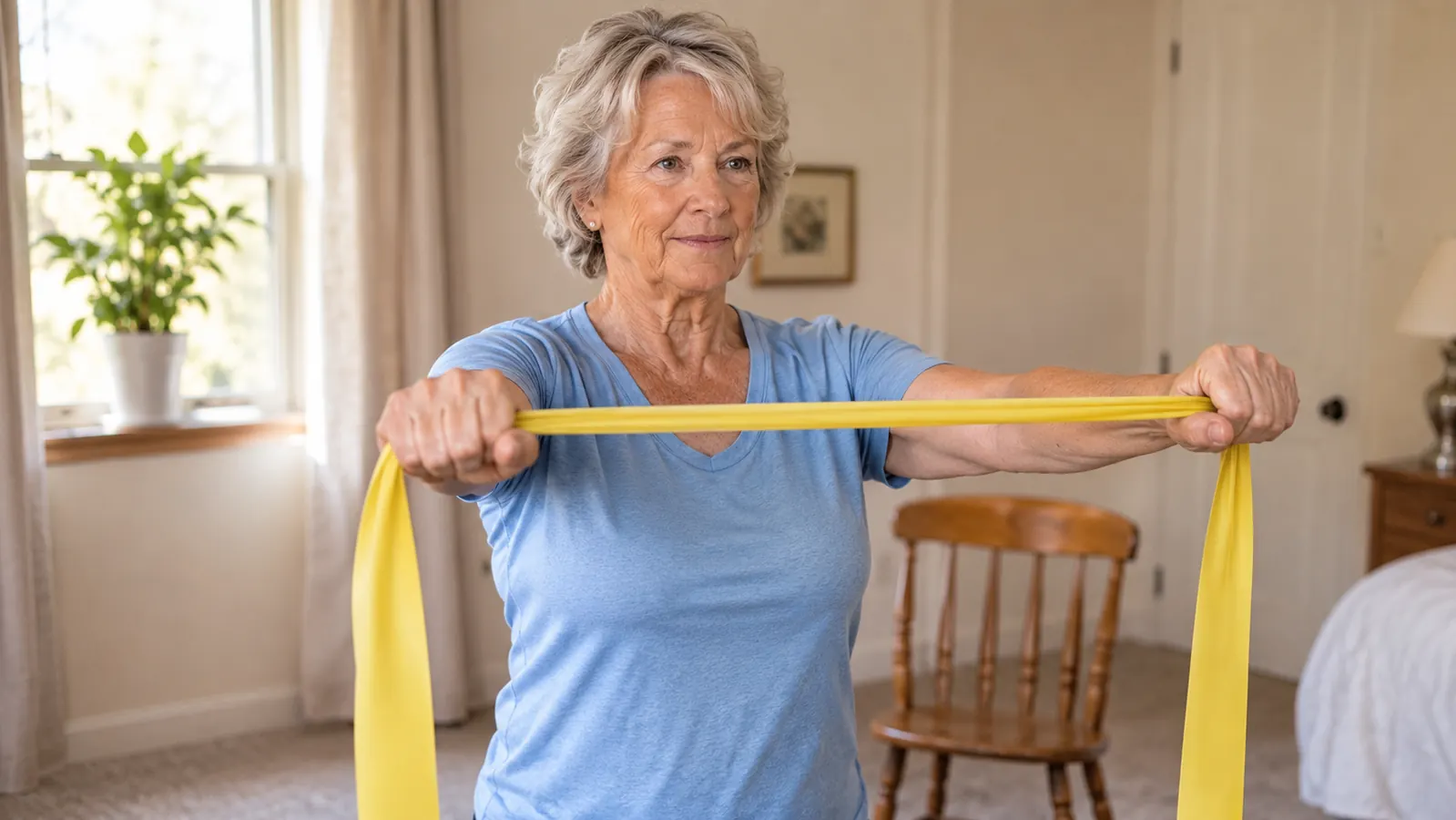
I did the wrong thing first, the way most of us do. I ignored it for a month. Then I bought a pair of heavy dumbbells at a garage sale and hurt my shoulder inside of a week, because a 68 year old woman who has not lifted anything heavier than a bag of groceries in twenty years cannot start where a 30 year old starts. What finally worked cost less than lunch out and lives in my sock drawer: flat elastic bands. I use the THERABAND resistance band set, the light ones, most mornings in the spare bedroom with the carpet and the good window light.
I have worked with them for going on two years now. My knee still clicks. But I take the stairs at church without holding the rail, and when the driveway iced over last February I caught myself instead of falling. This is how I got there, step by step, and how you can start this week without buying a gym membership or a single piece of equipment that takes up floor space.
The three light bands I started with, and still reach for first
Long flat bands, 5 feet by 4 inches, rated roughly 3 to 6.7 pounds of resistance. That sounds like nothing. It is not nothing when you are starting from a chair. Non-latex, and the whole set weighs less than two ounces.
Amazon Check Today's Price on Amazon →Step 1: Get the all clear, then set a floor instead of a goal
Before I touched a band, I sat in a chair across from my doctor and asked one question. Not what should I do, but what should I not do. That second question is more useful, because it tells you where the edges are. For me the edges were no jumping, no deep squats past a certain point, and stop immediately on any sharp pain rather than pushing through it. If you have a heart condition, a recent surgery, a replaced hip, or you are on blood thinners, have that conversation before you start. It costs one co-pay and it is the only part of this plan I will nag you about.
Then set a floor. Not a goal. A goal is what you hope to do on a good day, and a floor is the smallest amount of work you will do on your worst one. My floor is eight minutes and three movements, done in the exercise room before Gene has finished his coffee. Yours might be five minutes of seated work in the living room. The reason this matters is simple. A goal you miss makes you feel like a failure and you quit. A floor you keep makes you a person who exercises, and people who exercise keep exercising. That is the whole trick.
Step 2: Learn where the band anchors and how to hold it
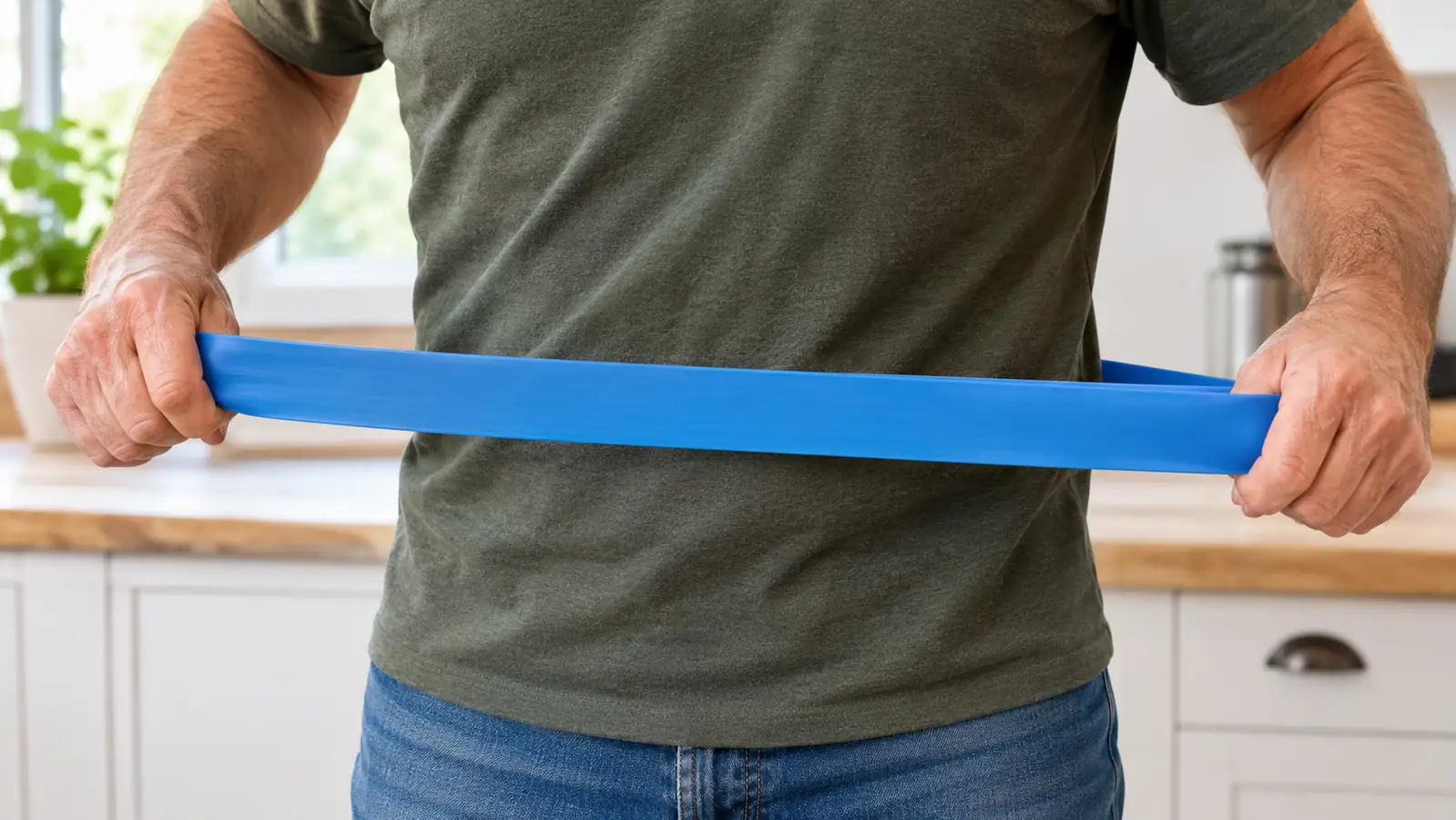
A flat band has no handles and no clips. That is not a flaw, it is the design. You get one long strip, 5 feet by 4 inches, and you create your own attachment points out of it. Three positions cover nearly everything you will do at home. First, looped around something that will not move: a stair newel post, the leg of a heavy sofa, a closed door with the band passing through the hinge side. Second, trapped under your foot or under both feet, which is how you do rows and curls. Third, held with both hands and stretched across your own body, which is how you do a chest press with no furniture at all.
The grip matters more than people expect. Wrap each end around your hand once or twice so the band sits across your palm and not across your fingers, then close your hand loosely. You are not strangling it. Keep the band flat, not folded or twisted, because a twisted band pulls unevenly and that is how wrists get sore. And never let go of a stretched band. It snaps back fast. I learned that one in the first week and I still have the mark on my forearm to prove it.
The third thing to learn is slack. At the start of a movement, the band should be loose. It should only go tight as you move into the hard part, and then you bring it back slowly against that tension. Most beginners set up already stretched tight and then wonder why their shoulders ache. Start loose, finish tight, come back slow. That single habit is the difference between the THERABAND set feeling gentle and feeling like a fight.
Step 3: Choose five movements and stop there
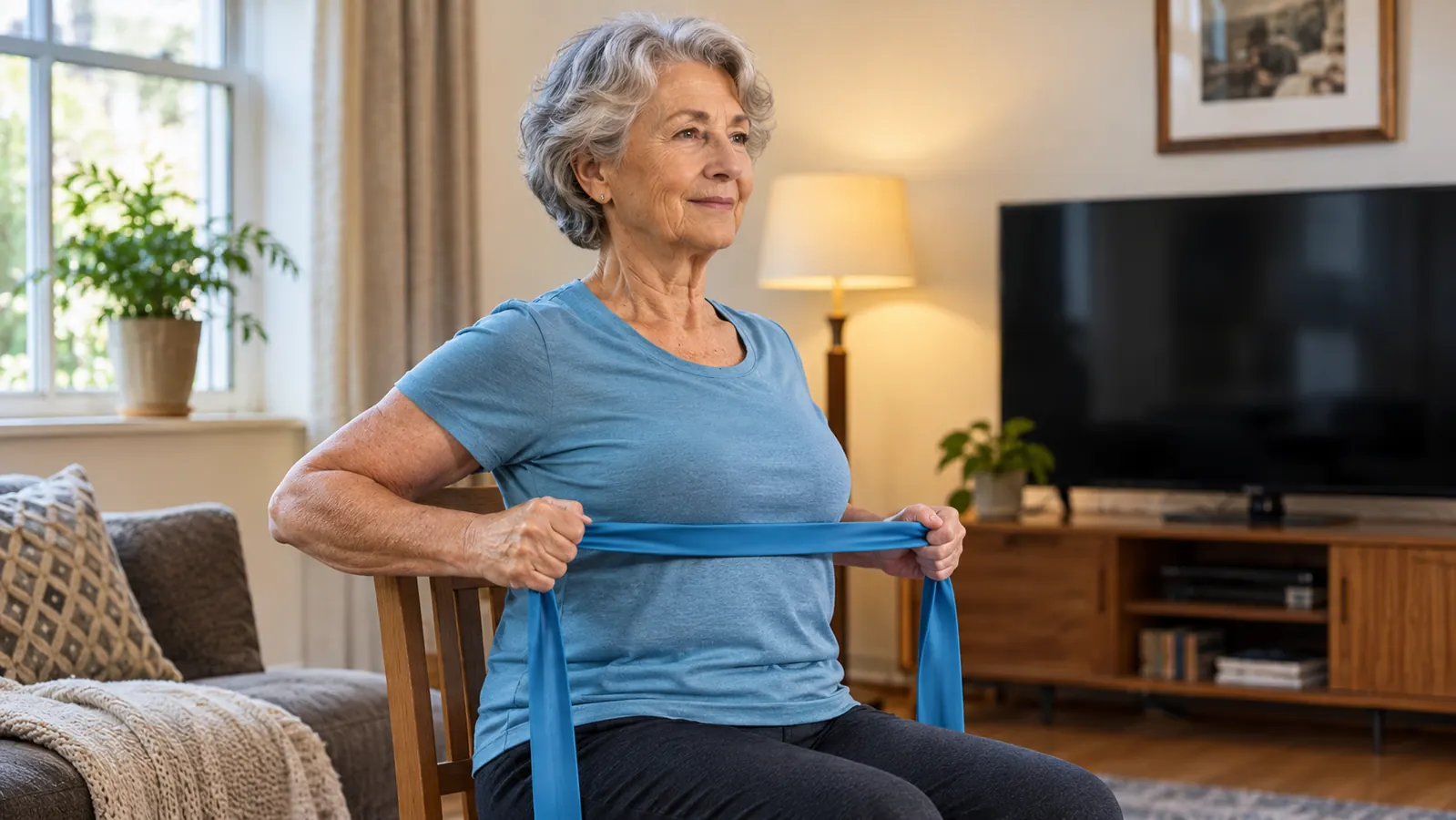
You do not need a program with forty exercises in it. You need five that cover the parts that catch you when you fall and the parts that get you out of a chair. Mine are these. A seated row, with the band looped around a post at chest height and pulled back toward your ribs. A chest press, pressing forward from your sternum. A biceps curl standing on the band. A side step walk with the band looped around both ankles. And a seated leg press, with the band around one ankle and the other end around the leg of a heavy chair, pressing the foot forward slowly.
Start with one set of eight to ten of each, and take two full seconds going out and three coming back. Counting the seconds feels fussy. Do it anyway, because speed is what turns a gentle movement into a strain. Between sets, sit down and breathe. If you cannot hold a conversation during the set, the band is too heavy or you are moving too fast, and both of those are fixable.
Here is what soreness should feel like. The next morning, the muscle should feel used, like you carried something yesterday. That is fine, and it fades in a day. What is not fine is anything sharp, anything that shoots, or a joint that hurts more after than before. Muscle tiredness is the goal. Joint pain is a stop sign. I say that plainly because I ignored it once and lost three weeks.
Step 4: Put it on a schedule you will actually keep
I do this three mornings a week, after coffee, before the day gets its hooks in me. Twenty minutes on a good day, eight on a bad one. From November to March in Michigan there is no walking outside, so this is the whole of my exercise for five months of the year, and it has been enough. Two days on, one day off is the shape of it, though I will confess I have never once looked at a calendar to check.
The practical part is making it easy to say yes to. I leave the band looped over the doorknob of the exercise room overnight, so the setup is walking through a door. I put my shoes by the chair. I lay out a towel on the carpet because the floor is cold. And when I miss a week, and I have, I restart one step down rather than trying to make up for lost time. You cannot bank exercise. The only thing that works is starting again at the level you are actually at, not the level you were at three weeks ago.
Step 5: Add tension before you add a single rep
The set comes with three resistance levels, rated roughly 3 to 4.3 pounds, 3.7 to 5.5 pounds, and 4.6 to 6.7 pounds. They are colour coded so you can tell them apart on the hook, and you will learn yours within a week. The jumps between them are small on purpose. That is exactly what you want at 68, because it means progress happens in steps your tendons can keep up with.
The rule I use: when ten repetitions feel like eight, move up. In other words, when you finish a set and could honestly do three or four more with the same good form, it is time for the next band. Do not move up because it has been two weeks. Move up because the movement got easy. And if the next band feels like too big a jump on one exercise, keep the lighter band and slow the tempo down instead. Slowing down is underrated and it costs nothing.
I will be honest about the limit here. This THERABAND set tops out around 6.7 pounds, and after about a year I was doing more sets rather than heavier ones. Eventually, if you keep going, you will want a heavier band or a set of light hand weights for your legs. That is not a flaw in the product. Light bands are for exactly one job, which is getting a body moving again safely, and they do that job better than anything heavier will.
What Else Helps
Walking, when the weather allows it. I walk with a neighbour three or four mornings a week from April to October, and it does something the bands cannot, which is teach your balance while you are moving. A sturdy chair with no arms, set in the middle of the room, is the second most useful thing I own. I hold the back of it for balance during standing work and I sit on it for everything seated. You do not need a bench or a mat or a mirror.
Stand on one foot at the kitchen counter while the kettle boils. Ten seconds each side, one hand lightly on the counter, and build from there. That is balance work, and it is free. Drink water before you start, not after, because older bodies are already behind on that and exercise makes it worse. And if a movement hurts in a way that makes you wince, drop it from the routine for two weeks and try it again lighter. Nothing in this plan is mandatory except showing up.
A year ago I could not stand up from a low chair without pushing off the arms. Last week I did ten in a row, and the only things that changed were three flat rubber bands and a wooden chair.
One last thing, and then I will get out of your way. The hardest part of this is not the exercise. It is the fifteen minutes before the exercise, when you are deciding whether to bother. What got me past that was lowering the bar until it was almost silly. Eight minutes. Three movements. A band on a doorknob. You can talk yourself out of an hour at a gym. It is very hard to talk yourself out of eight minutes in your own spare bedroom, and that is precisely why it works.
Start with the lightest band, not the middle one
Three flat bands, 5 feet long and 4 inches wide, roughly 3 to 6.7 pounds of resistance, non-latex, and light enough to hang behind a door. Buy it, hang it on the knob, and do eight minutes tomorrow morning. That is the entire plan.
Amazon Check Today's Price on Amazon →