
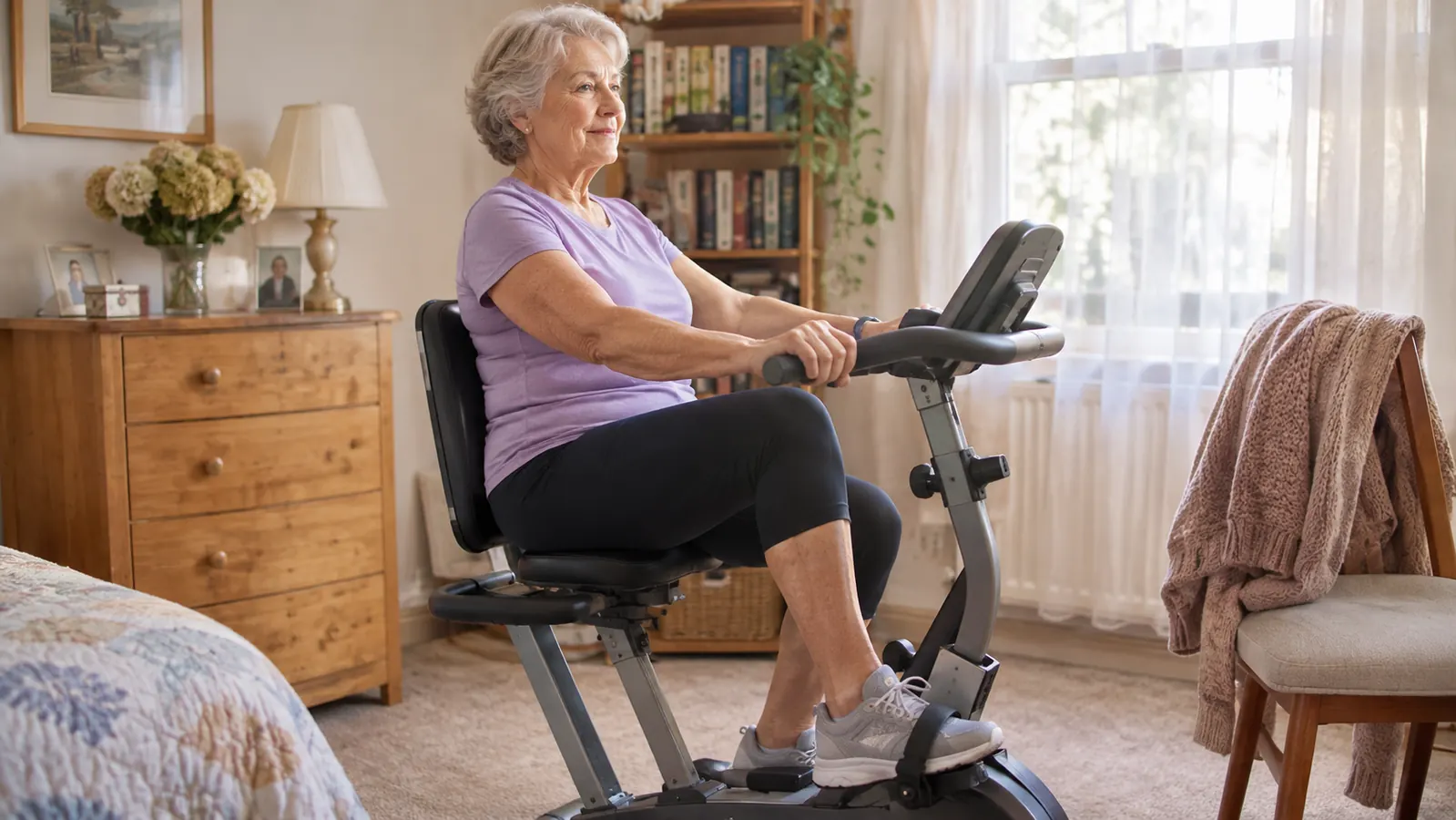
I bought the BARWING folding exercise bike in February, which in Michigan is the month where you either find a way to keep moving indoors or you quietly lose the habit until April. I am 68. I have a touch of osteoarthritis in my right knee and a healthy fear of ice since I went down on my own driveway two winters back. My doctor's instruction was not complicated. Keep the knee moving, build the muscle around it, and do not fall. The bike was supposed to be the boring, indoor, nothing-to-trip-over part of that plan.
Here is the rule I have for anything that comes into this house: I want to know what it is like on a Tuesday in week six, not what it looks like in a photograph. So this is not an unboxing. It is the honest version, which means the annoying parts get the same room as the parts that work. If you are past sixty, if your knees have opinions about winter, and if you are trying to work out whether a folding bike is real equipment or a clothes rack with pedals attached, this was written for you.
The Quick Verdict
Quiet, steady, and easy to tuck behind a door. The backrest and the eight seat heights are what make it usable with a sore knee. The sixteen resistance steps feel more like ten, and the console never earned a place in my morning.
Amazon Check Today's Price →Folds Into a Corner and Rides Quiet Enough for a Sleeping House
The BARWING carries a 350 pound rating, runs on a magnetic belt drive, and takes up a strip of carpet in a spare bedroom. See today's price and the current seat height range on the listing.
Amazon Check Today's Price on Amazon →The First Thing Nobody Tells You: The Fold Is the Whole Point, and It Is Not a Magic Trick
The bike measures 36 inches deep, 18 wide and 45 tall when it is standing, and it weighs 40 pounds in an alloy steel frame. Those are the published numbers and they held up on my carpet. I measured the corner first, with Gene's tape measure on a Saturday morning, because I have bought furniture that looked small in a photograph and then ate a doorway when it arrived. Thirty-six inches of depth is roughly two kitchen chairs pushed together, which told me more than the number did. I moved a small bookcase to the other wall and that was the entire renovation.
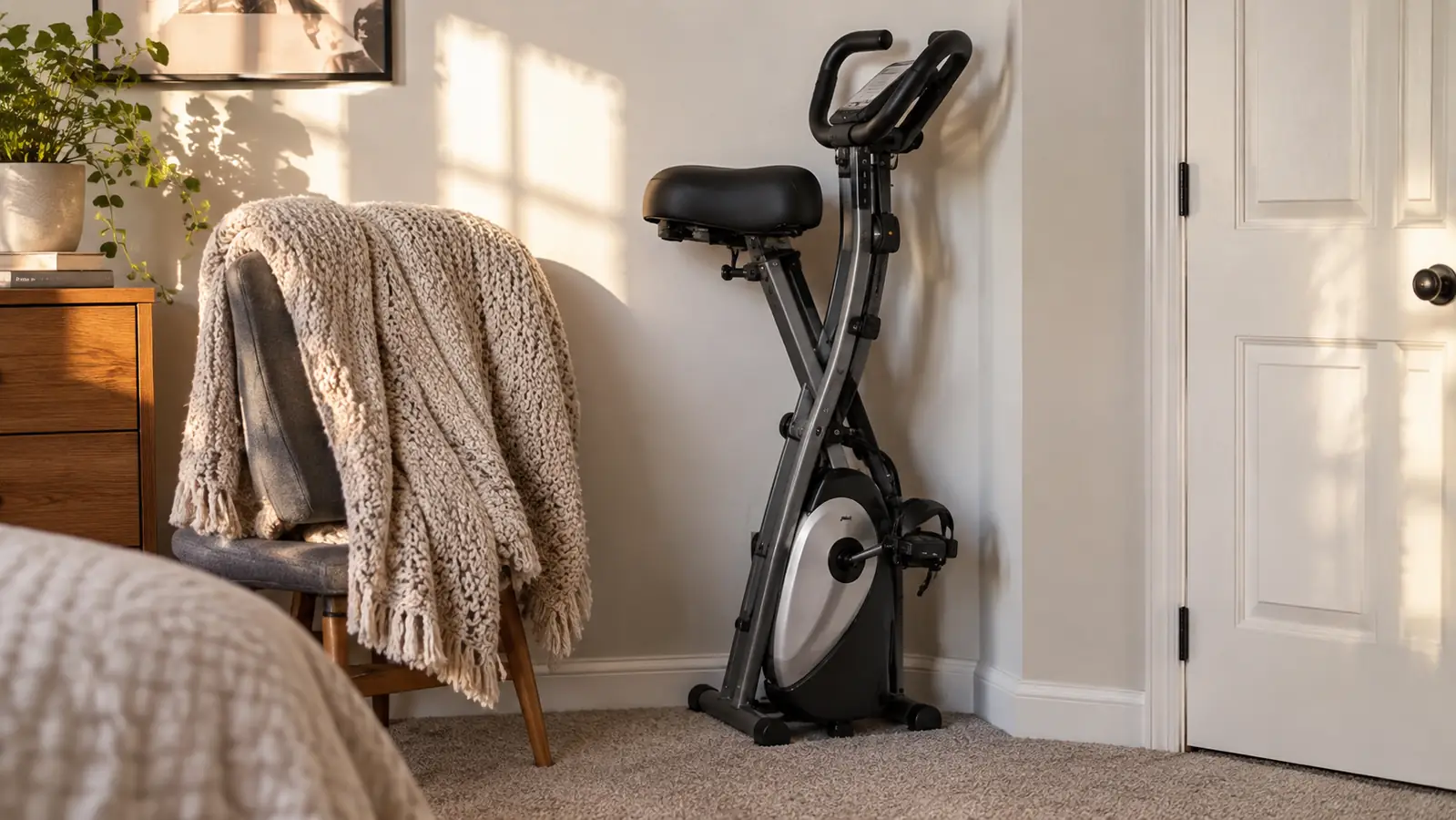
Numbers do not tell you what a 40 pound object does to a sixty-eight-year-old woman with a sore knee at seven in the morning. What the fold actually buys you is a doorway and a wall. My spare bedroom is small. The bike lives against the wall behind the door. When I want it, I pull it out. When the grandchildren come on a Saturday and need floor space for a puzzle, it goes back.
What the fold does not buy you is one-handed ease. It is a two-hand job and you will want something to lean it against while you do it. Gene does ours in about twenty seconds. I do it in about a minute, and I have stopped pretending otherwise. If your grip is not what it was, or if you have a shoulder that complains, plan on leaving it unfolded and pick your corner accordingly. That is not a failure. It is just the honest trade you are making.
How I Have Actually Used It
Coffee first. Then twenty to thirty minutes on the bike, most mornings, in the spare bedroom with the door open so I can hear the radio in the kitchen. I started at resistance two and stayed there for two solid weeks, which felt almost embarrassing and turned out to be exactly right. The goal was not to work up a sweat. The goal was to show up again the next morning. If you take one thing out of this review, take that one.
Here is what the first week actually looked like. I would get it out, unfold it, and then stand there with my hand on the wall for a second before I got on, because my balance is not what it was after that driveway. That second of hesitation is gone now. The reason it is gone is repetition, not courage. Do it ten times and your body stops asking whether the floor is going to move.
I ride upright. The backrest is behind me, the footstraps are snug, and I am not balancing anything. That matters more than I expected after a fall, because the fear is not the effort, it is the tipping. There is nothing to tip here. I sit down, I pedal, I get off. Some mornings I move the bike into the living room in front of the television for a longer session and watch half a news program. The listing calls this a five in one and mentions three riding postures. I have used two of them, the upright and the one with a bit more forward lean, and the upright is where I live.
The first two weeks taught me something about the knee. It did not hurt during, and it did not hurt after, but it did feel different, looser and warmer, by the time I got up. That is the whole reason I kept going. By week four I was riding five mornings out of seven without thinking about it, and by week six the bike had stopped being a decision and become part of the furniture of the day.
One morning in late February we had freezing rain and the neighbor did not walk, and I remember feeling grateful for a machine with no weather in it. Twenty-two minutes that day. I wrote it on the calendar and drew a small circle around it, which is a thing I do when a morning feels like a win.
The console display sits on the handlebars. I do not look at it. I use the timer on my phone and a paper calendar on the wall, and I mark each morning with a pencil. There is something about the pencil mark that a display cannot do for me. But if you are a person who likes numbers in front of you, the console is there and it works fine.
The 16 Resistance Levels Are Real, and They Are Not Evenly Spaced
Sixteen levels of magnetic resistance on a belt drive rather than a chain. The quiet part is not marketing. This is the quietest piece of exercise equipment I have ever had in this house. I ride at six in the morning, twenty feet from a sleeping husband, and he has never once mentioned it. That is the entire testimonial. You do not need a decibel figure, you need a man who does not wake up.
Here is the honest part, and it is the reason this is a four star review and not a five. The steps are not even. Level one through level four is a gentle walk uphill. Somewhere around six the bike starts asking real questions. And the jump from six to seven is a bigger jump than the number suggests, which means you can find yourself stuck between two settings, one too soft and one that makes you grunt. For about three weeks I wanted a setting that sat halfway between them. Then my leg caught up and I stopped wanting it. Younger knees will not notice this at all. Older ones will.
Take a Tuesday in March. I got on planning twenty minutes at level five, felt good at the ten minute mark, moved the resistance up to seven, and spent the next four minutes wishing I had not. Nothing hurt. It was just more work than the number implied. I finished the twenty, got off, and my legs were honest with me for the rest of the morning. That is not a complaint about the bike. It is a warning about the resistance levels.
The flywheel is 6.6 pounds, which is light next to the heavy bikes at a gym. That is the trade for a machine that folds and weighs 40 pounds overall. You will feel the difference in one specific way. The pedal stroke is not as smooth and heavy, and it does not carry you the way a gym bike does. For twenty minutes of upright riding it is perfectly fine. For standing sprints it is the wrong machine. I am not doing standing sprints, and my doctor would like a word with anyone my age who is.
I ride at six in the morning, twenty feet from a sleeping husband, and the loudest thing in the room is the clock on the wall.
The Seat and the Backrest Do the Real Work
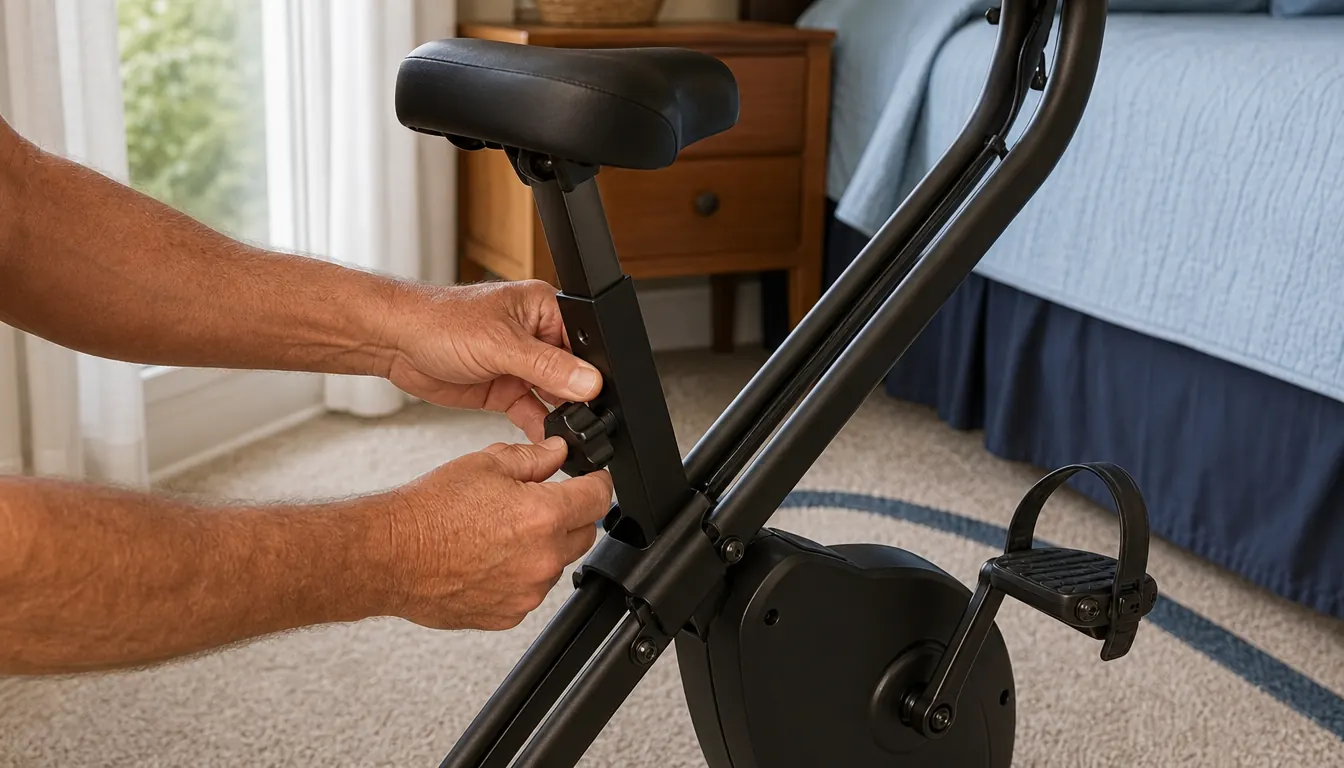
Eight seat height adjustments, two seat angle adjustments, a backrest, and adjustable footstraps. That is more adjustment than most folding bikes bother with, and for an older rider it is the difference between a machine you use and a machine you walk past. The height matters because a knee that cannot straighten on the downstroke is a knee that aches an hour later. I found my setting in the first week and I have not moved it since. A neighbor who is shorter than I am moved it in about ten seconds when she tried it.
The footstraps are worth a sentence. I did not use them for the first two weeks because they looked like fuss. Then my right foot slid forward on the pedal one morning, and I have used them every single time since. They keep the foot where the knee expects it to be, which sounds fussy and is not.
The seat itself is firm. Firm enough that I folded a bath towel over it for the first month, and then one Tuesday I did not need the towel and I have not gone back to it. If you are used to a padded armchair, give it two weeks before you decide you hate it. The angle adjustment is the one I did not expect to use. Two settings sounds like nothing. The difference between them turned out to be the difference between pressure on the front of the hip and no pressure at all.
The backrest is what makes this usable after a fall. I do not have to hold myself up with my arms. I put my hands on the handlebars and let the backrest take my weight, and my shoulders stay down where they belong instead of creeping up around my ears. If you have ever finished twenty minutes on a bike with your neck aching and your palms sore, you know exactly what I am describing.
What Genuinely Surprised Me
The stability. It is rated to 350 pounds and the frame is alloy steel, and the bike does not walk itself across the carpet while I ride. I expected a folding frame to feel like a folding chair, with a little shimmy in it. It does not. Set up properly, it feels like one solid piece of furniture with pedals on it.
The second surprise was how little room it takes when it is put away. Thirty-six inches deep when it is open, and against the wall folded it is narrower than the vacuum cleaner. In a one-story ranch house with three grandchildren who visit on weekends, that is not a small thing. The exercise room goes back to being a guest room when it needs to.
The third surprise was me. I have started and abandoned three exercise things in my life, including a treadmill that became a very expensive shelf in the basement. What is different here is that twenty minutes is genuinely available in a way that a thirty minute drive to a gym never was. The bike is eleven steps from the coffee maker. Friction is the whole war, and this thing has almost none.
What I Liked
- Genuinely quiet on a magnetic belt drive, quiet enough for a sleeping house
- The backrest and upright posture make it usable with a sore knee and a fear of falling
- Eight seat heights plus two seat angle settings fit a range of bodies
- Folds and tucks behind a door in a small spare bedroom
- Alloy steel frame rated to 350 pounds feels like one solid piece
Where It Falls Short
- The resistance steps are uneven, with a real gap between level six and level seven
- Folding takes two hands and about a minute, not one hand and a second
- The seat is firm and took me a month before I stopped using a towel
- The 6.6 pound flywheel means the pedal stroke is not as smooth as a gym bike
- The console display never earned a place in my routine
What I Would Change
The resistance spacing, first. Sixteen sounds like a great deal more choice than it is. Ten honest steps would serve an older rider better than sixteen with a cliff in the middle of them. Second, the console. It is there, it works, and I have never once looked at it twice. If a future version dropped it and put the money into a softer seat, I would not miss it for a day.
Third, and this is the one that cost half a star, the fold. I can do it. Gene does it faster. But if your hands are not what they were, budget for leaving the bike out and pick your corner with that in mind. I mention it because every photograph of a folding bike makes it look like a magic trick and it is not a magic trick. It is 40 pounds of steel, and 40 pounds is 40 pounds.
Who This Is For
This bike is for the person who wants twenty to thirty minutes of upright, low impact movement most mornings without leaving the house, and who wants to be able to put the thing away afterward. It suits a grumpy knee, an unsteady sense of balance, and a Michigan winter. It suits someone who has already tried a gym and knows in their bones that they will not go back to one.
If that is you, the BARWING does the job and it does it quietly. Start at the bottom resistance. Sit for the first week even when it feels silly to stop there. Mark the calendar with a pencil. And clear it with your doctor first if you have a heart condition, or a knee that has been imaged recently, or a medication that makes you lightheaded. That is not a disclaimer at the bottom of a page. It is a retired teacher telling you to do the sensible thing.
Who Should Skip It
Skip it if you want to stand and sprint, or if you are training for something that ends with a number on a leaderboard. Skip it if you cannot spare three feet of wall and will never fold it, because the footprint is the reason the fold exists. Skip it if you need the machine to track your progress for you, because this one mostly just sits there and lets you do the work. That last part is a feature in my house. It may not be in yours. And skip it if you are looking for a reason not to start, because it is eleven steps from the coffee maker and it will not give you one.
Twenty Minutes, Eleven Steps From the Coffee Maker
If you have been telling yourself you will get moving when the weather turns, the weather has turned. The BARWING is the version of that promise that fits behind a door and does not wake the house.
Amazon Check Today's Price on Amazon →