

If you are standing in your living room trying to decide between a pair of light hand weights and a set of ankle weights, here is the short answer I would give you over the phone. For most adults over sixty who want to keep their arms, shoulders and grip working, and who want something they can pick up and put down without a fuss, the CAP Neoprene Dumbbells are the better first purchase. The ankle weights are not a mistake. They are built for a narrower job than the name on the package suggests, and most of us buy them expecting something wider.
I am sixty-eight, retired after thirty-one years in a third-grade classroom, and I exercise in a converted spare bedroom with carpet on the floor and a space heater that clicks on at six in the morning. My doctor told me to keep moving and build the strength around my right knee, which has mild osteoarthritis, after I slipped on the icy driveway two winters ago. I have used both kinds of weight. One of them I reach for five mornings out of seven. The other lives in a milk crate by the closet door and comes out on Thursdays. That is the honest split, and this is how I got there.
| CAP Neoprene Dumbbells | Adjustable Ankle Weights | |
|---|---|---|
| Upper-body work | A medium-size iron handle with a non-slip neoprene coating holds load for curls, rows, presses and arm raises | Cannot load the arms at all, because the weight rides below the knee |
| Lower-body and hip work | Too light and far too awkward to strap on for leg extensions or hip work | Built to sit above the ankle for seated leg extensions and standing hip work |
| Changing the load | Fixed at three pounds each, six pounds for the pair. You progress by adding reps or buying the next pair | Adjustable versions add or remove small pouches so you can step the load up in small amounts |
| Setting it down mid-set | Flat-sided hex heads stay where you put them on carpet instead of rolling under the bookshelf | Straps have to be unfastened and refastened, which usually means bending over twice |
| An arthritic knee | The load stays in your hands, so your knee carries only your own body weight | The load hangs below the knee and swings with the leg on every step |
| Hand and skin comfort | Medium grip size with a non-slip neoprene surface that stays put once your hands warm up | Hook-and-loop closures can pull at bare skin, so you end up wearing socks with them |
| Storage in a small house | Two compact weights, about 7.87 inches long and 5.71 inches wide, that sit on a shelf | Rolls up small, but the straps tangle and the pair ends up in a drawer on its own |
| Long-term wear | Solid gray iron core under the neoprene, with nothing to fray or come unstitched | The hook-and-loop closure is usually the first part to give out |
Where CAP Wins
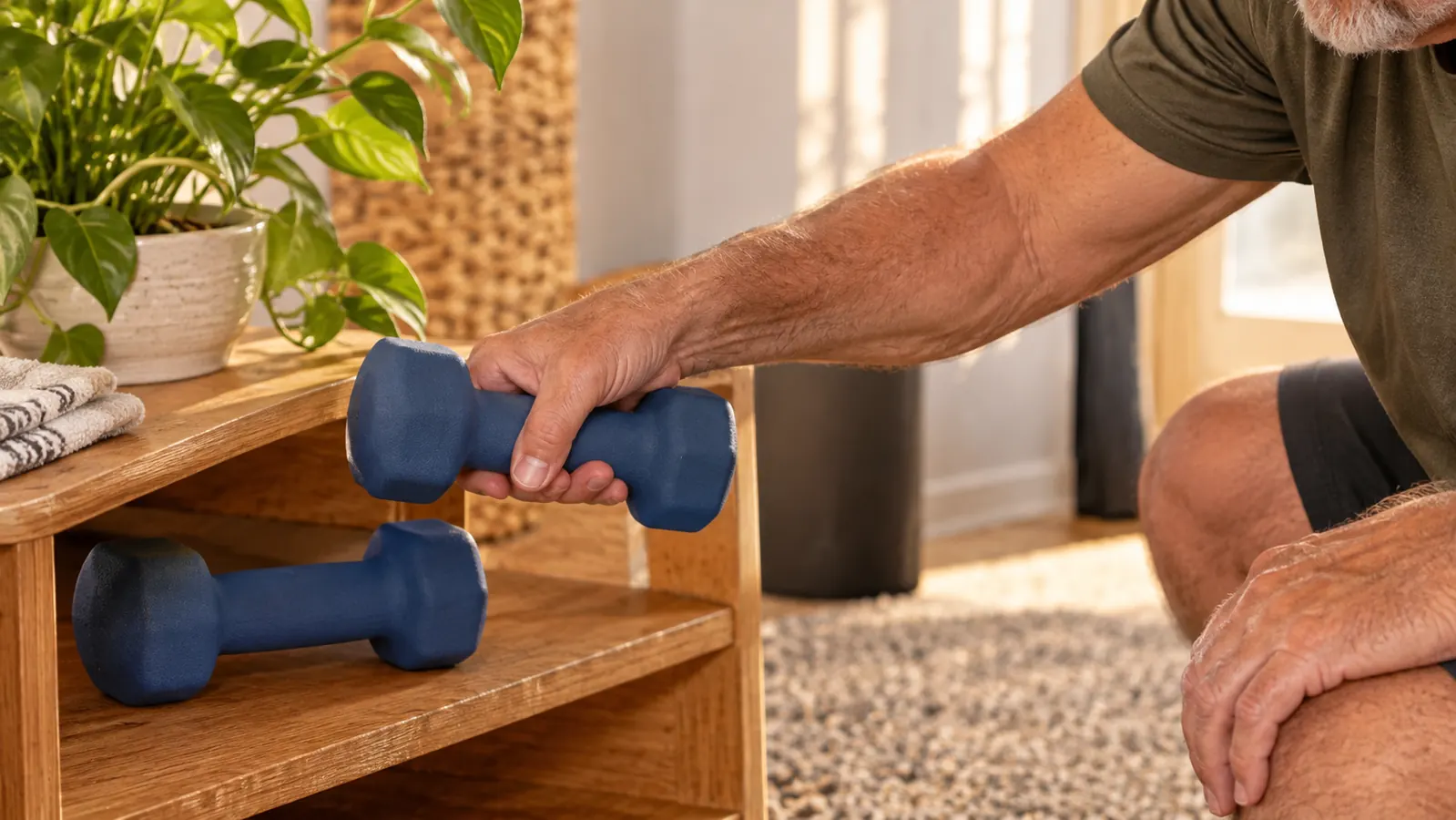
The handle is the part I notice most. It is iron with a medium grip size and a non-slip neoprene coating, and my hand closes around it the way it closes around a coffee mug. When you are sixty-eight and your grip is not what it was at forty, that matters more than any chart on the side of a box. I have held cheap vinyl weights that slid in my palm the moment my hands got warm, and I spent more time re-gripping than lifting. With these I do twelve slow curls, set them down, shake out my hands, and pick them back up. My fingers never have to fight the handle.
The second thing is the hex head. Flat sides mean the weight does not roll when you set it on carpet, and it does not roll when you set it on the arm of the sofa either, which I do more often than I should admit. That sounds like a small thing until you have chased a round dumbbell under a bookshelf with a vacuum cleaner attachment. The solid iron core under the neoprene is the third thing. These are not shells filled with sand. At three pounds each, six pounds for the pair, they feel denser than they look, and I expect the CAP pair to outlast me, which at my age is a strange compliment but a real one.
Where Ankle Weights Win
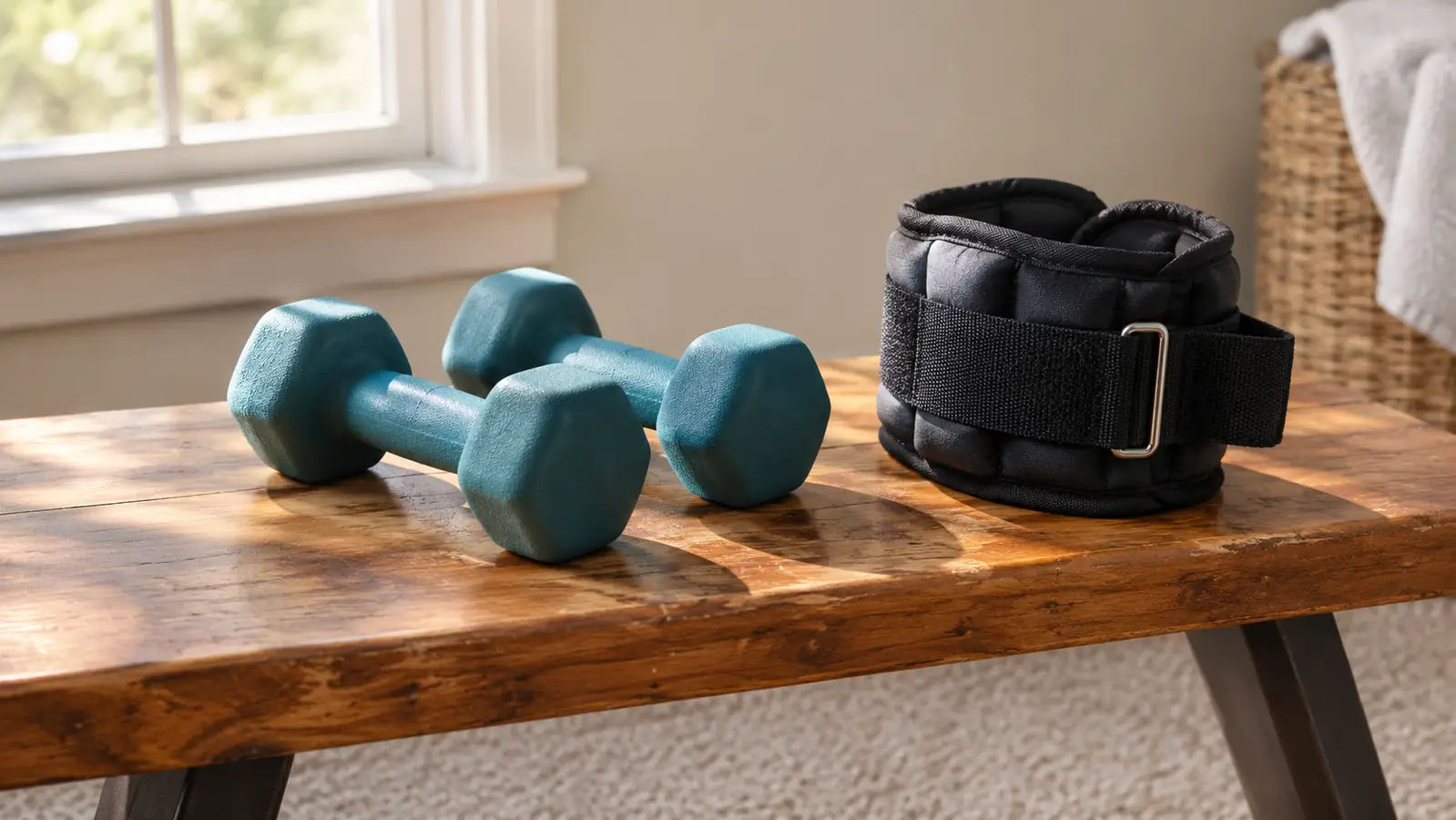
Ankle weights do one thing the dumbbells cannot do at all, and they do it well. They load the leg below the knee, which means you can work the muscles that straighten the knee and the ones that pull the leg out to the side without holding anything in your hands. If your doctor or a physical therapist has given you seated leg extensions or standing hip work, that is ankle weight territory. You cannot strap a three-pound dumbbell to your ankle. You can try, and you will look foolish, and it will fall off halfway through the first set.
They also free your hands. In the winter I like to hold the back of a kitchen chair for balance while I do leg lifts, and both hands need to be on that chair. That is a genuine advantage and I will not pretend otherwise. Adjustable ankle weights also let you change the load in small steps, usually by adding or removing small pouches, so you can go from two pounds to five without buying anything new. And they store in a drawer. When you live in a one-story ranch house with one spare bedroom doing double duty, drawer space counts for something.
The Pair I Actually Reach For on a Tuesday Morning
Three pounds in each hand, six pounds for the pair, non-slip neoprene over a solid iron core, and hex heads that stay where you set them on the carpet. If your goal is keeping your arms and your grip working through a Michigan winter, this is the simpler tool of the two. Check today's price and read what other people past sixty have said about them.
Amazon Check Today's Price on Amazon →How I Compared Them in a Spare Bedroom
I did not build a laboratory. I cleared a space between the treadmill that Gene uses as a coat rack and the bookshelf, put a kitchen chair in the middle of the carpet, and did the same eight movements with each kind of weight on alternating mornings for six weeks. Curls, presses, rows, arm raises, sit-to-stands, leg extensions, hip work, and a slow march in place. Twenty minutes, sometimes twenty-five if the coffee had not kicked in yet. I wrote down which weight I used, how many sets I finished, and whether anything hurt the next morning. That notebook is the only data set behind this article, and I am comfortable with that.
The first week was humbling in an unexpected direction. Three pounds felt like nothing on the first set and like plenty by the third. I had assumed light weights meant light work, and I was wrong about that in a way that made me laugh at myself. By the second week I could do three sets of twelve curls without my form falling apart, and by the fourth week I added a fourth set rather than a heavier weight, because heavier is not the point at my age. Form and consistency are the point. The CAP weights made consistency easy because there was no setup between me and the first rep.
The ankle weights took more fiddling. Strapping them on over sweatpants is fine. Strapping them on over bare ankles is not, because the closure pulls at skin. I learned to wear socks. I also learned to check the strap before every set, because a loose ankle weight swinging on your leg is a good way to lose your balance, and balance is the very thing I am trying to protect in the first place. That is not a flaw in ankle weights. It is a flaw in how I was using them, and it took me a week to notice.
Six weeks in, the dumbbells come out five mornings out of seven. The ankle weights come out on Thursdays. That is the honest score, and I am not sorry about it.
The Grip Question Nobody Talks About
There is a reason the dumbbells win the mornings, and it is not really the weights themselves. It is the getting ready. Picking up a dumbbell takes one second. Strapping on an ankle weight takes thirty, plus a check, plus the sock decision, plus the moment where you are bent over at the waist fumbling with a closure and wondering why your back is complaining before you have lifted anything. At six in the morning in February, anything that costs thirty seconds of setup is a thing you will skip. Not because you are lazy. Because you are cold and the coffee is ready and the day is already asking things of you.
When I skip, I skip the whole session rather than just the leg work. That is the trap. So the tool that gets used is the tool with the least friction between the coffee and the first rep, and for me that has been the dumbbells by a wide margin. Your mileage will vary if your main goal is leg strength and your therapist has told you so. In that case the friction is worth it. Make the ankle weights the priority, keep the hand weights for your arms, and do not let my Thursday habit talk you out of a program that was prescribed for you.
What Twenty Minutes Actually Looks Like
A typical morning with the dumbbells runs like this. Eight slow curls. Eight presses overhead, seated, back against the chair. Eight rows, hinged forward a little at the hips. Eight arm raises out to the sides, going lighter in range than I think I can manage. Then the weights go down on the carpet, hex side flat, and I do ten sit-to-stands from the chair with no weight at all. That is the whole upper body session. It takes fourteen minutes with rest between sets, and I am finished before the second cup goes cold.
A morning with the ankle weights has a different shape. Sit in the chair. Strap on, check the strap, do twelve leg extensions on the right, twelve on the left. Stand, hold the chair back with both hands, twelve leg lifts out to the side on each leg. Then unstrap and put them away. That is six minutes of actual work and eight minutes of strapping and unstrapping. It is not worse work. It is just less work per minute, and in a Michigan winter the minutes before the space heater has warmed the room are precious ones.
Safety Notes I Wish Someone Had Given Me
Two things I would tell anyone starting. First, store the weights where you will not trip over them. Mine live on a low shelf, not on the floor, because I have already fallen once and I am not interested in a repeat. Second, do not add load to a joint that is already angry. My right knee does not want extra weight hanging below it while I walk, so the ankle weights come off before I do anything that involves stepping. My doctor was plain with me that movement is the goal and pain is a stop sign, and I have tried to listen to that even when I did not want to.
Third, if you have a heart condition, uncontrolled blood pressure, or a replaced joint, have the conversation with your doctor before you buy anything at all. That is not a line I am reading off a card. It is what I did, and it changed what I bought. Start with the lightest thing that lets you do the movement correctly, and add work slowly. Three pounds is not an insult to anybody. It is a starting point, and if it stops being enough you can add a second pair later or add reps, which costs nothing at all.
Who Should Buy Which
Buy the CAP Neoprene Dumbbells if your goal is general strength for daily life, if your arms and grip are what you want to keep working, and if you know yourself well enough to admit that a thirty-second setup will turn into a skipped morning. Buy them if you want to sneak in a set of curls while the kettle boils. Buy them if you have a knee that complains and you would rather not hang weight below it. At three pounds each they are light enough to be safe on a bad day and heavy enough to matter on a good one.
Buy adjustable ankle weights if you have a specific lower-leg or hip program from a therapist, if you need both hands free for balance on a chair back, or if shoulder problems make holding weight uncomfortable. Some people do have those shoulders, and there is no shame in it. Buy them if leg strength is the priority and you are willing to do the strapping properly every single time. And if you can manage it, own both. They are not rivals in my house. They are a Tuesday and a Thursday, and both of them beat sitting down.
Start With the Pair You Will Actually Pick Up
Three pounds in each hand, six pounds for the pair, hex heads that stay where you set them, and no straps to fasten at six in the morning. Beginning is the hard part. A tool with no setup is a tool you will still be using in February.
Amazon See Today's Price on Amazon →